
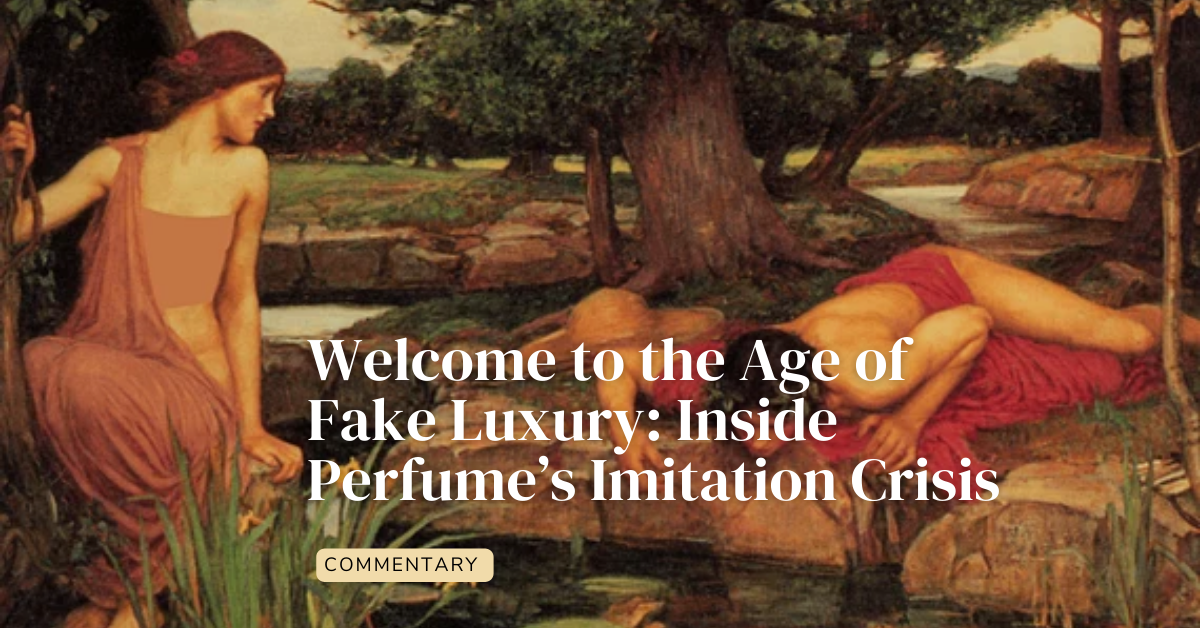
A forward-looking commentary on where the fragrance industry may be heading
For the past several years, the fragrance industry has been celebrating what many call a golden age. Sales are strong, younger consumers are discovering scent in large numbers, and perfume has become one of the most visible and culturally active parts of the beauty business. TikTok turned fragrance into entertainment. Niche brands became collectibles. Shelves that once held a few classics now bow under the weight of dozens of bottles owned by the same person.
From the outside, it looks like a renaissance. From the inside, it looks like the moment a successful industry tips from invention into repetition.
Every creative market passes through similar phases. First come the innovators who build the category. Then come the imitators who recognize an opportunity and rush to participate. The fragrance world today is clearly shifting from the first phase to the second.
The warning sign is simple: the industry is producing far more perfume than the culture around it can meaningfully absorb. In the mid‑1990s, only a few hundred perfumes launched annually; by the mid‑2020s, that figure had climbed into the many thousands each year, with industry data showing launch volumes accelerating sharply in the last half‑decade. No art form produces thousands of masterpieces annually. What you get instead is dilution. The signal is buried under an avalanche of releases that exist less because someone had an idea, and more because the market rewards having something new.
Once that happens, the ecosystem surrounding the product begins to grow as quickly as the product itself.
The Festival Economy
One of the clearest signals of oversaturation is the sudden proliferation of fragrance events aimed directly at consumers.

Perfume fairs were historically trade gatherings where buyers, distributors, and brand owners met quietly to conduct business. Today they increasingly resemble pop culture conventions, complete with panels, meet‑and‑greets, and shopping halls for fans. ScentXplore in New York has already established itself as a large enthusiast gathering, while independent expos and regional scent fairs are appearing in cities that previously had no fragrance infrastructure at all. New events like ScentFest in San Francisco, created by content figures such as Sebastian Jara (The Perfume Guy), are explicitly designed as festivals for collectors and fans rather than industry insiders.
None of this is inherently negative. Events create visibility, content, and community. But the pattern is familiar. Sneakers went through this phase. Wine did too. Craft beer arguably perfected it. When the number of festivals surrounding a product multiplies rapidly, it usually means the culture around the product is expanding faster than the product itself.
Perfume is now entering that same territory. If the number of gatherings keeps multiplying at the current rate, the industry will soon have more perfume festivals than reasons to attend them. At that point, the events themselves become part of the oversaturation.
The Content Explosion
If events are multiplying in physical space, fragrance content is multiplying even faster online.
The barrier to entry has essentially disappeared. Anyone with a shelf of bottles and a smartphone can become a fragrance commentator. In theory this democratizes the conversation around perfume. In practice it often produces a tidal wave of repetitive commentary, where the same handful of popular fragrances circulate endlessly through social media algorithms.

The psychology behind this is rarely discussed openly. Many collectors accumulate dozens, sometimes hundreds, of bottles. Creating online content becomes a way to justify that accumulation. The collection becomes the narrative. Posting transforms personal consumption into public expertise.
The more bottles someone owns, the more incentive they have to produce content about them. The content justifies further buying. Buying fuels more content. Collecting and broadcasting fuse into a single behavior. Algorithms do not reward nuance; they reward frequency and enthusiasm. The result is an attention economy where volume beats analysis.
This does not produce better criticism. It produces more noise. The fragrance industry has quietly built an entire attention engine around this cycle.
The Decant Economy
Another predictable consequence of the fragrance boom is the rise of the decant market.
Decant businesses purchase full bottles and sell them in smaller portions, allowing consumers to sample expensive fragrances without committing to a full purchase. From the consumer perspective this is logical. Few people want to blind buy a three‑hundred‑dollar bottle in a market where thousands of perfumes launch every year and discovery budgets are finite.
From the brand perspective the situation is more complicated. Many niche houses dislike decanting because it disrupts the traditional retail model and weakens the aura of exclusivity surrounding luxury bottles. It also creates legal and reputational risks. Once a fragrance is removed from its original packaging the brand loses control over storage conditions, labeling, and product integrity, yet its name continues to be used in the resale. Decanting exists in a legal gray zone shaped by resale rights, trademark law, and consumer safety regulations. For now most brands tolerate it quietly, but only because eliminating it would be far more difficult than adapting to the consumer demand that created it.

But the uncomfortable truth is that the decant market exists because brands failed to respond to consumer behavior quickly enough. Demand for smaller formats is clear: recent market research indicates that travel‑size fragrances and minis are among the fastest growing segments globally, projected to rise from roughly 1.5 billion USD in 2023 to around 2.3 billion USD by 2031 as consumers look for variety, portability, and lower financial risk.
If brands refuse to offer smaller sizes, someone else inevitably will. Decanters did not create the demand. They simply stepped into a vacuum the industry left open. Far from being parasites on luxury, they’re a symptom of how slowly many brands adjust to what wearers actually want.
Artificial Intelligence and the Coming Flood of “Perfumers”
Technology is about to accelerate a shift that the industry has barely begun to confront.

Artificial intelligence is entering fragrance creation at remarkable speed. New scent-generation systems can analyze ingredient libraries, simulate accords, and model formulas digitally before anything is ever blended in a lab. Some platforms already help brands scan consumer preference data, test combinations virtually, and predict which scent profiles are most likely to sell. What once required months of development inside a professional fragrance house can now begin with a dataset and a piece of software.
This will not replace trained perfumers overnight. But it will change who can participate in the business of making perfume.
For most of modern perfumery, becoming a perfumer meant entering a long technical apprenticeship. Many professionals studied chemistry before training for years inside fragrance houses such as Givaudan, International Flavors & Fragrances, or Firmenich. Apprentices memorized hundreds of raw materials, studied evaporation curves and formula stability, learned regulatory frameworks, and gradually developed the ability to construct a fragrance molecule by molecule. The craft required patience, technical knowledge, and years of disciplined training.
That barrier is now beginning to erode.
Artificial intelligence tools, contract manufacturers, and expanding access to raw materials mean that entrepreneurs who once lacked the resources to experiment with fragrance can suddenly assemble a product much more easily. Development timelines shrink. Prototyping becomes cheaper. Concept-driven brands can appear almost overnight.
The result will not simply be more perfumes. It will be more people calling themselves perfumers.
Some of these newcomers will bring fresh ideas and genuine creativity. Many will produce fragrances designed primarily around trend data, algorithmic predictions, and the safest interpretations of what has sold before. If AI systems are trained on past bestsellers and popular accords, the results are likely to resemble polished echoes of existing perfumes rather than true departures from them.
The fragrance industry should prepare for an explosion of small brands in the coming years. A handful will be exceptional. Most will be forgettable. And consumers will increasingly struggle to tell the difference between a perfume composed by a trained perfumer and one assembled by a brand founder with a dataset, a supplier, and a compelling story.
Raw Material Democratization
Another structural change is happening quietly behind the scenes.
Access to fragrance ingredients is expanding. Major suppliers of naturals, such as Robertet, have begun offering online platforms where buyers can browse and purchase materials in smaller quantities suitable for small‑batch production, rather than only in industrial volumes. For the first time, independent creators can access ingredients that previously circulated mainly within professional perfumery networks.

This is a remarkable shift. It democratizes access to high‑quality materials and opens the door for independent experimentation. It also means that the number of perfume brands will likely grow even faster.
When raw materials become easier to purchase, formulation tools become easier to use, and digital platforms make it simple to reach consumers directly, the market inevitably fills with new products. Democratizing access to ingredients does not automatically democratize good taste. As supply increases, differentiation becomes harder, and the risk of aesthetic homogenization grows.
The Luxury Escape
In oversaturated markets, some brands attempt to escape the chaos by moving upward.
Expect to see more perfumes priced aggressively at four hundred dollars and beyond. These fragrances arrive wrapped in narratives about rare materials, artistic independence, and extreme exclusivity. Some will genuinely deserve their price. Many will not.

The uncomfortable truth is that a surprising number of luxury perfumes are produced using the same supply chains, laboratories, and ingredient palettes as far less expensive fragrances. The difference lies primarily in positioning. In a crowded market, price becomes theater.
In a landscape where everything shouts, a four‑hundred‑dollar price tag functions like a flare gun: it doesn’t prove the juice is better, only that you are meant to look. Luxury has always relied on storytelling. But when too many brands rely on the same story, exclusivity begins to look suspiciously like strategy rather than craftsmanship.
The Socialization of Perfume
Perhaps the most fascinating shift is cultural rather than commercial.
Perfume is becoming social.

Collectors organize swap events where bottles and samples circulate through communities. Retailers host fragrance clubs and smelling sessions. Online groups coordinate local meetups where enthusiasts gather to smell and exchange scents, sometimes adopting the rituals of a book club, except the texts are atomizers.
This transformation tells us something important about the future of fragrance. Perfume is evolving from a solitary luxury purchase into a participatory hobby. Hobbies build communities. Communities create markets. Markets invite entrepreneurs.
The same culture that fuels overspending and oversharing may also be the one that quietly decides which perfumes survive. In living rooms, Discord servers, and Telegram chats, people are already curating faster than retailers.
The Coming Reckoning
None of these trends mean that the fragrance boom is ending. But they do suggest that the industry is entering a new phase.
The imitation phase.
In this phase, the number of participants grows faster than the number of meaningful ideas. Launches multiply. Events multiply. Commentary multiplies. The industry becomes louder and busier, but not necessarily more innovative.
Eventually, the market begins to sort itself out.
The houses that survive will not be the ones releasing the most perfumes. They will be the ones confident enough to release fewer, and disciplined enough to stand for something that cannot be reduced to a hashtag. They will be the brands that prioritize identity over algorithmic visibility and craftsmanship over marketing theater.
Everyone else will simply contribute to the noise.
And there is going to be a lot of noise.







Leave a Reply