
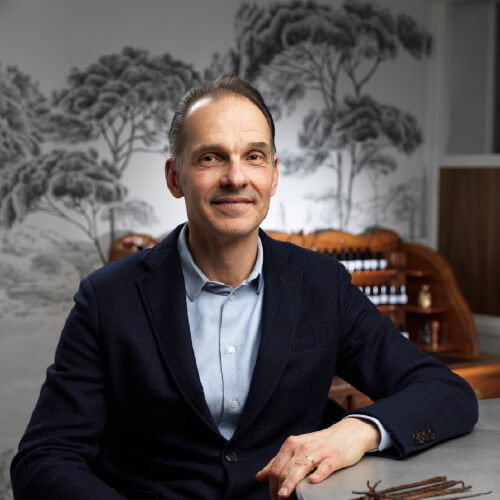
A conversation with Rémi Pulverail on time, risk, and the erosion of creative space in modern perfumery
In 2025, the perfume industry crossed an uncomfortable threshold. By multiple industry accounts and reporting, roughly 6,000 new fragrances were launched in a single year. The number matters less as trivia than as atmosphere. A market that no longer expects you to live with a scent, only to move through it. More launches, shorter lifecycles, louder claims, faster forgetting.
At Elevated Classics, I have been tracking the independent side of perfumery since the beginning. The question was never romance. The question was structure. Who controls the process, who pays for experimentation, and what gets sacrificed when fragrance is treated like content.
I have spoken with Rémi Pulverail before, including an earlier interview about Les Indémodables, and what struck me then still holds now. He does not speak about perfume as a lifestyle object. He speaks about it as a system.
Pulverail is the founder of L’Atelier Français des Matières, and also a voice shaped by years inside the machinery itself. Before building his own model, he worked at the global scale of Givaudan, including senior responsibilities in naturals sourcing and strategy. That perspective, from inside procurement and inside industrial decision-making, informs the clarity of what follows.
Here is our conversation.
How Perfumes Are Actually Made Today
Most perfumes today, including many positioned as niche, are developed inside large fragrance houses through competitive briefs, tight budgets, and extremely short timelines. Perfumers are salaried, evaluated on performance, and rewarded when their formulas succeed commercially.
From your perspective, what does this system fundamentally prioritize, and what does it quietly exclude?
This model is a mass-market model based on volume and cost, constantly seeking to produce perfumes that sell. This is a purely financial approach to business which, by definition, excludes any risk-taking and, consequently, any creative exploration.

All of this is a far cry from fine craftsmanship, the pursuit of beauty, and the creative quest, for the simple reason that these companies, run by financiers, are extremely profitable and have no desire whatsoever to evolve their business model. These houses, which previously looked down on niche brands, are now forced to accept them (despite their ridiculously low sales volumes) for the simple reason that this is the only market segment experiencing strong growth with high margins, while mainstream brand projects are becoming more and more numerous, yet with increasingly lower expected revenues.
Which companies are creating and manufacturing fragrances for niche perfume brands?
Major fragrance houses who do not charge the creation, and do not expect sufficient turnover from the sales to these small or emerging brands. As a result, they mostly resell juices already on the shelves.
Independent perfumers, a rapidly growing category, but things are complicated here. First, due to the lack of training among most of them, who do not have sufficient technical foundations. There is no academic school specialized in the training of future perfumers as Roure was in the past, and let’s keep in mind that this process takes several years, just to become a junior perfumer.
As regards the quality of the ingredients used, major houses play on volume and have a cost optimization approach for their palette, while medium or small-scale fragrance houses have no clue about sourcing and buy the ingredients exclusively from local traders.
Competition Inside Fragrance Houses
How does this competitive structure affect both the work and the people making it?
In this model, multiple perfumers are often working simultaneously on the same brief, under pressure to deliver something that will win internal and external selection.
In major houses who employ armies of perfumers (Givaudan, IFF, Firmenich, Symrise), perfumers are either constrained by time and never get the chance to explore new olfactory patterns, or constrained by consumer testing, which inevitably steers them toward me-too creations.
Perfumers compete internally before they compete externally, which is terrible for atmosphere and creativity.
Brands, even if they were tempted to launch truly innovative fragrances, no longer give a perfume the time to establish itself on the market. Let’s remember that Angel from Mugler (last perfume that made a strong statement and gave rise to a new olfactory family) had very poor sales until year four after it launched.
Budgets and Ingredient Quality
You’ve explained that once margins are accounted for, perfumers are often left with very limited budgets to compose a formula. What does this mean concretely for ingredient choice and overall juice quality?
This is quite simple. Today, whether it be in fine fragrance creation for major brands or niche, the budget price perfumers have to formulate does not allow them to use, in a significant amount, the most precious natural ingredients. You need to know that almost all formulas on the market are made of four or five cheap ingredients that represent more than fifty percent of the formula.
Why? Because this is the way the industry has worked for decades. Marketers prefer to invest in packaging (or advertisement for larger brands) rather than in the juices. And probably, entrepreneurs or brand directors of niche brands still think the consumer has no education, and will not make the difference whatever the quality.
All of this becomes truly scandalous when you see the price of perfumes, which keeps rising.
Speed Versus Exploration
Development timelines today are measured in weeks.
What is lost creatively when perfumers simply do not have time to explore structures that fall outside proven formulas?
In major houses, a perfumer is managing several projects at the same time with very short deadlines. No time to test bold and innovative accords, or new ingredients never used before. Creativity is reduced to nothing when so-called creators retreat into controlled, familiar formulas and, of course, impoverish perfumery. Something everyone can observe today.
On Consumer Testing
Consumer testing plays a decisive role in selecting which formulas move forward.
Who actually makes these decisions, and what is their relationship to perfume?
Yes, today perfumery is a massive industry and most of its leaders have been trained at P&G, Unilever or Coty, and manage the perfume business the same way, massively using consumer testing and benchmarking. Most of the leaders of these giant companies are pure financial people and have not a single clue of what a perfume really is. This lack of cultural depth among executives turns the perfume industry into just another industry, with profit expectations, share prices, and the like.

In your view, does consumer testing merely guide creativity, or does it actively filter out anything unfamiliar or challenging?
Consumer tests inevitably lead to converging toward the benchmark. Everything is said.
Perfumes are launched worldwide and the objective is to please everyone and finally turn it into a blockbuster for the companies involved (brand and fragrance house).
As regards niche, new brand owners are mostly entrepreneurs who do not know anything about perfumery and will therefore, most of the time, follow trends as regards the fragrance creation.
On Why Perfumes Smell Increasingly Similar
When benchmarking, trend alignment, and test performance become dominant decision tools, sameness becomes almost inevitable.
Do you think the current olfactive landscape reflects a lack of talent, or a lack of freedom?
This is, in my opinion, both a lack of risk-taking and a lack of knowledge (perfume creation process, ingredients, perfume history, distribution, consumer expectations), because before breaking the rules, you need to master them.
On So-Called Niche Brands
Many small niche brands now work within the same fragrance house system as major brands, often unknowingly from the consumer’s perspective.
In practical terms, how different is the creative process for these brands compared to mainstream launches?
Unfortunately, in small fragrance brands, fragrance formulas are most of the time reverse-engineered using a very effective tool: gas chromatography, which makes it very easy to copy or reproduce a leading fragrance from the market. The perfumer will then tweak the formula at the margins to make it slightly different. This is what is known in perfumery as a twist.
Entrepreneurs investing in the perfume space do not have a single clue of what perfumery is and therefore prefer to limit the risk as regards the fragrance creation. Most of them think a good marketing concept is the key element to build a successful brand.
On Recycled Formulas
You’ve spoken openly about the use of existing collection juices that are slightly modified to fit a brief. How common is this practice today, and why is it so difficult for consumers to detect?
This is unfortunately 95% of the launches, but consumers are more and more educated (especially in the niche space) and probably more expert than brand owners themselves. These expert consumers are fully aware of that situation. We see their comments every day at our own boutique, and on our social networks.
On Independent Perfumers
Independent perfumers work very differently. They are paid for their creative work instead of winning competitions, and they are no longer in competition once selected for a project.
How does this shift change the way they approach a blank page?
The challenge for independent perfumers is that most lack formal academic training and have learned the craft on the fly. Becoming a true perfumer is an extremely long and demanding process, and today there is no longer a reputable school to train the perfumers of tomorrow.

Therefore too many of them reproduce existing patterns or create formulas that are often unbalanced and lacking in harmony.
The few who have had academic training have freed themselves from the constraints and rigid frameworks imposed on perfumers employed by large companies. As a result, they can take much more time to develop a fragrance and explore olfactory structures that venture off the beaten path.
On Risk and Uncertainty
Independent perfumery comes with financial uncertainty and far fewer guarantees.
Why do you believe this uncertainty creates conditions for meaningful creative work?
Starting a new perfume brand is a major investment and, as you know, today the market is more than crowded. It is impossible to be authentically niche if you do not have the adequate knowledge about the mainstream market. As previously said, before breaking the rules, you need to master them.
Having said that, I fully agree with your statement as regards uncertainty. True artists create because they are in a constant state of tension. They are completely free, not bound by the rules of any market, and the element of uncertainty (success or failure, limited financial resources) is probably a determining factor in the creative process.
On the Absence of Marketing Filters
When there is no marketing team, no consumer testing, and no trend mandate between the brand owner and the perfumer, what kinds of decisions become possible that simply are not in an industrial framework?
Independent small and emerging perfume brands are started and managed by purely marketing people.
For a small emerging brand, the challenge is that the perfumer commissioned for the project often pushes it toward a safe, crowd-pleasing fragrance to minimize risk, which is unwise, given that the market is already saturated with such consensual scents.
If you look at some niche brands that have been successful and even pioneers (Frédéric Malle before the EL acquisition, Etat Libre d’Orange or Serge Lutens), all of them have been created by people who have had a background in perfumery.
On Your Role as a Laboratory
Rather than employing salaried perfumers, your lab positions itself as a support structure for independent creators.
What does support mean in practice, and how do you avoid recreating the same hierarchies you critique?
Our way of working is very clear, and quite uncompromising, I must admit. We impose, in particular, qualitative constraints to the independent perfumers we collaborate with.

We only collaborate with independent perfumers with a sufficient background and technical know-how (Antoine Lie, you know him; Delphine Dentraygues has been trained many years by Maurice Roucel, and Andrea de Lassus has been trained by Nicolai).
We impose a significant use of precious naturals, and our exclusive labelled Grands Crus, in the formulas created at our lab, which means a much higher budget. In return, we are transparent as regards the percentage of the most expensive naturals used in each formula. Clients who are not willing to follow this approach are redirected elsewhere.
We also impose to perfumers to start from a blank page in terms of fragrance creation and never work using a fragrance library, with ready-made juices.
On Materials as a Starting Point
You place unusual emphasis on ingredients themselves as a creative foundation rather than interchangeable inputs.
How does working with exceptional raw materials change the way a perfume is imagined from the very beginning?
Working with a high concentration of precious natural ingredients requires a specific technique that typical perfumers, accustomed to strict cost constraints, usually do not have. In the end, we find that such fragrances have many more facets, are less linear, and become more captivating, revealing something new each time they are worn.

Ultimately, we don’t use expensive natural extracts just to say we’re using precious ingredients. We do it because they genuinely produce a different result and evoke a unique emotion when worn.
In fact, the classic formulas that were successful for decades, for example, the classic Guerlains, were of this kind and have stood the test of time for a reason. This is the kind of perfumery that interests us, and we try to work with the same level of rigor as in the past, but without a backward-looking vision, staying aligned with our time, particularly by taking advantage of the extraordinary tools available today.
On the Grand Crus Ingredients
You’ve gone as far as making these ingredients available to perfume lovers through the Grand Crus Ingredients Box, allowing them to smell materials outside of finished formulas. Why was it important to expose the raw materials themselves, rather than letting them remain abstract concepts?
Because our aim is also to show passionate clients what, for us, constitutes the luxury of a perfume: first and foremost, its precious ingredients. The second element of this authentic luxury is the creativity of the perfumer who will use these ingredients, and this is, of course, where Antoine Lie’s role is crucial.

We also believe we have a mission to educate these lovers of fine perfumery, and we intend to do so increasingly, using ever more sophisticated tools. Our goal is to equip perfume lovers with the technical knowledge to judge for themselves, with discernment, and to help them refine their taste. This takes time, patience, and commitment, all of which we have in abundance, even with our modest resources.
On Smelling Versus Reading
Most consumers encounter ingredients through note lists and marketing language.
What do you think changes when someone actually smells a high-quality patchouli, rose, or vanilla on its own?
I think all of this is quite straightforward and shouldn’t be reserved for so-called experts. It’s just like dining at a restaurant. You can immediately tell the difference between thawed scallops and fresh ones. In perfumery, it’s the same. A far more powerful emotion arises instantly when you encounter a truly high-quality ingredient. To me, it is an intuitive response to beauty.
You can make the test easily by smelling vanillin together with a good vanilla absolute. There is a world of difference.
On Extraction as Authorship
You speak about extraction methods, vintage crops, and plant pre-treatment as decisive creative acts.
At what point does extraction stop being technical and become a form of authorship?
Extraction is just one step in the long journey that results in an ingredient earning our Grand Cru designation. Everything starts with the sourcing of the plant material. We work with our producers to identify specific plots, which we then compare with others to select the perfect plant, best suited for what we want to create.
Next comes the pre-treatment phase, which can include drying, roasting, aging, fermentation of the plant before the actual extraction begins. All these elements, these details to which we pay meticulous attention, completely change the outcome in the end as regards the olfactive profile.
On Control of the Production Chain
You also emphasize control over the entire production process, including bottling.
Where is this control most essential: in preserving quality, protecting creative intent, or enabling refusal?
The perfume-making process involves numerous steps, all of which we pay great attention to. Custom maturation and maceration phases are a prime example, but there are many other techniques we apply that are perfectly suited to small-scale productions like ours.
Of course, on a large scale, it would be absolutely impossible to implement all these small details and careful attentions, but this is true in all artisanal trades.
In perfumery, even niche perfumery, no house controls the entire manufacturing process like we do. It’s funny because no one seems to be surprised by this. It’s a bit like going to a three-Michelin-star restaurant and discovering at the end that there’s no kitchen and everything was delivered. Wouldn’t you be shocked? In perfumery, nobody is.
On Les Indémodables as an Alternative Model
Les Indémodables is often cited as proof that another way of making perfume is possible.
What compromises have you deliberately refused in order to preserve this model?
Our fragrance formulas are about ten times more expensive than what you can find elsewhere, and we are proud of that. Our ingredients and formulas increasingly include our exclusive natural ingredients, making them ever harder to copy, and we take pride in that as well.

We also deliberately limit the brand’s development, striving to maintain a controlled, human-sized distribution network, where we take the time to provide proper training. We remain with independent retailers and will never go into chains, because we place the utmost importance on maintaining human relationships, which means independent perfumeries.
Our productions are limited and will remain so, as many of our precious ingredients are rare and not available in large quantities. This limitation is our business model, and we fully embrace it.
We are the only house to have implemented a binding and transparent Charter of Excellence, and we are proud of that.
On the State of the Industry
You’ve suggested that the mass-perfumery model may be reaching the end of its cycle. What concrete signs do you see that suggest this system is no longer sustainable?
I don’t think mass-market perfumery is dead, far from it. What I do think is that perfumery as it exists today will have to drastically evolve,, because the current business model will increasingly fail.
Google is entering the mainstream market, and I wish the major fragrance houses good luck. Nowadays, everyone talks about AI, AI-assisted fragrance creation, all in pursuit of that holy grail: the universal perfume that will make a company a millionaire. But if data becomes the key success factor, it won’t be the current fragrance houses that come out on top. It will be the companies that control the data: Google, Amazon, Microsoft, Facebook.
The model of major fragrance houses is at breaking point because it relies on a free and competitive creation phase. Twenty years ago, fragrance houses could manage because when they won a brief, the volumes were substantial and the formula would sell for many years. Today, the market is far too fragmented, and the product’s lifespan far too short to amortize the development phase.
The only solution is to shorten the creation phase, either by more frequently using existing fragrances on the shelf, or by providing automated assistance to perfumers (generative AI) so they can produce more formulas faster.
As for independent perfumery and the current surge of activity, it’s both a challenge and a positive development. A challenge because many brands adopt a purely marketing-driven approach, replicating the same biases of mass-market perfumery that we strive to avoid. But a positive development because there’s also a fresh, invigorating energy sweeping through the sector.
On Guidance for Perfume Lovers
For people who love perfume but feel increasingly disconnected from what’s on the market, what should they be paying attention to if they want to support real creative work?
One must avoid purely marketing-driven approaches, ask questions about transparency, ingredients, find out who the perfumer is and where they come from, and pay attention to all the details that brands often try to hide or deliberately keep vague.
It’s also essential to develop a perfume culture in order to judge more effectively, to rediscover the scents of classic perfumes, and to understand where perfumery comes from, and where it has lost its way.
I think this can be compared to the difficulty many people have in appreciating modern art. There is an essential need for knowledge of art history and of the artist’s journey whose works one is contemplating, in order to understand abstraction, and then there is the subjective dimension of the emotion one may feel, or not, when faced with an abstract work.
On Distribution and Where Perfume is Actually Presented
Regarding the distribution network, which remains the key point of any project, since it is the ultimate place where a perfumer’s creations are presented.
What role does the point of sale play in how a perfume is actually understood?
Let us start with an example that is particularly striking to us: the brand Serge Lutens, one of the pioneers of auteur perfumery, whose collection includes some true works of art, yet which has adopted a distribution strategy that runs completely counter to expectations.

This brand adopted a mass-market distribution network, where sales teams are absolutely not trained to present a brand that remains niche and demanding. As a result, it ends up lost among dozens of brands displayed on shelves. Distribution is too often the poor relation in brand strategy, or else the strategy is simply to sell as much as possible, which runs completely counter to the spirit of auteur perfumery.
Auteur perfumery, in our view, should be represented in points of sale that practice seated, consultative selling, taking the time to explain an approach and to smell the fragrances with customers, guided by people who have been properly trained.
I still remember visiting Geneva last month and going into one of the major department stores on Rue du Rhône that has a so-called auteur perfumery section. For 45 minutes, I was able to smell many perfumes on display without the saleswoman, who was less than five meters away from me, ever once taking the initiative to approach me and offer advice.
The numbers will continue. More launches, tighter margins, faster cycles. But the conversation has moved. The question was never romance. The question was always structure. Who controls the process. Who pays for the time to explore. What gets protected when budgets tighten.
Pulverail’s model is deliberately unscalable. That is the point. It exists as proof that perfumery can function differently when the incentives change, when materials stop being interchangeable, when the people making decisions understand what they are actually making.
The industry will not reform itself. It will shift only when consumers stop buying the script.
For now, 6,000 launches a year. And a handful of people asking where the fragrance actually comes from.




Leave a Reply