
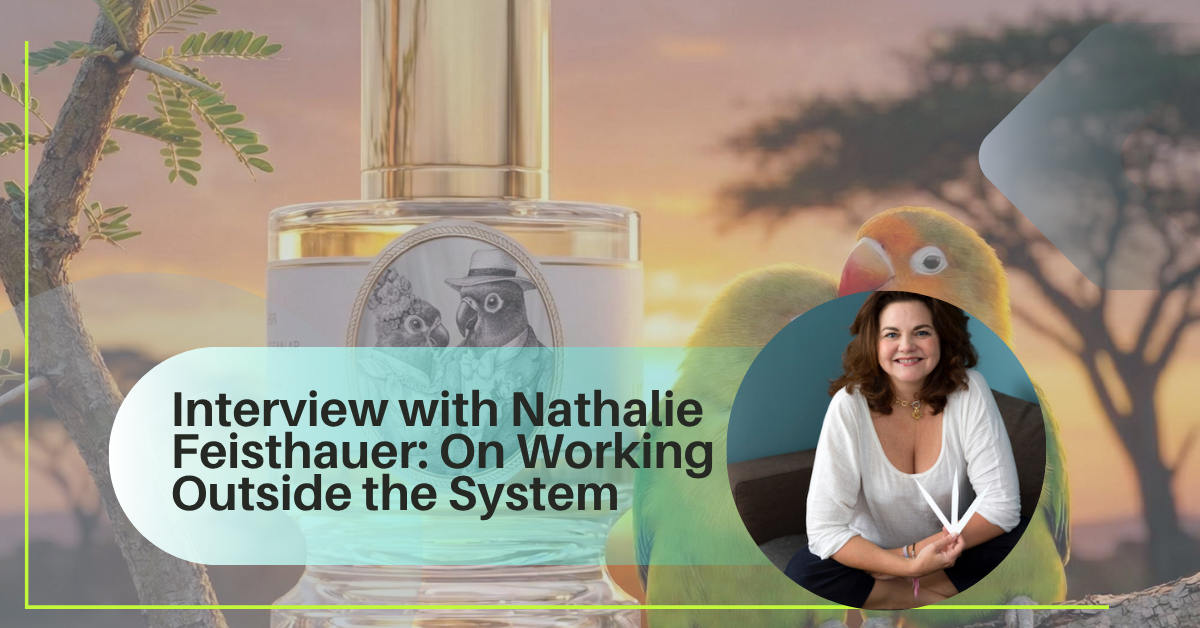
There is something disarming about speaking with Nathalie Feisthauer. She does not perform the role of a perfumer in the way the industry often expects. There is no mythology, no effort to elevate the story beyond what it is. She speaks directly, sometimes bluntly, with a clarity that feels grounded in experience.
Her path began at sixteen, she had no particular interest in perfume. She walked into a shop out of boredom. A few scents were sprayed, including Opium, and when she stepped back outside, something shifted in a way she could not explain at the time.
“It was a change of my life,” she says. “The beginning of a revelation.”

She returned again and again, saving money just to own a bottle. What she did not know then was that perfumery was even a profession. There was no clear path into it, no visibility into how fragrance was actually made. She assumed the brands themselves created what they sold, and when she discovered that was not the case, it only deepened her curiosity.
So she wrote letters.
Learning the Language of Scent
Most of those letters led nowhere. Eventually, one reached the right person. That conversation brought her to Grasse, where she spent three years learning materials, composition, and the discipline required to turn instinct into something structured.
From there, Paris. Then New York in 1990. By twenty-five, she was already working inside the corporate fragrance system, surrounded by some of the most established perfumers of the time. The environment was demanding, but it offered something essential: exposure, repetition, and the chance to build a foundation.

She remained in that world for thirty years.
What is striking is that she speaks about those years without resentment. The structure gave her stability. It allowed her to focus entirely on creation. There was a rhythm to it that worked, until it didn’t.
When the System Stops Making Sense
The shift was not gradual. It arrived with a kind of clarity that made it impossible to ignore. The work itself had not changed, but everything around it had. Decision-making moved further away from the perfumer. Layers of approval multiplied. Marketing and testing began to shape outcomes before the scent itself had fully formed.
“At one point, I couldn’t stand it anymore,” she says.

It was not about rejecting the system entirely. It was about no longer recognizing herself within it. The distance between creation and decision had grown too wide.
Leaving meant giving up the security she had relied on for decades. She does not soften that reality.
“I was very scared,” she says.
Building Something of Her Own
What followed was not a slow transition, but an immediate shift. Clients began reaching out as soon as she stepped away. The work came with a different kind of energy, one that felt more direct and less mediated.
Today, she works from her own lab in Montmartre, LAB Scent in a setting that reflects the scale she prefers. The structure is simple. She collaborates directly with founders and art directors, without layers translating ideas along the way.
“I feel like I am a real perfumer again,” she says.

Her projects now span nearly forty countries. The diversity is not something she seeks out deliberately, but it reflects the kind of work she has built. Clients come to her, often because they are looking for a more personal way of developing fragrance.
What matters to her is not the scale of the brand, but the clarity of its direction.
“I like people who have a story,” she says.
What It Means to Be a Perfumer
There is a tendency to describe perfumery as either artistic or scientific, as if it belongs fully to one category or the other. Feisthauer resists that simplification.
For her, creating a formula is closer to working within a language. It has structure, rules, and a logic that must be understood before it can be manipulated.

“Creating a formula is like a grammar,” she explains.
Each perfumer develops their own way of working within that system. Some repeat familiar constructions. Others reshape them. The difference is not in access to materials, but in how those materials are interpreted.
That interpretation is what defines a signature.
From Complexity to Precision
Her own approach has changed over time. Early in her career, she believed that complexity signaled quality. More materials, more layers, more construction.
Now, she sees it differently.

“When I was young, I thought the more complicated, the better,” she says. “Now, it’s the opposite.”
The work has become more focused. There is less interest in excess, and more attention on clarity. Each element has to justify its place. Nothing is added without reason.
The work has become more focused. There is less interest in excess, and more attention on clarity. Nothing is there by accident. Everything has a reason.
Still Chasing That First Feeling
What hasn’t changed is why she stayed.
Not for the structure of the industry, or the scale of it, but for the work itself. The act of building something that feels precise, balanced, and complete.
After everything, that’s still the focus. Not how a perfume performs in a room, but whether it feels right on the skin.
If you would like, the full interview can be listened to here.









Leave a Reply