
White
I didn’t think of White as a perfume at first. I knew I was opening a perfume box, but what it felt like was something else entirely. More like lifting the lid on a vintage Dior gown. Ivory satin, ribbons, everything placed with care. The kind of object you don’t rush, because you can already feel its value before you even touch it.

There’s a moment, as you open the box, when that becomes clear. The structure gives way to softness. Satin, slightly warm to the touch, holds everything in place without tension. It feels considered, as if the experience begins before the fragrance does. White follows that same line.
You can name the materials if you want to, rose, orris, sandalwood, musk, but that’s not how it arrives. It doesn’t unfold in a way that asks to be analyzed. It settles almost immediately, close to the skin, steady, continuous. Not evolving so much as remaining.
It has that same sense of proportion. Nothing stands out, nothing needs adjusting, but everything sits exactly where it should. The kind of stillness you see in an Irving Penn photograph.
The Discovery
The discovery set made that impression harder to ignore. I went through each scent slowly, not comparing, just observing. What stood out wasn’t that I loved everything. I didn’t. Some I connected with instantly, others I respected more than I wanted to wear. But none of them felt unnecessary.
That’s where most collections fall apart. You start to see repetition, filler, things that exist to extend a line rather than complete it. That didn’t happen here.

Each perfume felt like it had been given enough time, and then left alone. It felt less like a collection and more like a tightly edited museum or art exhibition, the kind where each piece is given space, and nothing is included without reason.
Meet Puredistance
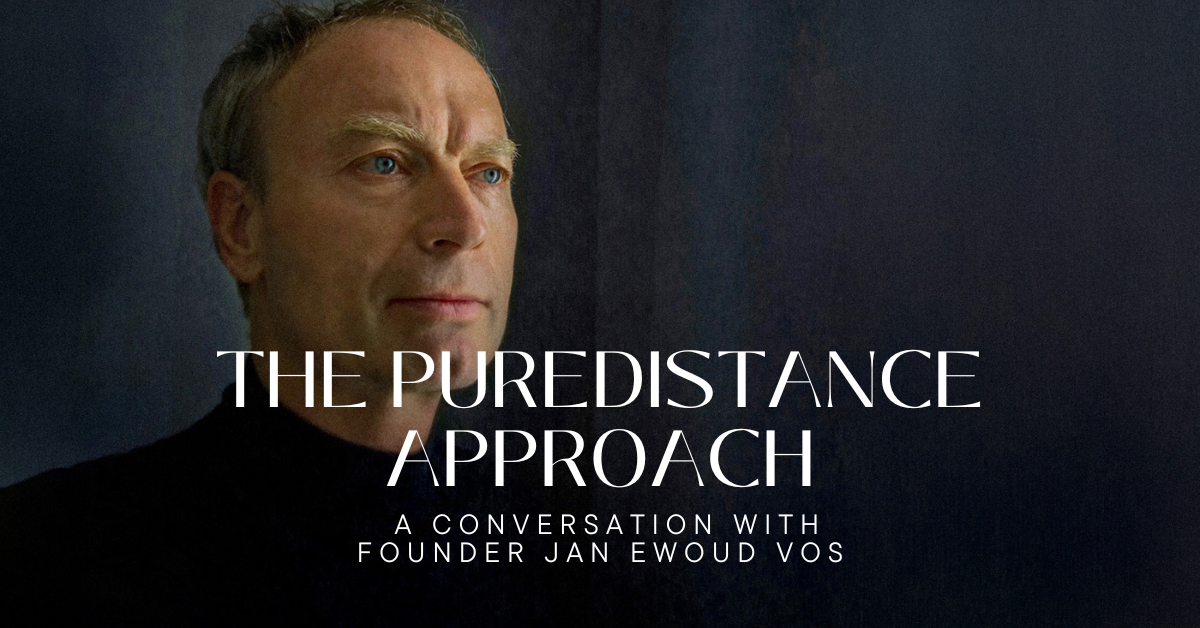
Puredistance is an independent perfume house based in the Netherlands, founded by Jan Ewoud Vos. It operates on a deliberately limited scale. Fewer than one hundred stores carry the brand worldwide. Production is largely done by hand. New releases are rare, often taking a year or more to develop.

The perfumes are created in collaboration with perfumers such as Annie Buzantian, Antoine Lie, Nathalie Feisthauer, Cécile Zarokian, and Roja Dove. Vos does not compose the formulas himself. He builds the idea around them, then stays with the process until it aligns with that original feeling.

In certain compositions, particularly those developed with Antoine Lie, materials are sourced through partners such as L’Atelier Français des Matières, a French laboratory known for working closely with growers and producing small-scale extracts with distinct character.
The Man Behind the Brand
Before Puredistance, Jan Ewoud Vos worked in photography and visual media. He built and sold a successful company, then turned to perfume not out of technical interest, but because it allowed him to create something that could hold meaning over time.

He has said more than once that he prefers not to know too much about perfumery in a technical sense. That too much knowledge can interfere with instinct. He evaluates fragrance the same way you recognize something as beautiful. Immediately, without needing to explain why. That way of thinking runs through everything he does.
Over time, the industry has shifted. Niche has expanded, production has accelerated, and language around fragrance has become increasingly technical, increasingly explanatory. Puredistance hasn’t followed that shift. It hasn’t tried to keep up.
And whether you agree with that approach or not, it creates something very clear. A brand that knows exactly what it is, and what it isn’t trying to be.
The Conversation
What follows is a conversation with Jan Ewoud Vos, about beauty, instinct, restraint, and what it means to build something slowly, then leave it as it is.

Origins
Before founding Puredistance, your professional world was photography and visual media. Perfumery seems, at first glance, like an entirely different language. What drew you into fragrance seriously enough to build a house around it?
The timeless nature of perfume. The deep beauty of it. The mystery. Smell is the most mysterious of the human senses. Smelling something instantly causes an emotional reaction. And I think in this cold, analytical world we need to analyse less and feel more.
The other thing that attracted me was the challenge. To successfully build a perfume house one needs the right name, the right flacon, the right packaging, the right fragrance, solid financial funding and a lot of patience. Quite a challenge! But I knew I would love to do all that myself, apart from creating the fragrance. I just needed time and a bit of luck.
Were you a perfume collector or devoted wearer before becoming a founder? Is there a particular memory, bottle, or moment that shifted perfume from appreciation into profession?
Twenty years ago, after selling my previous company John Foxx Images, I was reading a book about the life of Coco Chanel. I was fascinated by her story and the wonderful world she created. The timelessness of it. The magic.

I felt I also wanted to create a magic world using my love and passion for beauty, arts and magic. A world of timeless beauty. Building a perfume house would be the perfect way to use my artistic talents. So I got seduced by perfume later in life.
When you decided to enter perfumery in 2002, what gap did you feel existed in the market? What kind of house were you trying to build that you could not yet find?
For many years I collected vintage perfume flacons, often with the original packaging, from the twenties, thirties and forties. The passion, the creativity, the beautiful materials, the wonderful names… all that was missing in the highly commercial mass perfume market that ruled in the nineties.
So I decided to bring back the grandeur and quality and creativity of the good old days. But my way: in an understated way.
Looking back, did founding a luxury perfume brand from the Netherlands, outside the traditional French system, feel risky, or liberating?
It never felt risky. I financed everything with my own money. So whatever the results, I would keep my freedom. I also used all my energy to create something beautiful and always believed some people would appreciate the final result.
Also it never felt liberating, since all my life I have been as free as a person can be. I don’t care so much what other people do or think or say. I do what feels right to me, put all my passion in and then always find some people who love what I do.
Building Puredistance
From the beginning, Puredistance has moved slowly, with very few releases and extremely selective distribution. What convinced you that restraint and limited growth were essential to preserving the integrity of the house?
Instead of selective distribution let’s use the term selective sales. Because at Puredistance we hardly ever work with distributors (only in China.) We prefer to sell directly to the stores to avoid being discounted on the grey market.
We really want to keep Puredistance exclusive and make sure the customer who buys Puredistance gets the best possible service and can trust our brand.

Less than 100 stores worldwide are authorised to sell Puredistance and in these stores the sales people have time and the necessary knowledge to tell the full story of Puredistance and our perfume collection. I think true luxury involves an element of intimacy, so a personal service is a necessary part of the whole experience of luxury.
The same restraint we show in selecting the stores that sell our brand, we show in new releases. On average we only launch one new perfume a year. Developing an original perfume with a soul simply takes time.
Last but not least the fact our perfumes are made by hand by the Puredistance team also limits our growth. But adds something special to our perfumes. Few perfumes today are hand-made and I know our customers appreciate this and realise this is another guarantee for exclusivity.
Our small Puredistance team simply cannot produce large quantities. But loves the manual process! We have flexible and relative short working hours and I go to great lengths to create the perfect working circumstances and make sure my team is as happy as the customers who buy our perfumes.
You often speak of “quiet luxury” and understatement. Today that phrase is widely used. In your work, what does quiet luxury mean in material and practical terms when you are actually developing a perfume?
From the very first days of our existence I have preferred to whisper instead of shout.
Already in 2008 the Parisian perfume writer Octavian Coifan wrote about our first perfume Puredistance I:
“It’s not a fragrance to stare at and admire the virtuosity of the perfumer but rather it’s a luxury to be worn in silence. It’s like a moment of personal luxury, a secret and intimate pleasure.”

So we don’t shout, don’t push, hardly advertise and don’t pretend. I keep the design of our flacons and packaging minimally stylish, we never participate in perfume contests, we avoid the perfume “in crowd” and don’t rub shoulders with celebrities.
At the same time we do offer a very luxurious product with timelessly beautiful elements. This is how I see “Quiet Beauty”. And fortunately we have a select and loyal following who likes this approach.
Creation and Development
When you begin developing a new Puredistance fragrance, where does the process usually start?
It always starts with a certain thought, message or feeling. There is no science behind this, it just happens.
I have a curious mind and I allow it to wander and explore. When something really interests or touches me I come up with a name for a possible new perfume.
The next step is to try to register the name of the perfume so it is uniquely ours. Many Puredistance perfume names I have invented. To name a few: RUBIKONA, SHEIDUNA, AENOTUS, YSAYO and a soon to be launched perfume with the name of AMBRAGIO.

I love words and I love music and the names I invent must be musical and poetical. When I know the name is OK, it takes several months to work out the concept with visuals, music, video and written brief. Then I give the concept to a perfumer who is given carte blanche budget-wise and time-wise. This is the only way I think a perfumer can create something exceptional and timeless.
(There is however one exception and that is the upcoming perfume AMBRAGIO. I asked Stéphanie Bakouche from Paris to work on a perfume she truly loves and present it to me when she feels it is totally “her” and encapsulates her soul. So she did! Then, with the perfume already finished, I thought of a concept and a name that would match the character of this perfume.)
During the process of creation of a perfume I never give feedback on ingredients or do comparisons with other perfumes (which is easy for me, since technically I don’t know much about perfumery and ingredients and like to keep it that way). Instead I come up with metaphors. For example I ask to put more red in the perfume or that I want to hear the violin more clearly.
Based on such feedback we get reworks. Often we need three or four rounds of reworks to get to a perfume that matches my feeling of the concept. In some cases we have to start all over again or go back to an earlier version. And in some cases this process does not work and I decide to stop and find another perfumer and start all over again.
How do you choose which perfumer to collaborate with on a particular project? Are you guided by their technical strengths, their aesthetic style, or the chemistry between you?
Many things in the world of Puredistance just happen. Organically. Some things are meant to be, I think. I learnt to be open to anything the universe offers me and, based on my feeling about it, decide if I accept the offer or opportunity I get. So all perfumers I have worked with were not chosen by me, but on the right moment they were simply there. In sometimes amazing ways.
I have told the story of Puredistance I perfume many times, but this story illustrates it best. After I had visualised the concept of Puredistance I, I made a briefing with text, photography and music. By chance I met Mick van Vlijmen, who was about to move to Firmenich in New York, one of the world’s leading producers of fine fragrances. Mick really liked the idea of Puredistance and promised me to show it to some of the best perfumers at Firmenich.

And now the amazing part of the story starts. When he showed the briefing to Annie Buzantian, a Master Perfumer at Firmenich, she turned pale and looked in disbelief at the front picture of the briefing: a fashion advertisement from a magazine in which a woman with brown skin, elegantly dressed in a simple silk grey dress, is photographed in the pure white, cold snow. After a long silence Annie said, “Mick, I don’t need to create this fragrance…” She opened a drawer in her office, pulled out exactly the same advertisement and told him, “Two years ago I used the same advertisement as inspiration for creating my personal fragrance, my own masterpiece… trying to combine coolness and warmth in one and the same fragrance…”
It clearly was meant to happen that way. Jung would call it synchronicity: two people having the same idea without knowing each other.
What does your creative brief typically look like? Is it emotional and visual, or highly structured and technical from the beginning?
It is emotional and visual. I use images, video and words. Sometimes music. I show the colours of the gift box, outer box and the colour of the satin inside the gift box. Using the right colours and colour combinations is a very important part of the whole concept.
Once development begins, how closely are you involved in the evolution of the formula? Do you see yourself as refining, directing, or challenging the perfumer throughout the process?
I am the creative director, so directing the process is what I do. And once there is a fragrance selected that, according to me and my team, syncs with the concept, the process of reworks starts, so we are refining. This usually takes another couple of months.
In this process I never look at trends or use AI. I prefer to use my very own “beauty instinct.”
You have maintained long-term relationships with specialized French production partners such as L’Atelier Français des Matières, rather than frequently shifting laboratories. How important is continuity of laboratory and materials in shaping the Puredistance identity?
I leave it to each perfumer to select the company for the raw materials. They know best and I trust their choice. All perfumes done by Antoine Lie in his independent years are made of high-quality ingredients from L’Atelier Français des Matières.

I have visited them last year and it was a pleasure to see the intense passion of Rémi Pulverail, the driving force behind the company. The testing and filling is done by a company near Paris we have been working with for many years.
Puredistance perfumes are produced exclusively at extrait concentration and are known for their richness. Beyond longevity, what does working at that concentration allow you to achieve artistically?
The higher the concentration of perfume oil, the more the perfume fuses with your own skin scent, resulting in a richer and more personal scent.
And the longer the perfume lasts, the longer you will be able to follow its development: a long and interesting voyage instead of a quick visit. For the real perfume lover, this voyage is part of the beauty of wearing an extrait de parfum.
When evaluating a formula in development, what tells you that it has reached the level of quality you expect? Is it the materials themselves, the balance, or something more intangible?
I have been fascinated by beauty all my life. My mother was a ballet dancer, a creator of fashion and art, and a very elegant lady. The love for timeless beauty was instilled in me at a young age.

I find beauty in nature, in design, in art, in music and in people. So when I evaluate a perfume I simply use my intuitive sense of beauty. No analysis at all. It only takes me a few seconds to feel beauty or not. Don’t we all do this in one way or another? How long does it take you to decide if you like your soup?
From first idea to finished bottle, how long does a Puredistance perfume typically take to develop? At what moment do you know it is ready?
Between 6 to 12 months. In two cases it was close to two years. I know when it is ready, when it is ready. The moment cannot be defined or predicted.
Craft, Quality, and Industry Perspective
In today’s crowded niche market, many brands speak about “high-quality materials.” From your perspective, what truly distinguishes a high-quality perfume from a well-marketed one?
Honesty. Unfortunately many brands are not speaking the truth when they promise high-quality materials or exclusivity.
In general, when a brand heavily markets its products, you can be sure the money goes to advertising and not into high-quality perfume oil.
Luxury fragrance pricing has risen dramatically across the industry. How do you determine the value of a Puredistance perfume in a market where prices often increase faster than quality?
In the end, our goal is to make customers happy so they become loyal, recurring customers. We do this by offering a perfume collection with very high-quality perfume and unmatched exclusivity for a fair price.
Of course, if you don’t care about exclusivity or beautiful packaging, or if you are happy with a lower-quality perfume, you will find us too expensive.
Unlike other brands, Puredistance has not increased its pricing for many years. Way back in 2007, when we launched, we were very, very expensive. Today we are still expensive, but not as expensive as before, considering there are many brands now asking the same price or even more.
I could maintain the same retail price for many years by accepting smaller profit margins and working more economically, but without ever sacrificing quality. Late this year we will have to increase the price a little bit, for the first time in 20 years, because the prices of perfume oil and shipping have gone up constantly.
When you look at the current state of niche perfumery compared to when you began, what changes concern you most, and what developments still inspire you?
I am concerned by the fact that people who are paying high prices for mediocre perfumes, marketed as “niche” but sold everywhere, will be disappointed and get the wrong idea about niche.
Therefore, I prefer to refer to Puredistance as “truly exclusive” or “timelessly beautiful” rather than niche.
One thing I do to guarantee our customers that we are indeed one of the most exclusive perfume brands in the world is to personally sign every certificate of authenticity that is included with every perfume we sell. I only sign a small amount at a time, put on nice music, use my favourite pen (I collect them, pens can be beautiful too), and try to infuse each certificate with good emotions.

What also concerns me is the surge in regulations. The latest is that all perfumes need a new INCI label with more than double the amount of potential allergens, many of which consumers have never heard of.
Thanks to IFRA, many perfumes need to be reformulated regularly, so the label then has to change again. This feels unnecessary when we could use a QR code on the label, but that is not allowed.
I fully support a healthy world, but governments should start by properly regulating the food and beverage industry if they want to keep people healthy.
Do you believe there will always be space for slow, carefully produced perfumery, or is the definition of luxury shifting?
There will always be people who care for quality and who want a product with a story. A story that is true.
In fact, there will be more and more of such people, because in many countries the education of perfume users has only recently begun. But people learn fast and will soon be able to recognise high-quality perfume and understand that truly special perfume comes with a real story.
Personal Aesthetic and Inspiration
Beyond fragrance, what forms of art or culture influence you most? Are you inspired more by music, architecture, painting, or literature?
For me, music goes deepest, then painting and literature. I can also be inspired by people, the way they look, what they say, what they do.
Architecture I can admire, but it doesn’t move me in the same way.
Are there perfumes, past or present, that you personally admire or consider benchmarks of excellence?
I have been using Chanel Antaeus for more than 40 years, so for me that is a perfume I really love and admire.
From the same legendary brand, I also highly think of 31 Rue Cambon.
After more than two decades building Puredistance, what still excites you creatively?
To come up with a new concept, a new creation.
Right now I am in the process of creating three perfumes that are exclusive to some of our most loyal Puredistance ambassadors. They will have exclusive selling rights for their country or countries.
One for Sachi in Japan, one for Chi Wai in China, and one for Lana in Zagreb.
This way we emphasise both our exclusivity and reward loyalty. Loyalty is priceless. Giving back is something I have always done and will continue to do.
Giving back also means offering customers the most beautiful and highest-quality experience for their money. All of this excites me, every day.
Is there a perfumer or collaborator you have not yet worked with but would love to in the future?
No. There is nobody right now, since I am not on the lookout. If it is meant to be, it will happen.
When someone wears a Puredistance fragrance, what do you hope they feel, or understand, that they might not encounter elsewhere?
I hope they feel special.
Special because they wear a timelessly beautiful perfume with a soul and a signature. Special because few people know Puredistance, as we are so exclusive and only available in fewer than 100 stores worldwide.
In the end, everybody is unique. Wearing Puredistance should help them truly feel and express that.
After spending time with the perfumes and hearing him speak, nothing feels accidental. The restraint, the pacing, the decision to leave things as they are. It all comes from the same place.
There’s no effort to explain everything or make it more accessible than it is. You meet it where it stands.
And if you do, it’s clear.
Not louder. Not bigger. Just more certain.


Leave a Reply