

If you love and collect perfume, you’ve likely encountered a moment when you hesitate before saying a French word printed on a bottle, wondering how to pronounce it without sounding forced or awkward.
I’ve been there.
Even though I took French for five years, I don’t speak it fluently. And yet, perfume has drawn me deeper and deeper into the French language, a world where everything from the bottle to the scent itself is wrapped in history, artistry, and culture. My husband, who attended a French school and speaks fluent French, is my sounding board when I stumble over a word. His advice has always been simple: don’t try to sound French, just say the word as it’s meant to be read — softly, elegantly, and without forcing your tongue to do what it can’t.
So this guide is for women like me, women who love perfume, who collect it thoughtfully, and who respect the artistry behind it. These are the words we see on bottles, hear in perfumer interviews, and read in reviews, words that deserve to be spoken beautifully.
How to Speak About Perfume Concentrations and Bottles

Eau de Parfum — oh duh par-FAHⁿ
A rich and concentrated type of fragrance, long-lasting and often the standard for fine perfumes.
Eau de Toilette — oh duh twah-LET
A lighter concentration of fragrance, typically more casual or for daytime wear.
Extrait de Parfum — ex-TRAY duh par-FAHⁿ
The highest concentration of perfume oil, deep, intense, and often worn close to the skin.
Absolu — ab-soh-LOO
A pure, concentrated extract of a raw material, such as rose absolu or jasmine absolu.
Sillage — see-AHZH
The scented trail a perfume leaves in the air as you move, soft or bold, but always part of a perfume’s identity.
Flacon — flah-KOHⁿ
The bottle, and for many collectors, as important as the perfume itself.
How to Describe Fragrance Families and Styles in French

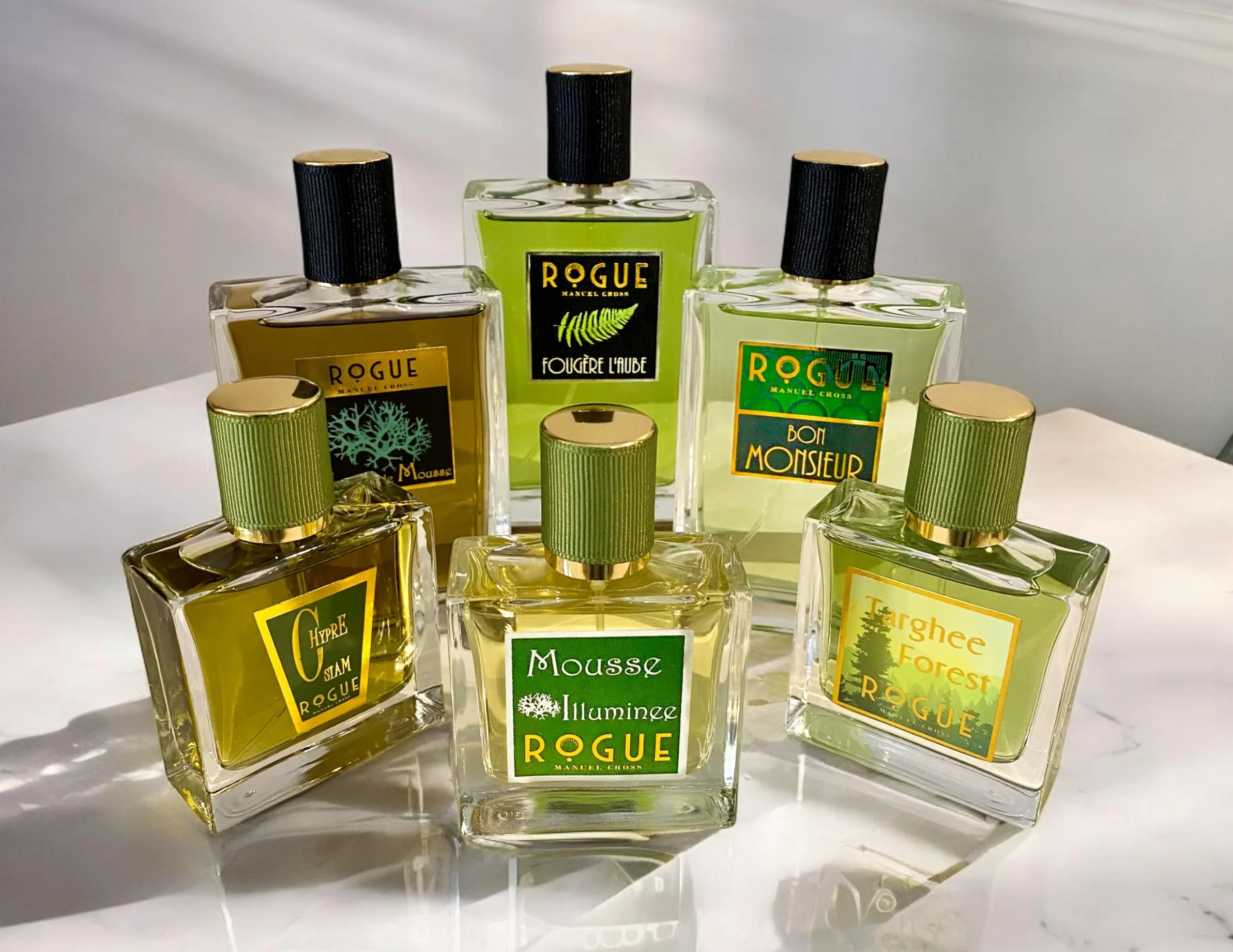
Chypre — SHEEP-ruh
A mossy, woody fragrance family with notes like oakmoss, patchouli, and citrus, elegant, refined, and complex.
Fougère — foo-ZHAIR
An aromatic style built on lavender, oakmoss, and coumarin, sharp, clean, and often used in masculine perfumery but increasingly unisex.
Gourmand — goor-MAHⁿ
Scents that evoke edible pleasures, think vanilla, caramel, chocolate, but refined, not childish.
Oriental (Ambré) — oh-ree-ahn-TAHL / AHM-bray
Warm, resinous, and spicy perfumes, often featuring amber, incense, and rich florals, sometimes called “ambery” today.
Boisé — bwah-ZAY
Woody perfumes, built around sandalwood, cedar, vetiver, or oud.
Poudré — poo-DRAY
Powdery scents, soft, elegant, often featuring iris, violet, or musks.
Cuir — KWEER
Leather from soft suede to deep, smoky leathers.
Épicé — ay-pee-SAY
Spicy fragrances, notes of pepper, saffron, cardamom, and cloves.
French Words in Perfume Names and Descriptions

Noir — NWAHR
Black, often used for deeper, richer, more sensual versions of fragrances.
Blanc — BLAHⁿ
White, fresh, light, sometimes powdery or floral.
Rouge — ROOZH
Red, bold, dramatic, seductive.
Vert — VEHR
Green, fresh, crisp, leafy, and herbal.
Bleu — BLUH
Blue, cool, aquatic, often light and modern.
Frais / Fraîche — FREH / FRESH
Fresh, often bright, airy, and light.
Doux / Douce — DOO / DOOS
Soft, sweet, gentle.
Sensuel / Sensuelle — sahⁿ-SWELL
Sensual, intimate.
Animalique — ah-nee-mah-LEEK
Animalic, musky, leathery, sometimes daring and provocative.
Balsamique — bal-sah-MEEK
Smooth, resinous, and warm, balsamic notes add depth and richness.
Savon — sah-VOHN
Soapy, clean, refined, elegant.
French Words Used in Niche and Collector Fragrance Culture

Maison — meh-ZOHⁿ
House, as in Maison Francis Kurkdjian, Maison Crivelli, a perfume house, often indicating artistry and heritage.
Atelier — ah-tel-YAY
Workshop or studio, as in Atelier Cologne, suggesting craft and creativity.
Haute Parfumerie — oht par-foo-muh-REE
High perfumery, the world of exclusive, luxurious perfume creations.
Parfumeur — par-fuh-MUHR
Perfumer, the artist behind the scent.
Collection — ko-lek-SYOHⁿ
Collection, as in Collection Privée, a curated line of special releases from a perfume house.
Famous French Perfume Houses

Lahr ay lah mah-TYEHR, Pesh Mee-RAHZH, oh duh par-FAH
Guerlain — Gher-LAHⁿ
Dior — DEE-or
Diptyque — Dip-TEEK
Maison Francis Kurkdjian — May-ZOHⁿ Frahn-SEES KURK-jhan
Parfums de Marly — Par-FAⁿ duh Mar-LEE
Serge Lutens — Sairzh Loo-TAⁿS
Frédéric Malle — Fray-day-REEK Mahl
Legendary French Perfumers Every Collector Should Know

Francis Kurkdjian — Frahn-SEES KURK-jhan, master perfumer and founder of Maison Francis Kurkdjian.
Jacques Guerlain — Zhakh Gher-LAHⁿ, the genius behind Guerlain classics like Shalimar and Mitsouko.
Jean-Claude Ellena — Zhahn-KLOHD El-EN-ah, known for minimalist masterpieces, including many Hermès creations.
Mathilde Laurent — Mah-TEEL Lor-AHⁿ, in-house perfumer for Cartier.
Christine Nagel — Krees-TEEN NAH-zhel, current in-house perfumer at Hermès.
Dominique Ropion — Doh-mee-NEEK Roh-pee-OHN, the nose behind classics like Frédéric Malle’s Portrait of a Lady.
Pierre Bourdon — Pee-AIR Boor-DOHN, creator of iconic fragrances like Davidoff Cool Water and Serge Lutens Féminité du Bois.
Perfume is more than scent, it’s artistry, history, and language. And if you collect perfume as a form of personal expression, learning to speak about it beautifully is part of the experience. You don’t need to be fluent in French to speak about perfume with elegance, but knowing these words, and saying them with care, shows your respect for the craft.
If this guide has helped you, share it with a fellow collector, or let me know if you’d like a printable version to keep at your vanity. And if there are words you still wonder how to say, leave a comment, I’d love to add them.





Leave a Reply