
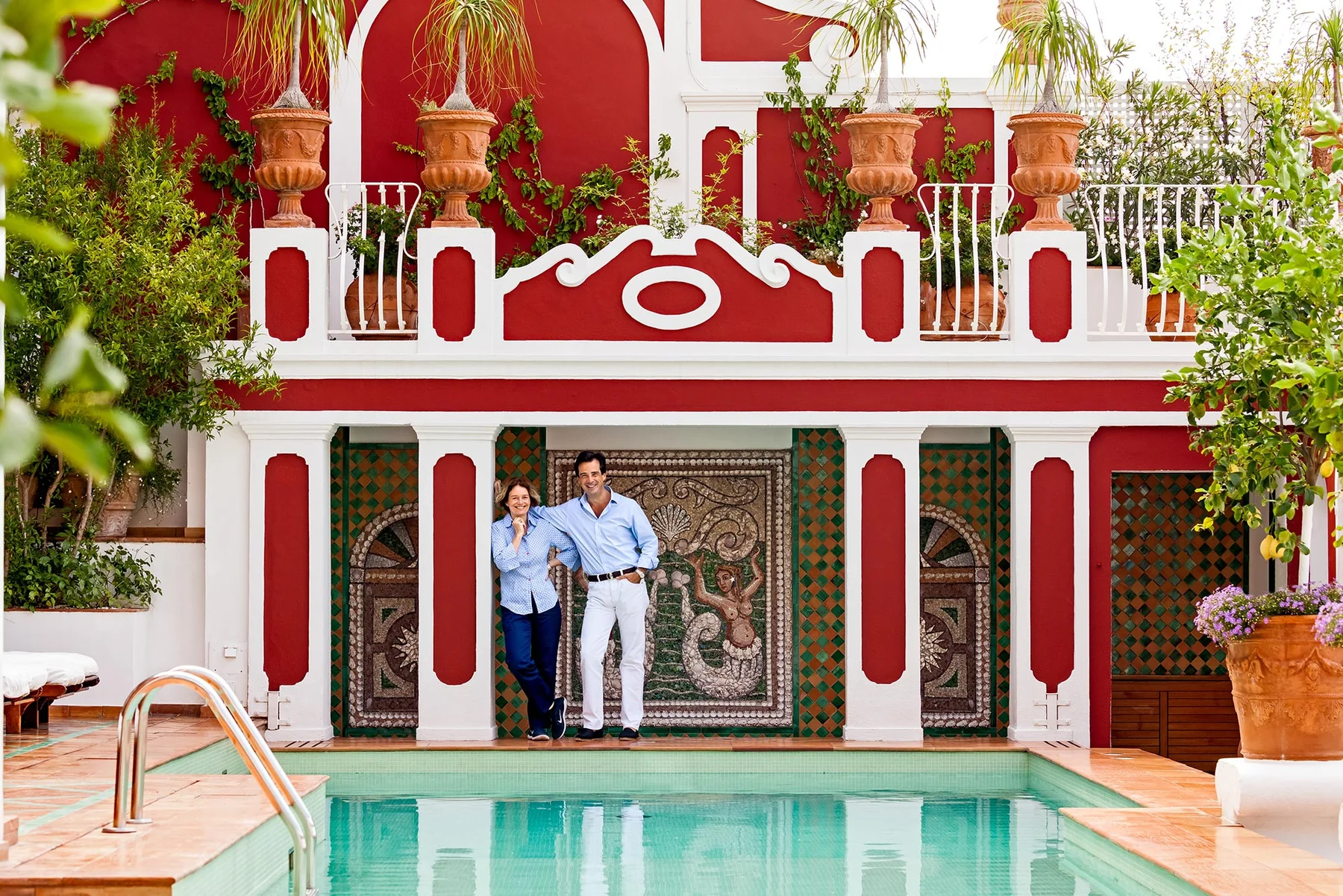
The light in Positano has a way of settling on terracotta as if it belongs there. By late afternoon at Le Sirenuse, the tiles hold the warmth of the day, and the air carries salt, citrus, and the faint mineral hush of stone. It is a hotel shaped by lineage and restraint, owned by the Sersale family since 1951, its architecture unfolding in quiet levels above the Amalfi Coast. The rhythm is unhurried. The provenance, assured.
It was on that terrace, during a winter gathering in early 2002, that a decision was made which would extend the hotel’s legacy beyond hospitality. The fiftieth anniversary had passed in the shadow of September 11; a planned celebration was cancelled. Something remained unfinished.

“The younger generation of the hotel,” Sebastián Alvarez Murena recalls, “were sitting on the terrace on a sunny winter day thinking that we needed to do something to celebrate.” Marina Sersale was there, along with her cousin Antonio, his wife Carla, and her sister Giulia. One of them suggested creating a fragrance. No one remembers who. “Marina and I got the ball,” Sebastián says, almost lightly. “And here we are almost a quarter of a century later.”
The idea was not impulsive. Both had lived fully formed lives before fragrance entered the picture. Marina, raised within the cultural continuity of the Sersale family, moved between Rome and Positano with the sensibility of someone attuned to atmosphere. Sebastián, descended from the Mitre lineage of Argentina and steeped in writing and intellectual life, approached the world through language and archive. They met in Rome. “Rome smells of pine resin and sun,” Sebastián says. The description lingers. It suggests an early education in olfactory memory.

Their partnership has never relied on theatrical tension. “Romanticism lies in the fact of doing something together, building something,” Sebastián reflects. The reality is more exacting. “Lots of work. More work than you ever imagined it would be. And yet be happy about it all along.” He insists there have been no dramatic disagreements about direction. When they see things differently, one persuades the other. “Creating something new together always happens in harmony and with joy.” The statement is delivered without embellishment. It feels considered.
Marina’s training in film sharpened her sensitivity to environment. “It’s the light,” she says of what she notices first upon entering a space. “And actually often also the smell.” For her, scent is part of composition. A room is never purely visual. Texture, air, the quiet residue of use, all register at once. This attentiveness would become foundational.
Sebastián, for his part, communicates with perfumers through text. Every fragrance begins with a written brief. “It has always been a written brief,” he explains. Sometimes long and descriptive, sometimes composed of “precise sentences and unequivocal words.” Mood boards appear occasionally, but language remains the governing structure. A sentence can contain a place. A word can determine a formula’s direction.
The first development meeting for what would become Eau d’Italie took place far from Positano, in the living room of a Haussmannian apartment near Place Saint-Augustin in Paris. Nineteenth-century architecture, furnished in an unexpectedly contemporary manner. There, Marina and Sebastián encountered the accord that would anchor the fragrance. “A note based on the smell of terracotta warmed by the sun,” Sebastián recalls. They called it Argile. Clay.
Le Sirenuse has always been defined by terracotta and Mediterranean air, yet what they sought was less literal than emotional. “A specific feeling of being on the terrace of Le Sirenuse, in summer, with the sun kissing the terracotta tiles and vases,” Sebastián says. “An image gives one side of the sensation. A fragrance takes you there.” The distinction is subtle. A photograph records. A scent returns.
When Eau d’Italie launched in April 2004, it was conceived as a tribute to the hotel. By the end of that summer, it had found its way to Colette in Paris and 10 Corso Como in Milan. Demand followed. The hotel was unprepared for international distribution. A decision had to be made. “Either limit it or take it outside the hotel and let it fly,” Sebastián recalls. They chose expansion. In 2005, Eau d’Italie stepped into the wider world.

From the second fragrance onward, the brand’s scope broadened. It would become an olfactory journey across Italy. The criteria were clear. Each creation must feel Italian in style. Chic. Timeless. The word timeless is used sparingly by the couple, and always with deliberation. It implies a refusal to chase cycles.
In speaking of perfumers, Sebastián corrects the common vocabulary. “Perfumers are not collaborators, they are the real creators of fragrances.” Without them, he notes, fragrance would not exist as it does. Their partnership with Bertrand Duchaufour was built on shared references, including a mutual interest in African art. With Daphné Bugey, it was the “lightness of her hand” and her unmistakable style that aligned with the house’s codes. The relationship rests on trust. “Perfumers tend to be precise on what they deliver.” There has never been a submission that felt technically accomplished yet fundamentally misaligned.

Evaluation remains intuitive. “It’s just, well… feeling it,” Sebastián says. “There is no other way for us.” Occasionally, regulatory reformulations have yielded unexpected refinement. A fragrance returns altered by necessity and arrives improved. Alchemy through constraint.
The second act of their creative life began at home, in a quieter moment. Marina was reading a biography of her ancestor James Morrison when she noticed references to Argentina that echoed Sebastián’s own family history. At first, the connection felt improbable. “We thought we were just making things up for one another,” he admits. Public records confirmed otherwise. The Sersale and Mitre lineages had intersected in nineteenth-century Argentina long before Marina and Sebastián met.


The discovery would lead to ALTAIA, an acronym for “A Long Time Ago in Argentina.” It also brought a shift in posture. “It brought us to put ourselves in the limelight,” Sebastián says, something they had previously avoided. Where Eau d’Italie remains layered, archival, and rooted in Italian provenance, ALTAIA was conceived as a separate canvas. “We wanted ALTAIA to be very different… two distinctly different white canvasses we could work on.” The architecture of each house is deliberate. One draws from place. The other from lineage and fate.

Over two decades, they have declined opportunities that might have accelerated growth. They speak of these decisions without self-congratulation. “As time goes on you realize that… we don’t necessarily always know better,” Sebastián reflects. Mistakes are acknowledged slowly, then corrected. The posture is one of stewardship rather than conquest.
Their audience is dispersed across continents. Asia remains a territory of ongoing discovery. They do not speak in metrics. They speak of aficionados.
When asked to imagine twenty years ahead, their tone softens. “Who knows what will be twenty years from now,” Sebastián says. He smiles at the thought of their own aging. What he hopes for is simpler. That someone might look back and recognize in their work “the seed of something that took on.” A particular design sensibility. A fragrance style. A quiet signature.
If it happens, they will accept it with grace. If it does not, they will remain at ease.
In Positano, the terrace still warms under the sun. The tiles hold their heat. Somewhere between pine resin and clay, between Rome and Argentina, between archive and intuition, Marina Sersale and Sebastián Alvarez Murena continue their work. Carefully. Together.








Leave a Reply