
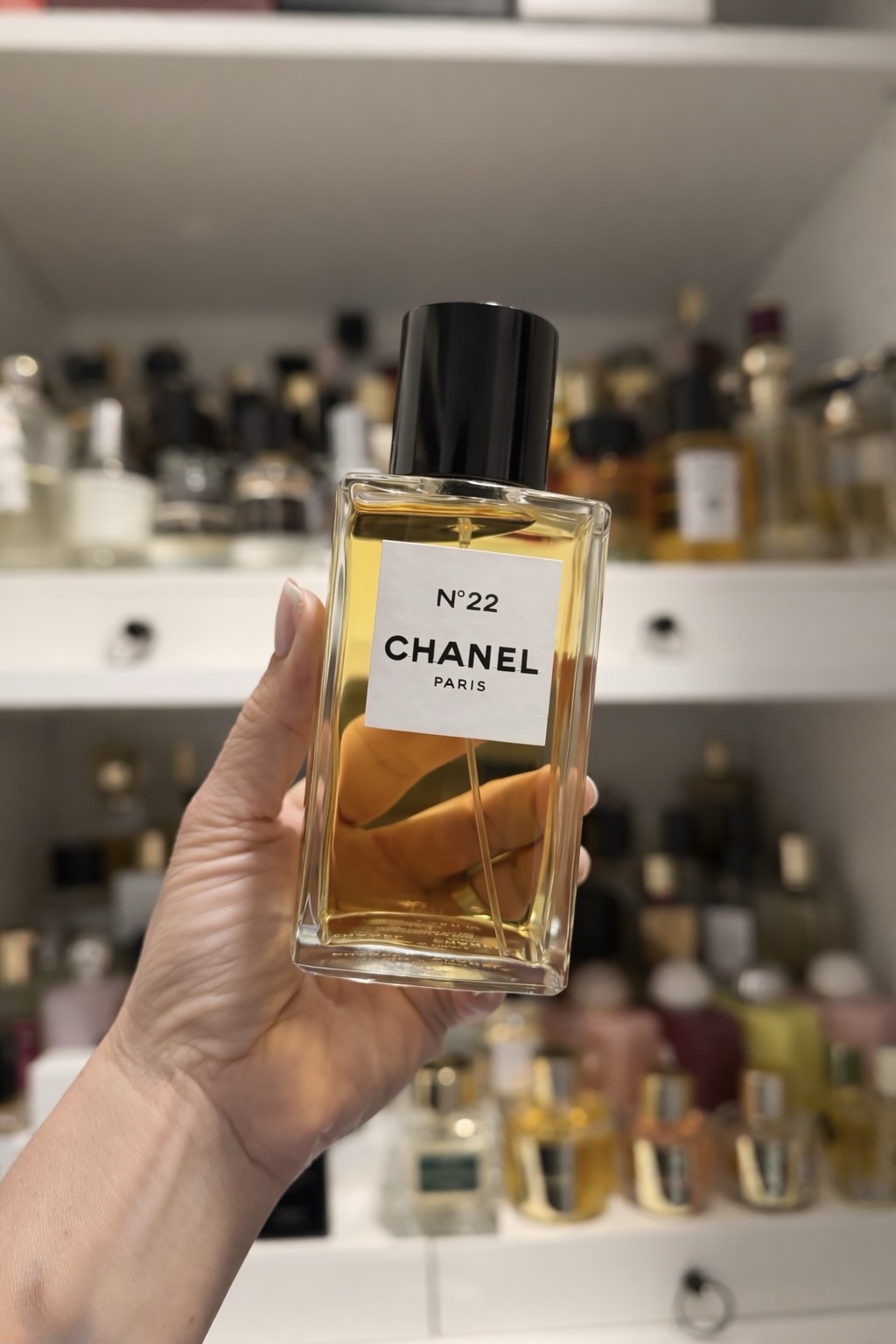
Every great house carries its own mythology. Chanel carries many. Some arrived with a roar. Others, like this one, took their place more quietly beside the legend of N°5.
In 1921, Ernest Beaux presented Gabrielle Chanel with a series of numbered perfume samples. She chose the fifth. It would become the most famous fragrance in modern history. Yet within that same set lay another composition, Sample 22, a perfume that did not compete with N°5 so much as reflect it through a different lens.

Released in 1922, Chanel N°22 embodied what Gabrielle Chanel called her “White Look.” Her fashion during this period leaned toward luminous whites, creams, and pale silks that moved away from the ornate heaviness of prewar couture. N°22 translated that aesthetic into scent. It was designed to glow.
Chanel, famously superstitious about numbers, favored five but held a personal affection for 22. If five symbolized destiny, twenty-two suggested refinement. The fragrance became the quiet counterpart to the global phenomenon that N°5 would soon become. If N°5 was the public icon, N°22 remained the insider’s perfume.
The Chemistry of Light
What makes N°22 extraordinary begins at the molecular level.
Both N°5 and N°22 rely heavily on aliphatic aldehydes, the synthetic materials that defined modern perfumery in the early twentieth century. Yet where N°5 uses them to create a softened, diffused floral veil, N°22 amplifies them. The composition features a pronounced concentration of fatty aldehydes such as C10, C11, and C12.

The opening is often compared to the sound of a champagne cork. There is a brisk, effervescent quality that feels almost crystalline. The effect is less about citrus brightness and more about texture. It suggests faint chill of cool air against skin. The aldehydes here are not disguised. They are pushed forward.
For many critics and perfumers, this is the truer aldehydic fragrance. It does not hide its synthetic brilliance behind lush florals or warm musks. Instead, it treats synthetic materials as an aesthetic statement. In the context of the 1920s, this was modernity in liquid form. Today, it reads as both vintage and strikingly contemporary.
The White Bouquet
Once the initial shimmer settles, the floral heart begins to reveal itself.
N°22 is built around a lush white bouquet. Tuberose provides a creamy density that anchors the composition, while jasmine introduces a narcotic sweetness. Lily-of-the-valley lifts the structure with a green, translucent brightness that keeps the florals from becoming overly opulent.

The interplay between these elements creates a sensation of layered whites. Not a single shade, but many. Silk, porcelain, fresh petals, candle wax. The florals feel structured. They carry a cool, composed elegance that aligns with Chanel’s aesthetic vision at the time.
The Monastic Base
Then comes the turn that defines N°22.
Where N°5 settles into a musky, softly animalic base, N°22 moves in an entirely different direction. Frankincense emerges, dry and luminous, lending the fragrance an almost spiritual stillness. Nutmeg follows, adding a subtle warmth that never tips into gourmand territory. The effect is quietly austere.
This base has often been described as monastic. It evokes polished wood, incense drifting through a quiet chapel, the faint spice of old books and candlelight. The transition from sparkling aldehydes and white florals into this contemplative dry-down is what gives N°22 its emotional depth. It begins with light and ends in shadow, yet never loses its sense of clarity. This duality separates it from its more famous sibling.
Anecdotes and Echoes
Throughout its history, N°22 has attracted a devoted, if discreet, following. The 1920s illustrator and dandy Ralph Barton reportedly wore it, drawn to its modern, almost androgynous character. Unlike many perfumes of its time, it resisted easy categorization. It felt both refined and unconventional.

A century later, Chanel revisited this legacy with the launch of the Chanel 22 handbag in 2022, marking the fragrance’s hundredth anniversary. The bag, like the perfume, balances classic codes with contemporary ease. It serves as a reminder that within the Chanel universe, scent and style often move in quiet dialogue with one another.
A Connoisseur’s Choice
Today, N°22 resides within Les Exclusifs de Chanel, the house’s curated collection for collectors and devotees. It is not positioned as a mass icon. Instead, it exists as a reference point for those who understand the language of aldehydes and the history of modern perfumery.
If N°5 belongs to the world, N°22 belongs to the individual. It appeals to those who seek luminosity and structure without heaviness. On skin, it feels almost weightless yet persistent, leaving behind a soft trail that suggests cleanliness, composure, and an inner sense of certainty. It is a fragrance that rewards attention. The more time one spends with it, the more its architecture reveals itself.
Connoisseur’s Verdict
Among critics and collectors, Chanel N°22 is often regarded as one of the house’s most intellectually satisfying creations. It stands as a masterclass in aldehydic construction and a testament to the elegance of restraint. While its brilliance may never eclipse the cultural dominance of N°5, it offers something that feels, to me, far more intimate and considered.




Leave a Reply