
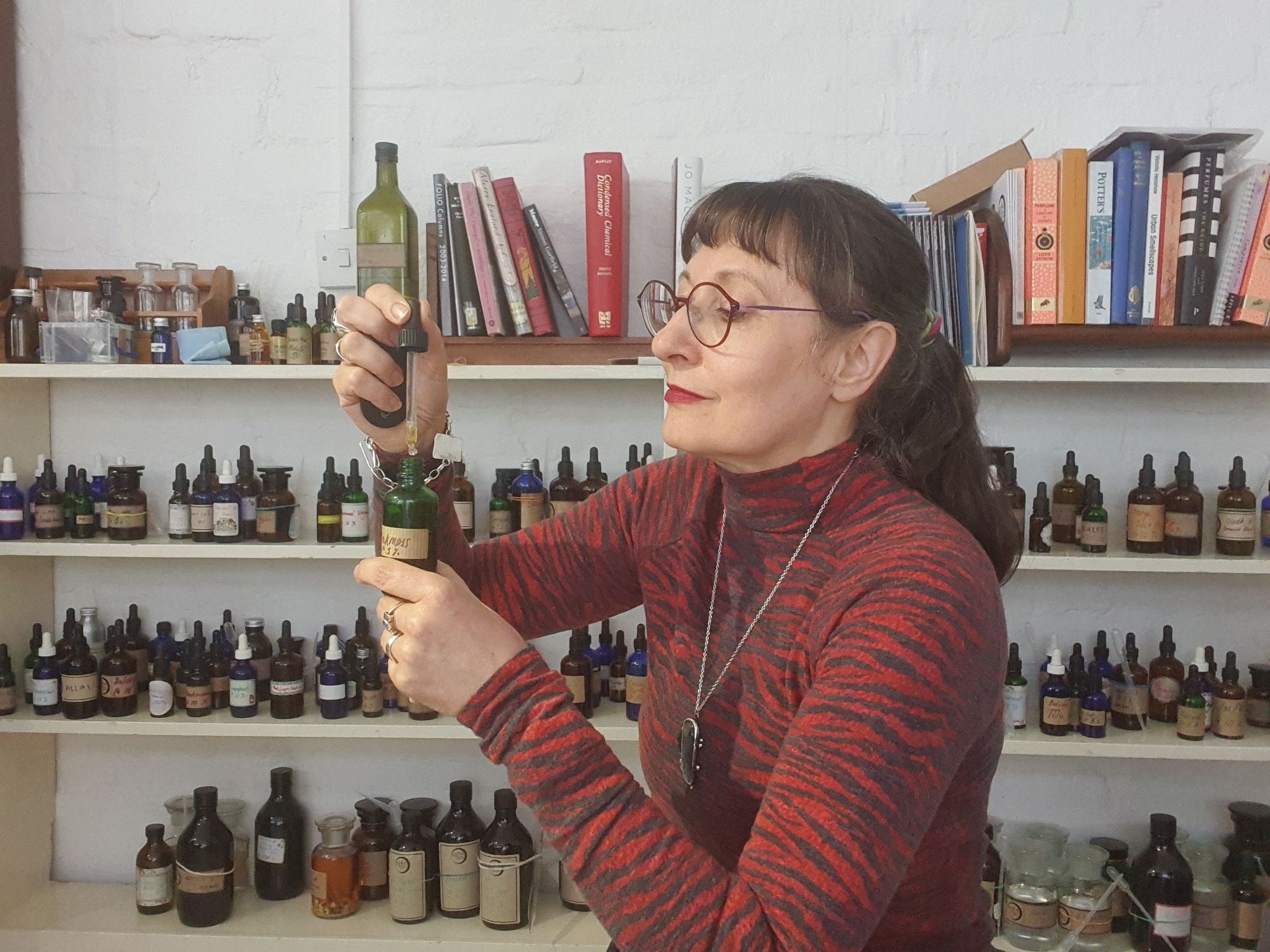
On the screen, Sarah McCartney appeared exactly as you might imagine a woman who has built her own perfume house would: short bangs, red lipstick, and a coral hoodie. Behind her, shelves were crowded with bottles, jars, and small containers, the signs of a studio in constant use. Light caught on amber liquid in small containers, and there was the kind of easy disorder that speaks not of neglect but of steady, hands-on work. It felt less like the backdrop of a marketing campaign and more like the working desk of an author, only here, the words were scent molecules, not ink.
We met her over Zoom, and she was generous with her time. For more than an hour, she answered every question, explained materials and methods, and demystified the industry with a frankness rarely heard in beauty circles. “I think people know I’m going to tell them the truth,” she told us. “Some people find that comforting. Some don’t.”
From Words to Perfume
McCartney did not come to perfumery by the classical route. For fourteen years she was the in-house writer at Lush, responsible for everything from naming products to writing training manuals for staff. Her work was not about “selling” but about describing an experience honestly. “I taught people to write the way they feel,” she recalled. “Not like an ad, but like a person who actually experienced something.”

After leaving Lush, she began writing a novel about a perfumer who recreated the scents of happy times. The book never found a publisher, but those who read early drafts asked if she could make the perfumes from the story. Fiction became practice, and 4160 Tuesdays was born in 2011, its name a nod to the number of Tuesdays in the average human lifetime, and the idea that they are meant to be used creatively. “I didn’t leap into perfumery,” she said. “I slid into it alongside my writing and training work.”
An Alternative Education
Her path is not the French model, the one that demands a chemistry degree, a place at ISIPCA, and an apprenticeship inside one of the big fragrance companies. “That’s one tradition,” she said, “but in India, in the Middle East, in so many places, perfumery is taught as an artisan craft passed down through families. At Lush, the perfumers were self-taught. You start with materials, you experiment, you get better. It’s like being a folk musician. You don’t need to play in the symphony orchestra to make music people love.”
McCartney has made this philosophy part of her own teaching. Through Scenthusiasm Perfume School, she works with students of all levels, sharing both practical techniques and the realities of working in fragrance. “You don’t need permission to make perfume,” she said. “You need curiosity, and you need to practice. The more you do it, the better you’ll be. And you’ll never stop learning.”
Her school is not about gatekeeping but about building skill and confidence. She encourages students to start small, learn the materials firsthand, and make mistakes. “You don’t have to create the greatest perfume in the world straight away,” she told us. “You have to make something, smell it, and figure out what you’d change next time.”
Building 4160 Tuesdays
In her West London studio, McCartney blends everything in-house. She works in small quantities, often just a kilo of concentrate at a time, so that every stage, from measuring to bottling, is under her control. “If I make a litre and it sells out, I make more,” she said. “Sometimes you know straight away something will work. Sometimes you think it will and it doesn’t.”
Some perfumes take years to develop. Right now, three in-progress fragrances, with the working titles Heaven, Hell, and Earth, are still taking shape. They began with a book series and a set of vintage silk scarves McCartney found on eBay, whose colors and patterns sparked the vision for three distinct olfactory worlds. She is still sourcing unusual materials to bring them to life, and expects they will take at least another year to complete. Other creations can come together in a single day. When a television program asked for the scent of Christmas pudding, she produced the accord in an afternoon. And some perfumes she makes simply because she wants to wear them herself, like Complicated Shadows, a smoky, enveloping blend I spray on my pillow at night.
A Philosophy of Transparency
McCartney is open about her materials and her processes, and does not hide behind vague marketing claims. “Some say I’m ruining the romance,” she admitted, “but there are two kinds of people: those who get joy from knowing how things work, and those who just want the magic. I’m in the first group.”
She also challenges the industry’s “natural” label. “Natural doesn’t automatically mean safe,” she said. “Essential oils are nature’s chemical warfare. Many synthetics are actually safer and more sustainable. Ninety-five percent ‘natural’ usually means the alcohol came from grain or sugarcane, which is true for almost everyone. The rest is spin.”
The Marketplace Today
The fragrance industry, she believes, is experiencing a gold rush. “In the actual gold rush, the people who made the money sold shovels and breakfast. In fragrance, it’s packaging companies, bottle suppliers, and the people making the 3D renders.” She is clear-eyed about the risks. “A few brands will be bought by the big groups, and many will burn out. My plan is to stay small and make scents no one else has smelled before.”
She does not court large-scale distribution. Retailers come to her. Brexit and changing shipping regulations have complicated her export business. “One day DHL said, ‘We’re not shipping perfume to America anymore.’ Just like that. No explanation. We had to scramble to find a workaround.”
Looking Ahead
For McCartney, the future of perfume lies not only in creation but in education and sensory engagement. She envisions smell clubs where people meet regularly to explore and describe scents, not just perfumes but the whole olfactory world. “Smelling lights up multiple parts of the brain,” she explained. “If you keep smelling new things, you build neural pathways. Start now, whatever your age.”
Her vision is not about preserving the old guard’s rules but about inviting more people into the craft. “You don’t have to be in Paris to learn perfume,” she said. “You can start at your own kitchen table. The important thing is to begin.”
Fragrance Highlights: From the Editor’s Sampler

A Flame in Your Heart
Magnolia, rose, kumquat, and pink pepper rise in a luminous opening, their brightness softened by the creamy hush of cocoa and tonka. Beneath, a quartet of balsams, labdanum, benzoin, styrax, and cistus, burns low and steady. The amber is plush but disciplined, glowing like candlelight through silk, shifting from petal-sheen to resinous warmth. On skin, it feels like an intimate whisper meant to be kept close.

Hammersmith Tea & Biscuits
A winter afternoon in a London kitchen: wholemeal lemon-ginger biscuits cooling beside a pot of black tea swirling with oat milk. Vanilla softens the tannic steam, toasted hazelnut and bran absolute add quiet depth. The gourmand is there, but never cloying. It feels like the memory of being indoors while rain dots the glass.

No Mow May
The green of uncut grass after rain, brightened by orange and privet in the breeze. Rose blooms in the heart, touched with hay and the almonded softness of tonka. Amberwood and patchouli anchor it in the golden light of late afternoon. A meadow left to itself, buzzing with life, unruly in the most beautiful way.

Salt Rose
A rose shaped by the shore, its petals brushed with salt and marine air. The bloom is lean and wind-swept, resting against driftwood and sand. There is no powder or sweetness here, only the briny romance of something rare that flourishes where land meets sea.

Burnt Cedar Rainbow Doves
Cedar embers release curls of smoke into sugared almonds. Wild rose and mock orange add fleeting brightness, while moss and civet bring shadow. It moves between contrasts, charred wood and candy, petals and fur, delivering something more enigmatic than its whimsical name suggests.

Complicated Shadows
Smoke and woods appear first, softened by resinous warmth that never quite lifts the darkness. It feels lived-in, the kind of scent that clings to scarves and lingers in rooms long after you have gone. On skin, it is more presence than projection, something you notice when the air shifts.
Sarah McCartney’s story is one of deliberate independence — a reminder that the art of perfumery can be learned, practiced, and perfected outside the walls of the establishment. She has built
on her own terms, creating fragrances that reflect curiosity, craft, and an openness rare in the beauty industry.
You can watch our full interview with Sarah on the Elevated Classics YouTube channel to hear her voice and insights in her own words. If you’ve already experienced her perfumes, we’d love to know which ones stayed with you. In the United States, her fragrances are available through Olfactif and Perfumology.








Leave a Reply