
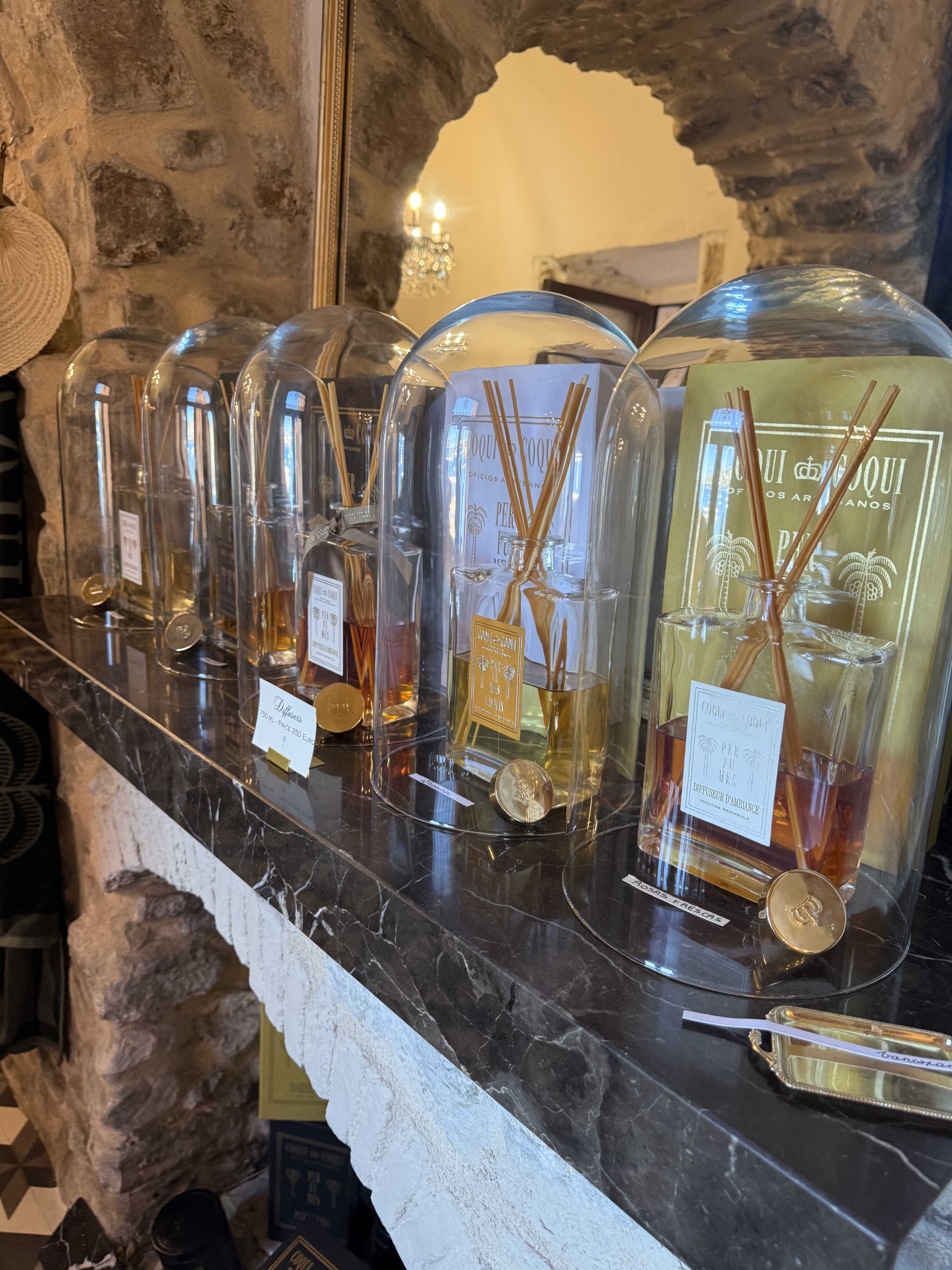
I found Coqui Coqui last year by accident, which is still the ideal way to discover a perfume shop. I was wandering through Menton with no plan beyond enjoying the town, the light, and whatever small pleasure appeared next. Menton has a way of making even an ordinary walk feel composed: citrus-colored buildings, narrow streets, pale shutters, sea air moving between stone walls. Somewhere in that rambling, I came across the Coqui Coqui boutique and walked in.

The store had that rare quality of feeling designed to transport you. Everything seemed to belong together: the bottles, the oils, the objects, the soft visual language of the room. Coqui Coqui knows how to make decor and retail feel naturally united, as if perfume is only one part of a larger sensory world. That first visit, I was guided through the collection by a very knowledgeable salesperson and smelled everything slowly. I bought Ficonero partly because I loved the scent, but also because it was exclusive to the boutique. I like bringing perfumes home from my travels, and when a beautiful store tells me something is only available there, I am exactly the customer who will fall for it.
Returning to Menton
This year, I knew I would return. Before my visit, I contacted Coqui Coqui’s headquarters to let them know I would be in Menton and asked whether I could film a short segment for Elevated Classics. They gave me permission, so I arrived genuinely excited, with my husband and friends from Istanbul with me. I wanted them to see the store because it had stayed in my mind from the year before, and because Coqui Coqui is the kind of place that is easier to understand once you step inside it.

The brand was founded by Nicolas Malleville and Francesca Bonato, whose work has always moved through place before product. Malleville came to perfume through a more unconventional path than the traditional French laboratory route. His path passed through modeling, landscape architecture, botanical study, and eventually the creation of Coqui Coqui in the Yucatán, where a residence became a hotel, a boutique, a spa, and then a scented universe. That origin explains a lot about the brand. Coqui Coqui feels like a place that began making fragrance because the rooms, gardens, oils, towels, and rituals needed their own scent.
When the Store Experience Changes
The Menton boutique still looked beautiful when we arrived, but the experience this time was more complicated. The store setup had changed since my last visit. There were notes placed around the space asking customers not to touch and to wait for assistance. I understand the practical need for that, especially in a small boutique with delicate objects and limited staff. Still, perfume needs freedom. It needs the customer to lift, test, pause, return, and compare. A scent becomes personal through movement. When that movement is restricted, the romance gets interrupted.
The saleswoman was helping other customers when we entered. She motioned for us to come in, which I appreciated, but the rhythm of the visit never quite relaxed. Many of the fragrances were presented through aroma jars on the large table at the back. I picked them up to smell, then later tested the perfumes on skin. The store was still attractive, but the feeling of discovery had become more cautious. It is difficult to sell escape while surrounding the customer with instructions.
Pamsavai: Grapefruit, Salt Air, and Warm Sandalwood
My husband chose Pamsavai from the Îles de la Société collection. On paper, it is a floral citrus built around grapefruit, sandalwood, and vanilla. Mandarin and Pacific salt shape the opening, calamansi flower, jasmine, and magnolia form the heart, and Polynesian sandalwood gives the base its warmth. At €145 for 100 ml, it sits in that interesting space where the perfume has to do real work, but the purchase still feels accessible.

Pamsavai is very good on skin. Grapefruit opens bright and clean, with mandarin giving it a softer glow. The salt accord gives the citrus air, as if the fruit has been cut near the sea. As the fragrance warms, sandalwood comes forward and gives it a smooth, sunlit base. Vanilla adds softness, while jasmine and magnolia give the composition a warm island body.
I often notice the difference between self-taught perfumery and the work of someone with deep formal training. A perfumer like Antoine Lie can make a composition move with architectural intelligence. There is tension, timing, shadow, and surprise. Coqui Coqui works differently. Its perfumes tend to begin with a place or an image, then build the scent around that impression.

Ficonero, the perfume I bought last year, still feels like one of the brand’s most successful ideas. It belongs to the Riviera dei Fiori collection and centers on fig and neroli. The opening has that green, milky snap of fig leaf, softened by bergamot and petitgrain. Then the fig fruit comes through, joined by neroli and white flowers. The drydown brings cedarwood, musk, and a light amber warmth. It smells like a fig tree growing close to old stone, with sunlight on the leaves and clean air moving through the branches. It is simple and compelling.
Fleurs des Îles: The Beauty of Scented Oil
The real discovery of this visit was the body oil. As we were leaving, the saleswoman suggested I look at the perfumed oils. I am glad she did. She later gifted me a small sample bottle, which was a kind gesture and softened the ending of what had been a slightly uneven visit.
Fleurs des Îles is a perfumed oil from the Îles de la Société collection, built around a Polynesian floral idea. Tropical fruits, pitahaya, and mandarin give it a bright opening. Tiaré flower, ylang ylang, and wild jasmine bring the heat of island flowers, while patchouli, vanilla, benzoin, and cinnamon give the oil its warmth. The base is coconut oil, and the texture is thick, emollient, and deeply pleasurable.

The scent sits closer than a spray perfume, but the pleasure is more physical. It becomes part of the skin. I kept imagining how beautiful it would be layered under the eau de parfum, with grapefruit and salt over warm tiaré, sandalwood over coconut oil, vanilla over benzoin. It made me understand scented oils in a way I had not before.
All Said and Done
Pamsavai was better than I expected. Ficonero remains beautiful. Fleurs des Îles may be the item that best expresses the brand’s deeper intelligence, because it turns fragrance into touch, skin, and ritual. Coqui Coqui understands pleasure. It understands why people travel, why they remember a hotel by the scent of the soap, why a boutique discovered by accident can stay in the mind for years.
Coqui Coqui has built a seductive world around scent, but the retail experience needs to protect that seduction. The products are strongest when they feel effortless, sun-warmed, and intimate. The store should feel the same way.




Leave a Reply