
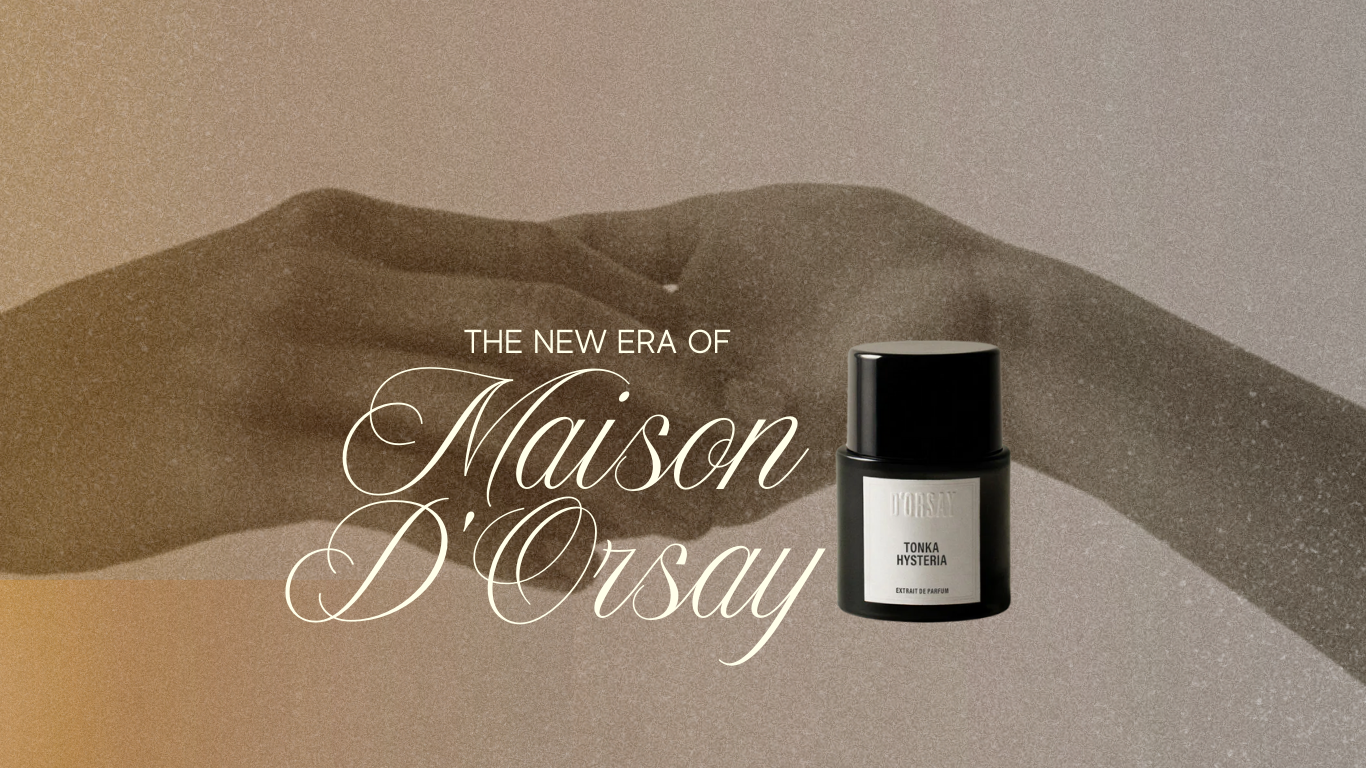
D’Orsay is a rare example. Its story starts in the 1830s with Alfred d’Orsay, a French painter and well-known figure in Paris and London society. He created a personal fragrance for Marguerite Blessington, the woman he loved. It wasn’t a commercial project or a public gesture. It was simply something he made for the two of them. That private creation left an echo strong enough to survive long after his lifetime.
The house itself came later. In 1865, thirteen years after Alfred’s death, Parfums d’Orsay was founded as French perfumery was beginning to speak to the world. The company was reorganized in 1908, and by 1916 Jeanne-Louise Guérin and Théophile Bader of Galeries Lafayette had taken ownership. Bader, who would later help launch Chanel’s perfume company, brought the kind of retail vision that propelled D’Orsay into its most ambitious era. The brand expanded across Europe and the United States, opened on rue de la Paix, and worked with Baccarat, Lalique, and the master glassmakers of the Bresle Valley on bottles that remain coveted by collectors today.

Jacques Guérin, Jeanne-Louise’s son, led the house for more than fifty years. He guided it through the Depression, through the war, and into the modern age. By the 1980s, however, the fragrance landscape had changed, and D’Orsay began to quiet. It never vanished, but its presence grew faint.
A series of owners followed, including Groupe Marignan. In 2007, Marie Huet initiated a revival, reintroducing parts of the house’s identity and returning its shared, unisex sensibility to public memory. Awareness rose, yet the brand still felt suspended between its nineteenth-century origins and a contemporary market.

That changed in 2015. Amélie Huynh, a French entrepreneur with a background in high jewelry, wasn’t looking to build a perfume house from scratch. She wanted one with depth, archives, and emotional gravity. D’Orsay offered all of it. Under her direction, the house has been restored with clarity and restraint. She preserved the mythology, removed the dust, and rebuilt the world around a single idea: the many states of love. Today the house includes fragrances, extraits, and home scents, each signed with initials that nod quietly to Alfred and Marguerite.
Below is our full conversation with the woman shaping D’Orsay’s new chapter.
The Interview
The Discovery
HA: D’Orsay’s story stretches back nearly two centuries, yet the house fell silent for years. What made you want to revive it, and what felt relevant for today?
AH: When I decided to bring a perfume house into our family group, I wanted a legacy brand with a real foundation. I had already created Maison STATEMENT from scratch, and that satisfied my desire to build. For perfume, I wanted something deeply French. My father worked in fragrance, so it was a world I knew, but I wanted archives, a founder with charisma, a sense of cultural history. In 2015, D’Orsay happened to be seeking new ownership. It was exactly what I had been searching for. A past that deserved a future.
The Creative Lineage
HA: Alfred d’Orsay was not a perfumer, yet he created perfumes. You now guide the house through collaboration. Who becomes the true author when several creative voices are involved?
AH: Many founders are not perfumers. Alfred d’Orsay was an artist who loved fragrance. I work with exceptional partners at Givaudan, IFF, and elsewhere. The creative process is never about ownership. Each perfume is a love story, and I always begin with a brief inspired by what moves me at that moment. Then I choose the perfumer who can interpret it with the right sensitivity. Once they join the process, they become part of the D’Orsay story. It is collective work. It is a village.
Defining the House’s Voice
HA: You collaborate with several celebrated perfumers. How do you maintain a unified D’Orsay identity across such diverse talents?

AH: It is a strength. Every brief begins with key notes that anchor the fragrance. From there, I seek a perfumer who enjoys working with those materials. When I wanted an extrait centered on white flowers, I turned to Dominique Ropion. No one understands white florals the way he does. Other fragrances call for younger voices or independent perfumers. This diversity allows our creations to speak to different personalities while remaining true to D’Orsay.
Defining “Niche”
HA: D’Orsay was once a global name. Today it is often described as niche. Do you see it that way?
AH: The word has changed significantly. For me, niche means independence, quality, and artistic freedom. All of that defines D’Orsay. We are not part of a group. I lead the creative direction myself. We are serious about growth, but we do not want to be everywhere. Rarity matters. We grow with intention.
Production and Transparency
HA: The historic D’Orsay once had its own manufacture. The modern house works through specialized partners. How do you protect transparency and craftsmanship in that model?

AH: Having our own manufacture would be wonderful, but that time has passed. What matters is that everything we produce upholds the standards that honor our origins. We select partners with great care. Our glass bottles are made in Normandy and reinterpret an archival design. Our filling partner holds an Ecovadis Silver Sustainability Medal. Our candles are produced by La Ciergerie des Prémontrés, whose roots go back more than a century. We meet all of our artisans personally. Staying true to the brand’s story is non-negotiable.
Raw Materials
HA: The early D’Orsay formulas relied heavily on naturals. How involved are you in sourcing today?

AH: We work closely with Givaudan and IFF LMR Naturals. They ensure that every raw material is harvested responsibly and never beyond natural capacity. For Flower Lust by Dominique Ropion, the composition is made entirely of LMR naturals, including Ylang-Ylang from Madagascar sourced through long-term partnerships. For Tonka Hysteria by Jordi Fernandez, many ingredients come from Givaudan’s Orpur® collection. These materials are precious, and their integrity is essential to our storytelling.
The Modern Market
HA: You relaunched the house in a very competitive moment for perfumery. What does growth look like for D’Orsay?

AH: We reopened in 2019 with a single Paris boutique. We now have a second in Tokyo and presence in nearly three hundred stores around the world. We are proud of that. The market is crowded, and new brands appear constantly, yet our priority is thoughtful expansion. We do not want ubiquity. We want longevity.
Growth and Global Strategy
HA: Different regions have distinct olfactory preferences. How do you navigate diverse audiences while preserving identity?
AH: It is true that tastes vary. Our Extraits may not match what many Asian consumers prefer, but they remain essential to our world. At the same time, we create lighter scents so that anyone can find a D’Orsay that feels right for them. Balance is important. I brief perfumers with the global picture in mind, but naturally my own sensibility appears in the work.
The Legacy
HA: Alfred d’Orsay lived for beauty, conversation, and love. If he walked into your atelier today, what would you want him to recognize?
AH: I have had many imaginary conversations with him. In the beginning, we argued a lot. The brand had become too nostalgic, too focused on the image of the dandy in a top hat. We had to rebuild almost entirely. The story remained, but we needed a contemporary expression of that story. Would he approve? I hope so. His name continues, his spirit continues. Our artistic tastes might differ, but I think we would enjoy the dialogue.
Elevated Classics Classification
Primary Category: Revived Heritage House
Secondary Tags: Creative Director-Led, Outsourced Production
Founded: 1830s, revived 2015
Creative Direction: Amélie Huynh






Leave a Reply