
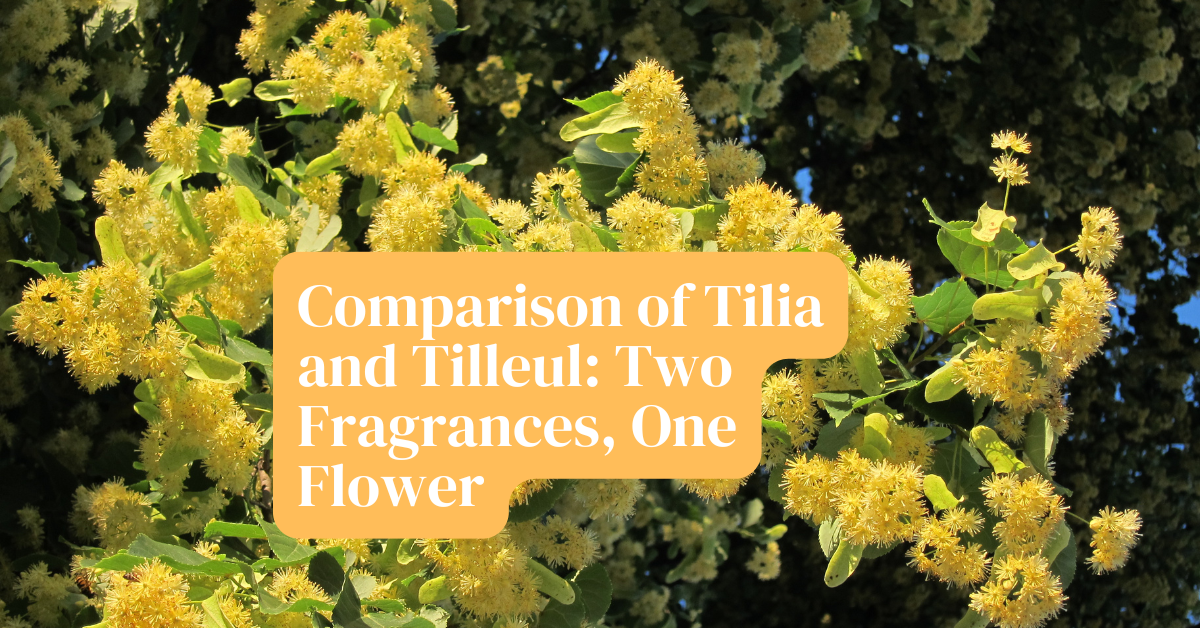
Two perfumes, one flower, and one perfumer. This year I found myself holding both Tilia by Marc-Antoine Barrois and Tilleul by Le Galion. Each is built around linden blossom, and both are signed by Quentin Bisch. Yet what they express could not be more different: one shines outward, luminous and architectural; the other folds inward, tender and nostalgic.
Linden, or lime blossom, is rarely attempted in perfumery. Its scent is honeyed, slightly green, with a soft powder that feels both floral and herbal, like a tree in full bloom on a summer evening, humming with bees. Capturing that duality in perfume is no easy task, which makes this pairing especially interesting.
Marc-Antoine Barrois Tilia
Marc-Antoine Barrois is a designer who built his reputation in tailoring, and it was only with perfume that his name entered the global stage. The turning point was Ganymede, created with Quentin Bisch, which transformed Barrois into a fixture of the modern niche scene.

Tilia, launched in 2024, continues that collaboration. It begins with the honeyed hum of linden blossom but quickly gathers breadth: broom adds apricot-like tones, jasmine sambac deepens the floral core, heliotrope dusts it with powder, while ambrox and Georgywood give a clean, modern lift. The result is radiant and expansive, a perfume that feels designed to fill space without ever becoming heavy.
How it wears: Tilia projects clearly in the first hours and has a graceful longevity that carries through the day. It suits spring and summer best, worn when you want presence with polish. The bottle, heavy and minimal, mirrors the fragrance’s contemporary poise.
Le Galion Tilleul
Le Galion tells a different story. Founded in 1930 by Paul Vacher, the house became known for elegant French perfumes like Sortilège before slipping into dormancy. Revived in the 2010s, it now works with external partners for production but remains devoted to classical French style.

Tilleul is among the most charming results of this revival. It keeps linden at the center, wrapped in honeyed warmth, softened by musk, and gently anchored with ambrox. There is no excess, no attempt to dazzle. Instead, it smells like standing beneath a linden tree in bloom, the air thick with nectar, sunlight filtering through leaves.
How it wears: Tilleul stays closer to the skin. It projects modestly for the first couple of hours before settling into a soft halo. The mood is contemplative, best suited to evenings or quiet settings where intimacy matters more than trail. Its tall, faceted bottle carries the charm of French heritage design, elegant without show.
Two Interpretations, One Hand
Owning both makes the parallels impossible to miss. You can feel Quentin Bisch’s touch in each, yet the context changes the outcome. Barrois’s Tilia is luminous and structured, a modern niche statement. Le Galion’s Tilleul is gentle and honeyed, a heritage revival that privileges elegance over spectacle.

Both are lovely, and both honor a flower that rarely finds its way into bottles. One carries me into daylight, polished and present. The other draws me into shade, quiet and nostalgic. Together they remind me why linden is so captivating in the first place, it holds summer’s light and shadow in equal measure.




Leave a Reply