
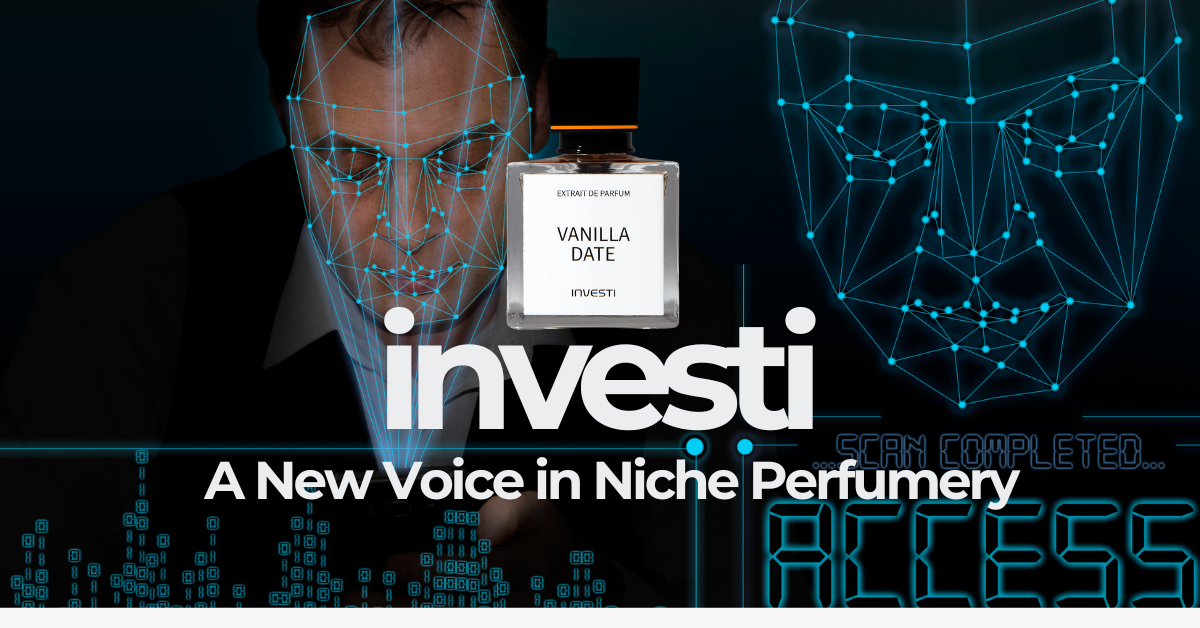
I first became aware of Investi Parfums in one of those very modern ways perfume stories now begin: through a social media post.
I had shared an Instagram post about Turkish-owned perfume brands, a subject that matters to me personally and editorially, because Turkish fragrance culture is far richer than the global niche conversation usually allows. That is when Ahmet Sahin, the Turkish founder of Investi Parfums, reached out. He lives in the Netherlands, is building a perfume house from Amsterdam, and approaches scent from a place I do not often encounter in founder-led perfumery: emotional profiling, facial microexpressions, and the psychology of response.

A few weeks later, while I was attending Paris Perfume Week, his discovery set arrived at my hotel.
There is something quietly memorable about receiving perfume in Paris. The city changes the way you smell. You walk through hotel lobbies, pharmacies, restaurants, old churches, boutiques, wet stone, leather handbags warmed by taxis, perfume on silk scarves, lipstick in elevator mirrors. Perfume feels less like an accessory there and more like part of the city’s soul. So I opened the Investi discovery set in the middle of that atmosphere, curious to see what a self-taught founder in the Netherlands, working with a French materials atelier, was trying to say.
The answer is not simple, and that is what makes the brand interesting.

Investi Parfums is not built around the usual founder mythology. Sahin does not present himself as the heir to a forgotten château or the keeper of a centuries-old perfume dynasty. His story is more contemporary and more unusual. Before building Investi, he worked as a criminal investigator and CQB instructor, and continues to work with professionals in security and law enforcement on facial emotion recognition and behavioral profiling. That background trained his eye on the small involuntary shifts in the face that can reveal feeling before language has time to arrange itself.
That background has become the conceptual spine of the brand. Sahin is interested in the moment before someone says, “I like this.” The flicker before opinion. The face before vocabulary. The body’s private response to scent.
His central question is deceptively simple:
What does emotion smell like?
For Sahin, perfume is less a traditional pyramid than an emotional sequence. He speaks about how a scent can move from joy to relief, from surprise to affection, from excitement to calm. During development, he observes real-time reactions and facial microexpressions rather than relying only on verbal feedback after the fact.
It is an intriguing idea, especially in a perfume market overflowing with vague language about emotion. Every brand now wants to tell us that scent is memory, identity, seduction, healing, self-expression. Investi’s distinction is that Sahin is trying to make emotion less decorative and more methodical. Whether that method produces truly memorable perfume is the more important question.
The French Materials Connection
The most important part of the Investi story, for me, is the material foundation.
Sahin originally developed his own formulas and even built a small lab to produce early versions of his perfumes. He later changed direction after discovering Rémi Pulverail and visiting L’Atelier Français des Matières in France. He says the quality of the materials was on “a different level” from anything he had experienced before, and that decision moved the brand away from his own production setup toward work with the atelier.
That choice gives Investi its real credibility.
L’Atelier Français des Matières has become increasingly relevant in the independent perfume conversation because it represents something rare: access to serious raw materials, technical knowledge, and a more intimate understanding of extraction. For a young founder-led brand, this is not a small detail. It is the difference between perfume as concept and perfume as substance.
Investi works with what the brand calls Grand Cru natural ingredients, selected through terroir, plant preparation, and extraction method. The vanilla example is especially revealing: late-harvest pods picked in September and left to ripen on the vine for nearly two extra months, creating a darker, rounder, more textured vanilla profile.

The brand also uses alcoolats, a labor-intensive technique associated with preserving delicate aromatic facets that can be lost through heat. In the Investi palette, this includes tonka, orange blossom, jasmine, tuberose, osmanthus, and rose alcoolat.
You can smell that the materials are crucial. The perfumes have weight on skin, strong diffusion, and real persistence. They do not give the impression of thin formulas inflated by marketing.
My critique is less about quality than identity. Investi lives in a stronger register. These are not quiet, barely-there compositions. They have density, projection, and a commanding temperament, which explains why early fragrance followers often describe the brand as experimental, hyper-niche, and highly performant. They will likely speak more directly to wearers who love power, texture, and a pronounced scent trail.
For me, the collection feels like the early chapter of a house still forming its olfactive handwriting. Sahin has a compelling concept, access to excellent materials through L’Atelier Français des Matières, and a clear fascination with emotional response. What I do not yet consistently smell is the unmistakable odor signature that makes a perfume house immediately recognizable. That takes time. Investi is a young house. The perfumes are polished and often impressive, but the brand’s deeper signature is still coming into focus.
The work has quality. The next step is identity.
In Conversation With Ahmet Sahin
Because Investi is so closely tied to Sahin’s way of thinking, I wanted his answers to stand in his own words. What follows is our written conversation about emotion, microexpressions, material quality, and the making of a young perfume house.

Your work begins with facial expressions and emotional response. What does that mean in practice?
It means that I focus on subtle, often involuntary facial expressions that reveal what someone is actually feeling beneath what they say. In practice, I use that to read reactions more accurately and respond better in conversations, or high-pressure situations.
My foundation comes from studying researchers like Paul Ekman and Carl Herman Hjortsjö, combined with training alongside psychologists specialized in this field. I’m still actively working with professionals in security and law enforcement, focusing on facial emotion recognition and behavioral profiling.
How did that world lead you into perfume?
My interest in scent started early, but perfumery became part of my professional life about 16 years ago when I opened a perfume boutique. After two years, I had to close it due to health reasons.
After that, I moved into work as a criminal investigator and CQB instructor. That world taught me a lot about observation, pressure, and human behavior, skills I still rely on today. In a way I’ve carried that same mindset into perfumery, just applied differently.
How did you learn to make perfume?
For me, the most important part wasn’t just learning materials, it was understanding how to evoke specific emotions through them.
I initially approached several established perfumery schools to understand their structure, but it didn’t fully match what I was looking for. So I built my own path, by following online courses, independent study, and a lot of hands on experimentation with raw materials.
So I’d describe myself as partly trained, but largely self taught. It took time, but it allowed me to focus very specifically on the connection between scent and emotion.
What made you believe this could become a perfume house?
The turning point came from observing how people talk about their favorite perfumes. They rarely describe just the notes, they describe how those scents make them feel, or the memories attached to them.
That made me question whether it’s possible to create fragrances starting from emotion itself, rather than raw materials alone. Once I started exploring that idea seriously, it became clear to me that it could become something meaningful.
Why build your own formulas instead of outsourcing everything from the beginning?
It is expensive and complex, no question. But for me, it was important to fully understand and control what I was creating.
Instead of outsourcing everything, I developed my own formulas and even built a small lab to experiment and produce early versions. That process gave me a much deeper understanding of composition and balance.
Interestingly, the first full batch I created was never bottled, but it was a crucial step in refining the direction.
Why did you choose to work with L’Atelier Français des Matières?
I came across an interview with Rémi, and what stood out immediately was his depth of knowledge and genuine passion for raw materials.
I reached out, and within two weeks I was in France, smelling their materials and asking a lot of questions. The quality was on a different level from anything I had experienced before.

At that point, I made the decision to move away from my own production setup and work with L’Atelier Français des Matières. It wasn’t an easy decision, but it allowed me to take the work to a much higher level.
How does your creative process work?
Everything starts with an emotion or a sequence of emotions I want to capture.
From there, I build on working with volunteers in structured smelling sessions, observing how people react to different materials and combinations. That process took some years to really understand emotion and scent at a deeper level.
On the technical side, I refine everything myself through emotional observation. I adjust the formulas based on real-time reactions, facial micro expressions in particular, rather than relying only on what people report afterwards.
That is probably the biggest difference with traditional perfumery. Most evaluation happens after the fact, based on verbal feedback. People often can’t articulate their own real time emotions or are not aware of their emotional state in the moment. I work in real time, observing subtle involuntary responses as guidance, which allows me to shape the emotional flow of a fragrance much more precisely.
What do you mean by emotional sequences?
What I noticed is that the most memorable perfumes tend to evoke strong, clear emotional responses, and that’s not a coincidence.
With my collection, I wanted to go a step further and create what I call emotional sequences. Instead of focusing purely on top, heart, and base notes, I focus on how emotions evolve over time when wearing the fragrance. The idea is that emotions should flow naturally, building on each other rather than clashing.
Some notes can trigger subconscious responses that the wearer may not notice at first. Initially the fragrance might feel pleasant or joyful, but over time those subtle cues can create irritation or unease. By observing micro-expressions and understanding each individual’s baseline, I can detect these early signals before they manifest as frustration or discomfort. The goal is to design fragrances that guide emotions intentionally, creating a layered experience that resonates both consciously and subconsciously.
What makes my approach different is how I refine that balance. Where traditional perfumery often relies on evaluation after the fragrance is worn and described, I work in real time, observing the subtle involuntary reactions as the scent develops.
That allows me to adjust compositions so the emotional transitions feel seamless, rather than conflicting.
I’ve taken inspiration from the Jean Carles method, but I apply it through an emotional lens, adjusting materials not just for how they smell, but for how they are felt moment by moment.
How do you see the current perfume industry?
I still think the industry is beautiful, but there’s definitely a lot of noise. The brands that will endure are those with a clear vision, transparency, authenticity, and respect for material integrity. You can’t really fake how a fragrance makes someone feel, people respond instinctively. The more we study and understand emotions, the stronger and more meaningful the future of perfumery will be.
What is your ambition for Investi?
My main ambition is to keep exploring and refining the connection between scent and emotion, and to share that in a meaningful way. I want to create fragrances that offer a more personal, emotionally engaging experience than people might typically expect. Over time, I also hope to help consumers and retailers better understand this side of perfumery, making the emotional dimension of fragrance more accessible and appreciated.
The Discovery Set
The Investi discovery set is not shy. These perfumes are built with high concentrations and a clear appetite for performance. Find Me is listed at 40% perfume concentrate, Sinan at 31%, The Architect at 30%, Vanilla Date at 27%, and priority:orange at 20%.

That explains why people respond to the brand with words like powerful, experimental, hyper-niche, and long-lasting. The collection favors presence.
For me, the set shows a founder with strong instincts, strong materials, and a concept that deserves attention. There are perfumes here that are very wearable, others that are ambitious, and a few that feel more familiar.
Find Me
Notes:
Top: Blackcurrant, raspberry, brown sugar
Heart: Cinnamon, jasmine, amber
Base: Oakmoss, rum, vanilla, patchouli
Key Ingredients: Patchouli Aceh Indonesia 21%, tolu 5.5%, fir balsam absolute 4.2%
Perfume Concentrate: 40%

Find Me is the most forceful perfume in the set, and it behaves that way from the first spray. It opens in a dark fruit register, with blackcurrant and raspberry thickened by brown sugar, then turns toward cinnamon, rum, vanilla, and a serious dose of patchouli.
This is not a transparent fruity perfume. It has a lacquered quality, almost like dark berries reduced over heat and poured over resinous woods. The patchouli gives it a deep, earthy pressure, while the rum and vanilla pull it into a warmer, more sensual space.
Sinan
Notes:
Top: Gingergrass, mandarin, bergamot
Heart: Patchouli, jasmine, amber
Base: Cedarwood, sandalwood, benzoin Laos, musk
Key Ingredients: Mandarin 4.23%, gingergrass 0.40%, Patchouli Aceh Indonesia 6.56%, benzoin Laos 5.71%
Perfume Concentrate: 31%

Sinan is where the collection feels most balanced to me. It opens with mandarin, bergamot, and gingergrass, giving the perfume brightness without making it feel generic. The citrus is clean and lively, but the structure underneath is warmer and more composed: patchouli, jasmine, amber, sandalwood, cedarwood, benzoin, and musk.
The emotional language around Sinan is peace, relief, calmness, serenity, and contentment, and I understand why. It has an ease that some of the heavier perfumes in the set do not have. The benzoin gives it a polished warmth, while the woods keep it from becoming too sweet.
This is one of the best entry points into Investi. It feels wearable, grounded, and quietly expensive.
Vanilla Date
Notes:
Top: Tonka alcoolat, cherry, marzipan, dates, figs
Heart: Jasmine, lily of the valley, tolu, styrax
Base: Sandalwood, vanilla absolute, tonka absolute, amber, musk

Key Ingredients: Tonka alcoolat 6.5%, tonka absolute 1.5%, sandalwood 2.7%, vanilla absolute 2.9%
Perfume Concentrate: 27%
Vanilla Date is the crowd-pleaser of the set. It has the immediate pleasure of dried fruit, almonded sweetness, tonka, vanilla, and amber. The cherry and marzipan give it a confectionary opening, while the dates and figs add a darker, stickier fruit texture.
The interesting part is the material quality. The vanilla does not smell thin or screechy. The tonka has body. The sandalwood softens the base and keeps the sweetness from becoming completely edible.
The Architect
Notes:
Top: Spices, cinnamon, yellow mandarin, bergamot
Heart: Jasmine, rose, orris butter, violet
Base: Ambergris, sandalwood, vanilla, cedarwood, musk, patchouli
Key Ingredients: Spice blend 1.55%, orris butter Morocco 0.4%, Patchouli Aceh Indonesia 7.1%, natural ambergris tincture 15.5%
Perfume Concentrate: 30%

The Architect is the most ambitious composition in the set, and the one that most clearly tries to build a full emotional arc. It moves from citrus and spice into florals, orris, violet, ambergris, woods, musk, vanilla, and patchouli.
On paper, this is exactly the kind of perfume I want to lean into: textured, floral, warm, mineral, musky, slightly animalic. The orris and violet bring elegance. The ambergris tincture gives the base a more serious character. There is a sense of structure here, a perfume trying to stand upright rather than simply radiate.
priority:orange (soon to be released)
Notes:
Top: Bergamot, grapefruit, lemon
Heart: Neroli, orange blossom
Base: Musk
Key Ingredients: Bergamot 24%, neroli Morocco 6.7%, orange blossom alcoolat 6.4%
Perfume Concentrate: 20%
The unmarked bottle in my set turned out to be priority:orange, which Sahin later confirmed. It is the brightest and most direct perfume in the collection: bergamot, grapefruit, lemon, neroli, orange blossom, and musk.
It smells like a clean window opened in the morning. Citrus peel, white petals, sunlight, and skin. The orange blossom alcoolat gives it a more textured brightness than a standard orange blossom musk, and the bergamot percentage is unusually high, which explains the clarity of the opening.
This is not the most complex perfume in the set, but it may be the most immediately charming. It does exactly what it promises. It lifts. It refreshes. It gives the collection a moment of daylight.
Elevated Classics Classification
Primary Category: Emerging Independent Niche
Secondary Tags: Founder-Led, Emotion-Driven Concept, L’Atelier Français des Matières Partner, High Natural Material Focus, High-Concentration Perfumes
Composition and Production Note: Founded by Ahmet Sahin. The brand is developed through Sahin’s emotion-led evaluation process and work with L’Atelier Français des Matières.
Best Entry Points: Sinan, priority:orange
Most Ambitious Composition: The Architect
Most Commercially Appealing: Vanilla Date
Most High-Impact: Find Me







Leave a Reply