
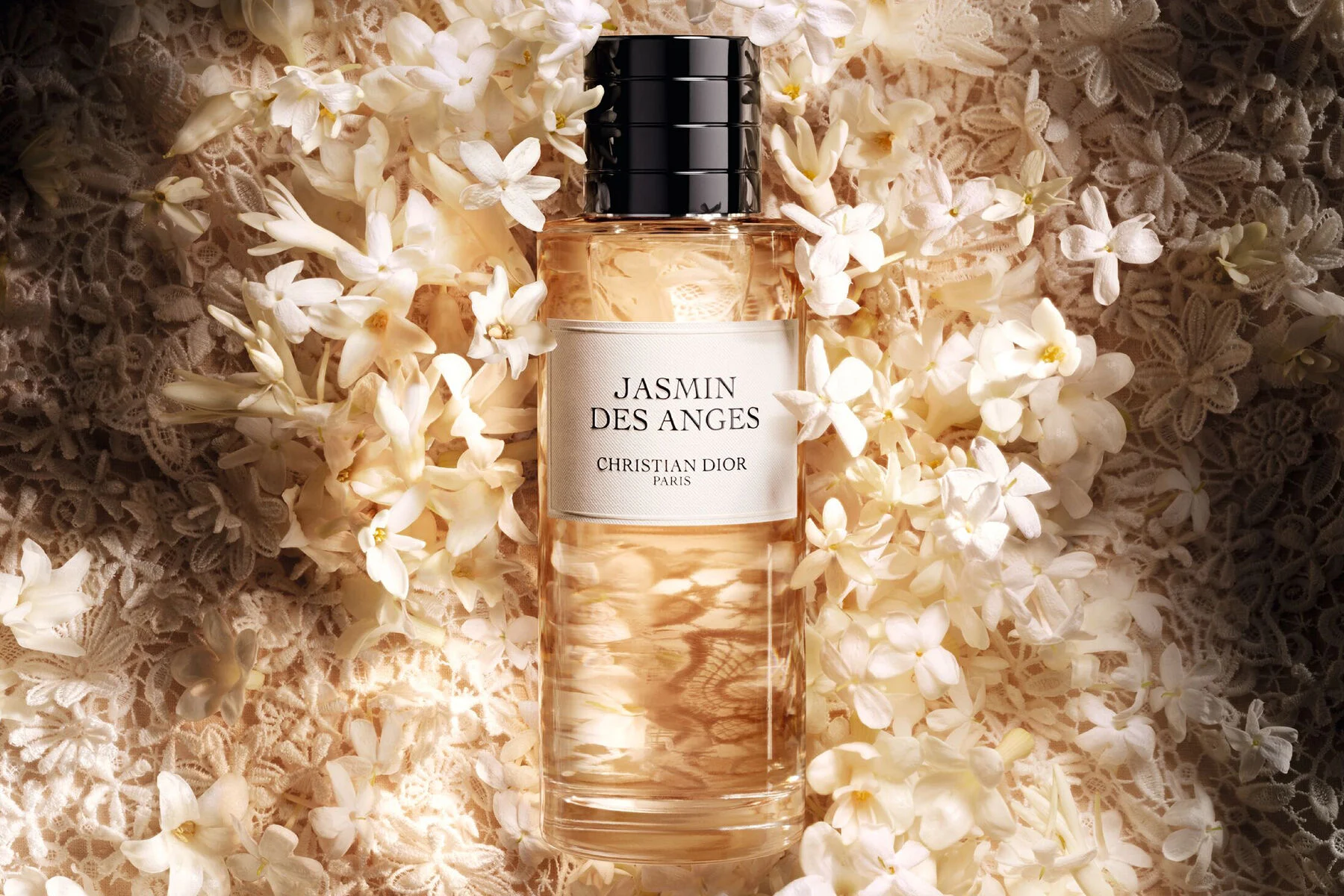
After iris, violet and tuberose, jasmine is probably my favorite flower in perfumery. It is also one of the least predictable. Jasmine can smell green and airy, creamy and voluptuous, honeyed, fruity or almost animalic. It can be polished, but it is never entirely well-behaved. Even at its most elegant, there is something warm and carnal beneath the petals.

Historically, jasmine sits at the center of some of the most important perfumes ever created. Chanel No. 5 made Grasse jasmine part of one of the most recognizable fragrances in the world. Jean Patou’s Joy, composed by Henri Alméras, transformed jasmine and rose into one of classical perfumery’s great displays of luxury.
In June, I spent a month in the South of France, where jasmine seemed to grow everywhere. It spilled over stone walls, climbed across doorways and hung above narrow cobbled streets. In the afternoon heat, the scent became richer and almost intoxicating, filling entire passageways before you could even see the flowers. I often thought that, if someone wanted to lead me through a town, all they would have to do was mark the route with jasmine. My nose would follow.

That month gave me a physical understanding of why jasmine is so often described as narcotic. In the heat, it moved beyond prettiness. It became ripe, musky and almost fleshy, yet never lost its luminosity. That contradiction is part of jasmine’s power. It can be refined and unruly, delicate enough to drift through a passageway and forceful enough to fill it completely.
Dior’s Jasmin des Anges reminded me how beautiful the flower can be when a perfumer resists the urge to turn it into something else.
The Sample
The sample arrived with the bottle of Diorella I bought for my birthday. Released in 1972, the year I was born, Diorella was a very deliberate purchase. I was completely focused on that perfume and treated the accompanying samples as pleasant extras. Then I sprayed Jasmin des Anges.
Lord have mercy.

It arrives in a rush of jasmine, generous, radiant and unmistakably feminine. There is nothing timid about it. The flower feels full-bodied and sensual, with enough projection to command attention, yet it never becomes dense or overbearing. Instead, it blooms around the skin in a warm, luminous cloud. A jasmine this confident and beautifully judged could only come from a perfumer with François Demachy’s command of flowers.
The Creator
Raised in Grasse, Demachy spent years at Chanel before becoming Dior’s Perfumer-Creator in 2006, a position he held until his retirement in 2021. In 2022, the Fragrance Foundation presented him with its Lifetime Achievement Perfumer Award. His experience is evident in the restraint of Jasmin des Anges. He understands how much support the flower needs and, just as importantly, when to leave it alone.

Dior describes the fragrance as a composition of jasmine, apricot and honey, inspired by jasmine harvested in Grasse at the end of summer, when the flower develops a riper, almost fruity character.
The Structure
The opening has a soft citrus brightness, but the jasmine appears almost immediately. It is expansive without the piercing sharpness that can make some white florals difficult for me.
Apricot gives the composition its distinctive character. Rather than smelling like a separate fruit note placed beside the jasmine, it draws out the flower’s naturally ripe and nectarous qualities. On my skin, the apricot takes on a peachy, almost osmanthus-like softness, giving the perfume a velvety, golden texture. The fruit feels warmed by the sun rather than crisp or freshly cut.

The honey is equally restrained. I experience it more as texture than as a clearly defined note, adding a gentle syrupiness without overwhelming the flower. It is as though the jasmine petals have been steeped in their own nectar.
As the perfume settles, a soft musky warmth with a faint vanillic quality smooths the edges. The base never becomes loud enough to obscure the jasmine. There is no wall of synthetic wood and no forceful amber arriving halfway through to flatten the composition. The flower remains clear and recognizable from the opening through the drydown.
Comparison
I already own several perfumes in which jasmine plays an important role, but each one gives it a different character. Amouage Portrayal Woman surrounds jasmine with tobacco, elemi and vanilla, making it darker, smokier and more imposing. Serge Lutens La Religieuse takes the flower somewhere cooler and stranger, pairing its white petals with musk and civet. Profumum Roma Sabbia Bianca gives jasmine a lush, tropical setting of coconut, tiaré, tuberose, ylang-ylang and vanilla.

All of them give jasmine a character to play. Jasmin des Anges simply allows it to be beautiful.
It is comparatively uncomplicated, but never basic. There is an important distinction between a perfume that feels simple because very little has been done and one that feels simple because everything has been done correctly. Jasmin des Anges belongs to the second category.
The apricot, honey and soft base warm and round the jasmine without competing with it. Everything is in proportion. The perfume is lush, feminine and openly sensual, but it never loses sight of the flower. It is a textbook example of a jasmine perfume done properly.
Price + Market
Jasmin des Anges sits within Dior’s La Collection Privée, where the 3.4-ounce bottle is currently priced at $350. That is hardly inexpensive, but many widely distributed neo-niche brands now charge considerably more. Mind Games asks $395 for 100 milliliters, while Parfums de Marly’s Valaya Exclusif reaches $430 for 75 milliliters. Against that market, I have no problem paying $350 for a perfume this beautifully composed, especially one I cannot stop wearing.
I bought Diorella because we share a birth year. I never expected the sample tucked beside it to become the perfume I wanted most. But Jasmin des Anges captures everything I love about jasmine and lets me smell the flower in full.
Now I have a full-bottle problem.







Leave a Reply