
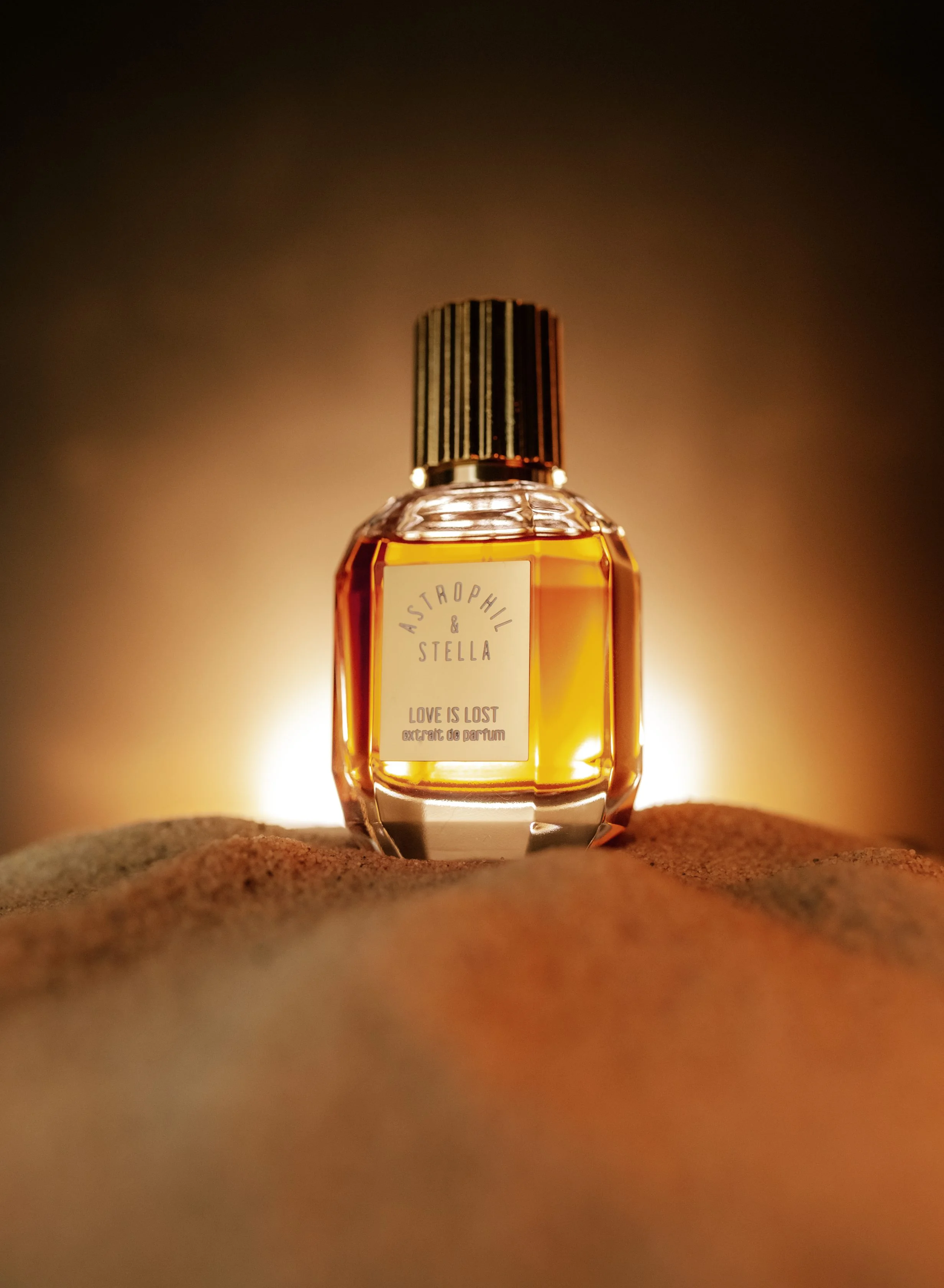
I first came across Astrophil & Stella at the Whiff Shop in Easton. I bought Shanghai 1930 and immediately became curious about the rest of the collection. The house works with major perfumers, including Nathalie Feisthauer, Bertrand Duchaufour, Luca Maffei and Chris Maurice, yet the company itself remains strangely difficult to understand. Who owns it? Who is making the larger creative decisions? Why does so much of the collection constantly appear on the gray market?

Naturally, after finding a particularly good deal, I bought a considerable portion of the portfolio. Let’s start with the losses. Love Is Lost was mistake number one.
Launched in 2020 and composed by Chris Maurice, Love Is Lost is an extrait de parfum built around bergamot, neroli, Bulgarian rose, jasmine sambac, geranium, vanilla, amber and oakmoss. On paper, it sounds like something I should enjoy: a classical floral structure with citrus, rose, jasmine, moss and a warm vanilla base.

The opening is pleasant enough. Bergamot and neroli provide a brief flash of brightness, but they disappear quickly on my skin. The rose and jasmine are present, although neither develops with much clarity. Instead, the composition seems to move almost immediately into a dense amber-vanilla base that sits over everything else.
Love Is Lost feels thick, sweet and strangely difficult to separate into individual notes. The florals are there, but they seem compressed beneath the weight of the base. The amber has a persistent, slightly scratchy quality, while the vanilla adds creaminess without giving the fragrance much softness. Rather than unfolding, the perfume remains in one heavy, sweet register for most of the wear.
I cannot say with certainty whether Love Is Lost contains one of the modern high-impact amber materials that I often struggle with. An ingredient list cannot reveal the full formula, and materials such as benzyl benzoate, coumarin or benzyl cinnamate do not automatically explain how a perfume smells. Amber is also an accord rather than one specific ingredient, and it can be created through many combinations of natural and synthetic materials.
What I can say is that it wears like a heavily constructed modern amber on my skin. It has the density, sweetness and persistent diffusion that I associate with fragrances designed primarily for projection and longevity. The extrait concentration only emphasizes that feeling. It lasts exceptionally well, but longevity is not the same thing as development.

There is nothing poorly made about Love Is Lost. Chris Maurice clearly understands how to build a powerful, polished and commercially appealing fragrance. People who enjoy rich vanilla, amber and white florals may find it comforting and sensual. For me, the balance feels off. The base arrives too early, the flowers never have enough room, and the entire composition becomes tiring before it becomes interesting.
The name suggests a love that disappears only to return. In my case, the citrus disappeared, the flowers became lost, and the amber never left. A beautiful list of notes, an accomplished perfumer and impressive performance were not enough to make this one work for me.






Leave a Reply