

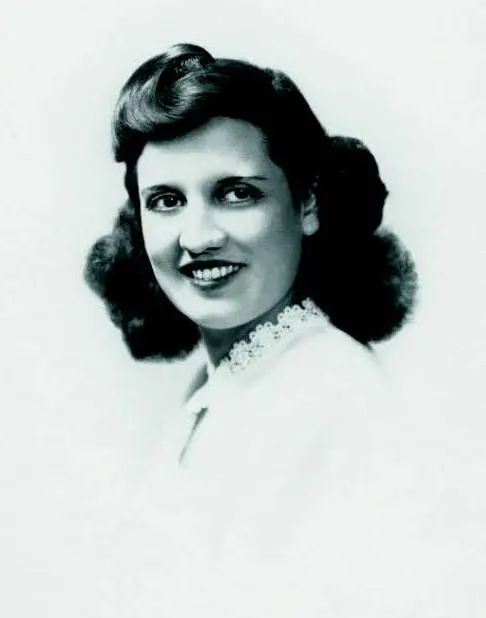
There is an old bottle of Diorissimo on Lynn King’s desk. It is empty now and probably dates from the 1970s, but she has kept it because it belonged to her grandmother, a Russian émigré who worked alongside Germaine Monteil and who, in Lynn’s childhood memory, was never anything other than beautifully put together and perfumed.

Lynn was the youngest and does not pretend to remember conversations about fragrance that never happened. What she remembers is the atmosphere around it. Her grandmother wore Diorissimo. The women on her mother’s side wore perfume every day. Nobody waited for an anniversary dinner or a sufficiently important dress before reaching for the bottle. Fragrance belonged to the business of getting ready, as ordinary and essential as lipstick. The empty bottle on Lynn’s desk has come to represent the beginning of her own perfume story because, even without the perfume, it still carries an entire philosophy of wearing it.
This is the idea behind Fleurit Parfums, the house Lynn began developing in 2022 and launched in 2024. She calls its original collection a Garde-Robe de Parfum, borrowing the language of fashion to describe a wardrobe in which fragrance changes according to mood, place, clothes and company. The concept makes particular sense coming from someone whose previous life was so thoroughly rooted in fashion. Before perfume, Lynn spent close to twenty years working at or for Bergdorf Goodman, Giorgio Armani, Ralph Lauren and Hermès, absorbing four very different ideas about what makes an object desirable and why some things retain their value long after the season that produced them has disappeared.

Lynn works principally with Maud Chabanis at PCW in Grasse, while Sainte Fumée was created by PCW perfumer Xavier Blaizot. She begins with an image, a place or a memory she wants translated and works with the perfumer until what comes back feels right to her. The technical and creative decisions that turn a grandfather’s pipe, a childhood florist or a holiday kitchen into perfume belong to the perfumer.
There is a romantic version of starting a perfume house in which the founder travels to Grasse, develops beautiful formulas with a perfumer, chooses a bottle and waits for the finished product to arrive. Lynn discovered the less photogenic version. A perfume may begin with memory and creative instinct, but eventually it becomes a complicated collection of physical objects that all have to arrive in the right place, at the right time, and actually work.

She deliberately chose PCW, a small, family-owned fragrance house in Grasse that works with independent brands, because she wanted to remain close to the development process. These were her memories being interpreted, and she wanted the kind of relationship in which she could stay involved as Maud Chabanis translated them into perfume.
Getting the fragrances right, however, turned out to be only part of the job. The finished oils come from Grasse, but once they reach the United States they still have to be blended, macerated and filtered before they can be bottled. Meanwhile, the bottle may be coming from one supplier, the cap from another and the packaging from somewhere else entirely. One missing component can hold up everything that came before it.

In Fleurit’s case, boxes and sleeves alone delayed the launch by almost a year. When they finally arrived, they were not quite what Lynn had expected, but by then she had spent long enough waiting and decided to move forward. Then came a problem with the caps. It was serious enough that she held back from retail and kept Fleurit direct-to-consumer while it was resolved. Lynn remembers checking every bottle herself before it left, sometimes going over the same one several times because she was unwilling to send something out without knowing the cap worked properly.
It is the sort of thing that disappears once a finished perfume is sitting beautifully lit on a boutique shelf. From the outside, the chronology looks reassuringly orderly: development began in 2022, Fleurit launched in 2024 and later expanded into wholesale, reaching close to thirty retail locations according to Lynn. Living through it was considerably messier. She says the creative side was actually the easy part. Building the company meant waiting on other people, dealing with problems she could not control and eventually accepting that nothing ever reaches a state of absolute readiness before it goes into the world.

The perfumes themselves reflect another conviction Lynn arrived with from the beginning. She does not want fragrance to enter a room before the person wearing it does. Fleurit favors intimacy over sheer projection, which is an increasingly distinct position in a perfume culture where strength and longevity are often treated as evidence of quality.
When we spoke, I wanted to know how much of the house could be traced back through the life that came before it.
Elevated Classics Interview with Lynn King
The Women Who Wore Perfume Every Day
Below is my conversation with Lynn King, founder and CCO of Fleurit. We spoke about the women who wore perfume every day, the memories that shaped her relationship with scent, and the long, unglamorous work of turning an idea into a perfume house. The conversation has been edited for length and clarity.

Your grandmother, a Russian émigré, worked alongside Germaine Monteil during an important period in New York beauty. What stories about that world were passed down to you, and what did she teach you about perfume, presentation and personal style?
Honestly, I don’t remember conversations with her. I was the youngest and just too young for that. What I remember is more of a feeling, an image really, this elegant woman who was always put together and always smelled like Diorissimo.
The women on my mom’s side all wore perfume like it was part of getting dressed, not something extra. You put on your fragrance the way you’d put on lipstick, every day, no occasion needed. I actually have one of her old bottles of Diorissimo, empty now, probably from the ’70s. It sits on my desk, and it sort of represents where my own perfume journey started. That’s really where the idea for Fleurit comes from, this belief that fragrance isn’t something you save for special occasions. It’s just part of the everyday wardrobe.
You describe Fleurit as the story of your life created through perfume. Which parts of your life are already represented in the collection, and which memories or chapters are still waiting to become fragrances?
Garde-Robe de Parfum is really about memory, the people and moments that shaped me. Coastal and City are a bit different, they’re about place.
Fleurs de Tabac actually comes from a real smell, my grandparents’ apartment in New York, where tobacco mixed with fragrance in the air. That combination is what I associate with being there, and it’s what I was trying to recreate. Gâteau des Anges is my mother baking for the holidays, that one’s basically a direct translation.
Coastal and City are their own chapters too. Coastal comes from places I’ve spent real time in, while City is New York-inspired. I was born and raised there and lived in New York until my early thirties. As for what’s still waiting, at my age I have a lot of chapters left to express, places I’ve lived, experiences I’ve had and the memories tied to them. My mind is always in motion.
I like to release one story at a time though, and for me a story is never told in a single fragrance, it takes a few. Sacré Coeur has been four years in the making and it still isn’t finished. I’m waiting for what is probably my eleventh round of trials. The top and the base are where I want them; it’s the heart we’re still trying to solve. Maud has four more trials coming with four different heart notes, so I’m excited to see where she takes it. The memory behind this one is so specific, which is what makes it difficult. But we’re not giving up.
An Education in Luxury
Before founding Fleurit, you spent nearly twenty years working at or for Bergdorf Goodman, Giorgio Armani, Ralph Lauren and Hermès. What did those houses teach you about the difference between something that is genuinely luxurious and something that is merely presented as luxury?
I started in New York in the late ’80s, and honestly, it was the undisputed best of times, for New York, for fashion and for being in your twenties.
Bergdorf Goodman gave me a front-row seat to the one percent. I saw what they actually bought, what they expected and how that customer set trends rather than followed them.
Giorgio Armani was the opposite of trend-chasing. It was about master tailoring, fit, simplicity, elegance that doesn’t age.
Hermès taught me quality and exclusivity, and how supply and demand themselves can be part of what makes something desirable.
Ralph Lauren, of all of them, was a marketing genius. He wasn’t chasing the Bergdorf customer, he was selling mainstream America the American Dream, a fantasy lifestyle that felt within reach.
I took a little from all of it. The story, the quality and never following trends.
The four companies could hardly have offered more different versions of luxury, which may be the more useful education. Lynn did not leave fashion with a formula to reproduce so much as an understanding that the strongest houses know exactly what world they belong to. Fleurit describes its own world as “undeniably French and unapologetically American.”
French Bones, American Voice
What does “undeniably French and unapologetically American” mean in olfactory terms? Where do you hear the French voice in the perfumes, and where does the American one enter?
The French side was intentional from the beginning. I wanted people to know immediately, even though it’s bottled here, this is authentic French perfume, made in Grasse. That’s part of why most of the names are in French, it’s meant to be that immediate connection, no explanation needed.

In actual practice, French craft and quality show up in the raw materials, the relationships French houses have built with suppliers over centuries. That’s not something you can copy, at least not yet.
The American part is my memories, as an American who’s traveled and who comes from immigrant grandparents. But it shows up in the perfumery itself too. I’ll sometimes ask my perfumer to take an ingredient that would normally sit in the background and make it the star instead.
That’s what happened with Fleurs de Déesse. Linden blossom was never meant to be a supporting note in that fragrance, it had to lead. French bones, American voice, that’s really the whole idea.
Giving Someone Else Your Memory
Perfume is a collaborative art. Who are the perfumers behind the Fleurit collection, and how does the authorship work between you and them? Can you recall a moment when a perfumer took one of your ideas somewhere unexpected and improved the final fragrance?
Maud Chabanis is my perfumer, and she’s a rare talent. I hand her a memory, and it comes back as an actual fragrance. It’s probably easier to create something from your own memory than someone else’s, it’s a different challenge entirely.
I give her the freedom to create from my brief, but ultimately it ends with me. It’s my memory, my story, and if it doesn’t resonate, we keep at it. I don’t approve it until it’s right, this isn’t just about putting something in a bottle.
Fleurs de Tabac is a good example of that trust. It was a last-minute addition to the Garde-Robe de Parfum lineup, and I needed something that would anchor the idea that these fragrances are for men and women both. When I briefed it, all I gave her was a memory, my grandfather smoking his pipe and that fresh, sweet tobacco smell. I didn’t specify ingredients.

Maud is the one who brought in sweet almond alongside a blonde tobacco, and it captured exactly what I remembered, and then some.
Gâteau des Anges is another. It’s more than just the memory of my mother baking, it also brings back visiting a pâtisserie in Paris with my daughter. Then, when the first trials came back, there was this Fruity Pebbles element in the dry-down that took me completely by surprise, a nostalgic twist I never expected, since Fruity Pebbles was and still is my favorite cereal.
It ended up giving the fragrance a whole extra layer I never briefed her for and, honestly, a better one than what I’d originally imagined.
The almond in Fleurs de Tabac and the unexpected cereal effect in Gâteau des Anges are good examples of why Lynn’s relationship with Maud is more interesting than a creative director simply handing over a list of notes. Lynn supplies the memory but leaves room for the perfumer to find something inside it that she did not know to ask for.
The Perfume Wardrobe
Your fashion background is central to the idea of the garde-robe de parfum, with fragrance functioning as the final layer of getting dressed. How do you decide what role each perfume should play within that wardrobe?
Some women won’t leave the house without lipstick on. For me, it’s perfume, it’s the final layer, the same way you’d reach for a blazer or grab your sunnies right before you walk out the door.
Fragrance should be an entire wardrobe, not a single signature scent, you want options. Deciding which one to wear comes down to mood, tied to where I’m going, what I’m wearing and who I feel like that day, or who I’m going to be with.
Sainte Fumée is a good example. It’s such a sexy fragrance, it has that effect people notice, like watching a hot guy or girl walk by in slow motion. I reach for it when I want my confidence boosted, it’s almost like tapping into an alter ego.
Lynn was actually closer to a signature-scent wearer for much of her life. The layering aspect of Fleurit developed when she began spraying trials together and noticed how naturally some of them worked in combination. She remembers Jo Malone doing something similar in the 1990s under the simpler term “combining.” Fleurit’s fragrances are intended to stand on their own, but a wearer who enjoys layering can treat the collection as a wardrobe in that sense too.
I am more interested in Lynn’s phrase “who I feel like that day.” We accept instinctively that clothes can accommodate several versions of the same woman. There is no reason perfume cannot do the same.
When Projection Becomes Someone Else’s Perfume
Fleurit places intimacy and softness above projection, describing fragrance as personal identity rather than public announcement. What led you toward that philosophy at a time when so much of perfume culture is focused on strength, longevity and filling a room?
Completely intentional. I’ve never been someone who wanted to fill a room, I want someone to lean in and catch it, not have it announce me before I walk in.
I remember being in an elevator once with a gentleman wearing a very loud oud fragrance. It filled the whole elevator, and I left smelling like it for hours afterward. If you’re not a fan of a fragrance, you shouldn’t have to smell like it just because someone else chose to wear it.
That’s the whole philosophy behind how I build these. Fragrance should be personal, something for you and the people close enough to notice, not something imposed on everyone around you.
It is a point worth making when projection and longevity are so often discussed as if they were synonymous with quality. They are useful things to know about a perfume, but eight hours is not inherently more beautiful than five, and filling a room tells us very little about whether what fills it is worth smelling.
A Floral for the Woman She Had in Mind
Fleurs de Déesse is identified as a bestseller among women over forty. What do you think that customer recognizes in its linden blossom, orange blossom, violet leaf and woods that younger fragrance marketing often overlooks?
I actually made this fragrance for myself. Linden blossom, orange blossom, violet leaf, woods, none of that is loud or trendy, and I know to a younger nose it might even read as “grandma.”
But fragrance is a bit like wine, your palate matures with you, what you loved at twenty isn’t always what moves you at forty or fifty. I think Gen X and older millennials tend to appreciate a floral more, where younger customers naturally gravitate toward gourmand, sweet, fruity notes.

Honestly, when I was building this one, I was just thinking of a woman who’s confident, who knows her worth and isn’t trying to prove anything to anyone.
Lynn is WSET certified, so the wine comparison comes naturally, but what I like about the answer is that she does not dance around the age of the customer. The perfume was made for herself, using materials she likes, with an adult woman in mind. There is no attempt to disguise that woman as younger in order to make the fragrance desirable.
A Flower Shop, Not a Bouquet
Is there one fragrance in the current collection that remained remarkably close to its original brief, and another that changed dramatically before it was finished?
Fleuriste is exactly what it says it is, a flower shop. I grew up with a local florist in New York, and there was something almost magical about that contrast, the dirt and petrol smell of the streets outside, then walking in to cold, fresh flowers, cut stems, all of it.
That contrast was the brief, and the fragrance became exactly that.
Antibes, from the Coastal Collection, is the opposite story, it changed dramatically. Originally it leaned much more lavender, and to me that read as Provence, not Antibes. I didn’t want a typical marine, Côte d’Azur fragrance either, the citrus, ocean and sunshine notes so many perfumes lean on.
Maud, who’s actually local to the South of France, pushed it toward the real terroir of Antibes instead, and it became something I wasn’t sure about at first, and now genuinely adore.
Antibes and the Côte d’Azur have inspired countless perfumes and luxury campaigns. How did you approach the location without falling back on familiar Mediterranean shorthand such as generic citrus, sea air and sunshine?
I love that you noticed that. I was thinking less about Antibes on its own and more about what surrounds it, because you’re right, countless perfumes lean on generic citrus, sea air and sunshine for that region.
I wanted something different, the smell a local actually knows, not what a summer tourist picks up on. Lived in it, not visited.
When creating the fragrance, I actually asked Maud what Antibes smells like to her, as someone who’s local to the South of France herself. I wanted it to be authentic, not just imagined.
The Coastal Collection comes from places Lynn has actually spent time: summers in the Hamptons, winters in South Beach, Malibu, which she describes as a favorite escape from San Diego, and Antibes. The City Collection is New York-inspired, drawing on the city where Lynn was born and raised and lived until her early thirties, including Mercer Street, the Upper East Side and NY1993. Lynn compares using these experiences to writing a screenplay: enough of real life has to remain for the story to feel true, but the finished work is allowed to become something of its own.
What Happens After the Launch
One thing Lynn did not anticipate was how many men would buy Fleurit. She had deliberately avoided attaching gender labels to the fragrances, but customer behavior has pushed the collection even further in that direction. Fleurs de Tabac has been particularly successful, while Sainte Fumée has also developed a strong male following. The latter does not surprise her given that Xavier Blaizot originally created it for himself. Fleurs de Tabac has a different appeal; Lynn compares its smoky, sweet, creamy character to an Old Fashioned.
There is also the question every young independent house eventually faces: how quickly to grow. Fleurit was built around personal memories rather than a release calendar, but fragrance moves quickly and disappearing for several years between launches carries its own risk. Lynn has new Coastal and City fragrances planned even as Sacré Coeur is taking four years to develop. Her answer to the contradiction is fairly simple. She would rather be late with a perfume that matters to her than release one on time that does not.
The ambitions from here are considerably larger. Lynn would eventually like Fleurit to have its own production facility and a flagship capable of housing the entire world of the brand. She dreams of seeing the collection at Bergdorf Goodman, Selfridges and Le Bon Marché, and there is one perfumer in particular with whom she would love to work.
Five Years From Now
Five years from now, what would meaningful success for Fleurit look like, and what part of the house would you refuse to compromise in order to reach it?
In just one year, this month, we’ve reached thirty locations across three countries, a real pinch-me moment. But that number is really just a byproduct of something bigger. Five years out, what I want Fleurit known for is being a legacy brand, not a launch moment, the kind of house someone finds and then hands down to someone else.
That’s why I’d love our own production facility one day, and a flagship somewhere the whole world of Fleurit lives in one place, and why I dream about seeing us on the floor at Bergdorf Goodman, at Selfridges, at Le Bon Marché. If I’m allowed one indulgent dream on top of that, it’s collaborating on a fragrance with Olivia Giacobetti.

None of that means anything, though, if I compromise on the juice. First and always, the formula is the whole reason someone falls in love with a fragrance. But the formula alone doesn’t get someone to try it. That’s where creative control comes in, staying closely involved in the design, the branding, the marketing, because people smell with their eyes before they ever smell with their nose.
I want every bottle to feel like a small piece of art, something you’d want to display, not just use and put away. That’s the kind of brand I want to leave behind, one where fifty years from now, someone picks up a bottle of Fleurit and knows exactly who made it and why.
Fifty years is a provocative measure of success for a perfume house that is only beginning. Lynn cannot decide what will still matter then, nor can any founder. Objects acquire their afterlives through the people who keep them, wear them and associate them with someone they once knew. There is already an empty bottle of Diorissimo sitting on her desk that proves the point rather well.
Wearing the Fleurit Garde-Robe

I had already spent time with five fragrances from Fleurit’s Garde-Robe de Parfum before Lynn and I had this conversation, so I knew the perfumes before I knew many of the stories behind them. I liked all five.
Fleuriste
Perfumer: Maud Chabanis
Family: Floral Green
Key notes: Tomato leaf, hyacinth, neroli, mimosa, musk, guaiac wood

Fleuriste was my favorite and the perfume I most wanted to return to after testing the set. The composition includes tomato leaf, hyacinth, neroli and mimosa over musk and woods, which gives Lynn’s flower-shop idea considerably more texture than a straightforward bouquet.
What I like is the inclusion of everything that surrounds the flowers. A florist is not only petals; it is cut stems, wet leaves, greenery, buckets of water and the less manicured smells of plants being handled. The tomato leaf is particularly important because it gives Fleuriste the botanical edge that keeps the idea interesting. Once Lynn told me about the childhood florist and the contrast between the New York street outside and the cold, fresh flowers within, the perfume’s point of view made even more sense.
Fleurs de Déesse
Perfumer: Maud Chabanis
Family: Floral Woody
Key notes: Linden blossom, orange blossom, galbanum, violet leaf, cedar, cypriol

Fleurs de Déesse is built around a more structured floral vocabulary: linden blossom and orange blossom with violet leaf, galbanum, cedar and cypriol. Lynn specifically wanted linden blossom to occupy the foreground rather than behave as a supporting note, and the greener, woodier materials give the fragrance a different posture from the sweeter floral-gourmands that currently dominate so much of the market.
Knowing that Lynn made it for herself also explains something about its character. This is not a perfume trying particularly hard to appear younger than the woman who conceived it.
Sainte Fumée
Perfumer: Xavier Blaizot
Family: Woody Aromatic Amber
Key notes: Incense, orris, clary sage, Ambroxan, myrrh, oakmoss

Sainte Fumée is the outlier in the original collection, both because it was created by Xavier Blaizot and because it moves into a darker register. Incense, myrrh and clary sage sit alongside orris, Ambroxan and oakmoss, giving it a more sensual role within the wardrobe.
It is also the perfume Lynn reaches for when she wants a little help from an alter ego. Her description of it as the fragrance equivalent of watching an attractive person walk past in slow motion tells you far more about the mood she wanted than a conventional list of adjectives would.
Gâteau des Anges
Perfumer: Maud Chabanis
Family: Floral Gourmand
Key notes: Lemon, peach, butter, milk, vanilla, tuberose

Gâteau des Anges begins with Lynn’s mother baking during the holidays and later absorbed another memory of visiting a pâtisserie in Paris with her daughter. Lemon, peach, butter, milk, vanilla and tuberose give the composition its gourmand framework, but the detail that makes its development story memorable is the one Lynn never requested.
When a trial came back, she detected something that reminded her of Fruity Pebbles, her favorite childhood cereal. Maud had no knowledge of that association. Lynn kept the effect because somehow it belonged there, an accidental memory arriving inside a perfume that was already built from other memories.
Fleurs de Tabac
Perfumer: Maud Chabanis
Family: Tobacco Gourmand
Key notes: Almond, whiskey, blonde tobacco, vanilla, incense

Fleurs de Tabac began with the smell of Lynn’s grandparents’ apartment in New York, where her grandfather’s pipe tobacco mixed with perfume in the air. When she gave Maud the brief, she described the memory rather than dictating the materials. The sweet almond paired with blonde tobacco was Maud’s contribution, one Lynn immediately recognized as belonging to what she had been trying to recall.
Whiskey, vanilla and incense complete the composition, and it is easy to understand why Lynn describes the overall mood as reminiscent of an Old Fashioned. It has also proved particularly comfortable crossing the gender divide, becoming one of Fleurit’s strongest sellers.
After testing the discovery set, Fleuriste is the one I would choose for myself. I like that it takes an inherently pretty idea and remembers the less polished parts of it. A flower shop is beautiful precisely because flowers have not yet been completely separated from leaves, stems, water and work, and the tomato leaf gives this perfume enough green resistance to keep me coming back to it.
There is also something fitting about discovering my favorite Fleurit through one of Lynn’s most ordinary memories. Much of this collection begins not with grand occasions but with smells that became important because they were encountered repeatedly: her grandfather’s tobacco in an apartment, her mother baking, a florist she knew growing up. That is ultimately much closer to the way perfume becomes meaningful in our own lives. We wear something often enough that eventually it stops belonging only to the perfumer or the person who created the brief. It begins collecting a history with us. Of the five fragrances Lynn sent me, Fleuriste is the one I would most like to give that chance.
Elevated Classics Classification
Primary Category: Creative Director-Led
Secondary Tags: Independent | American-Founded | Grasse-Created | Long-Term Perfumer Partnership | Small-Scale Production | Founder-Financed
Creative Direction: Lynn King
Perfumers: Maud Chabanis and Xavier Blaizot, PCW
Production: Fragrance oils created in Grasse; blending, maceration, filtration and bottling completed in the United States.





Leave a Reply