
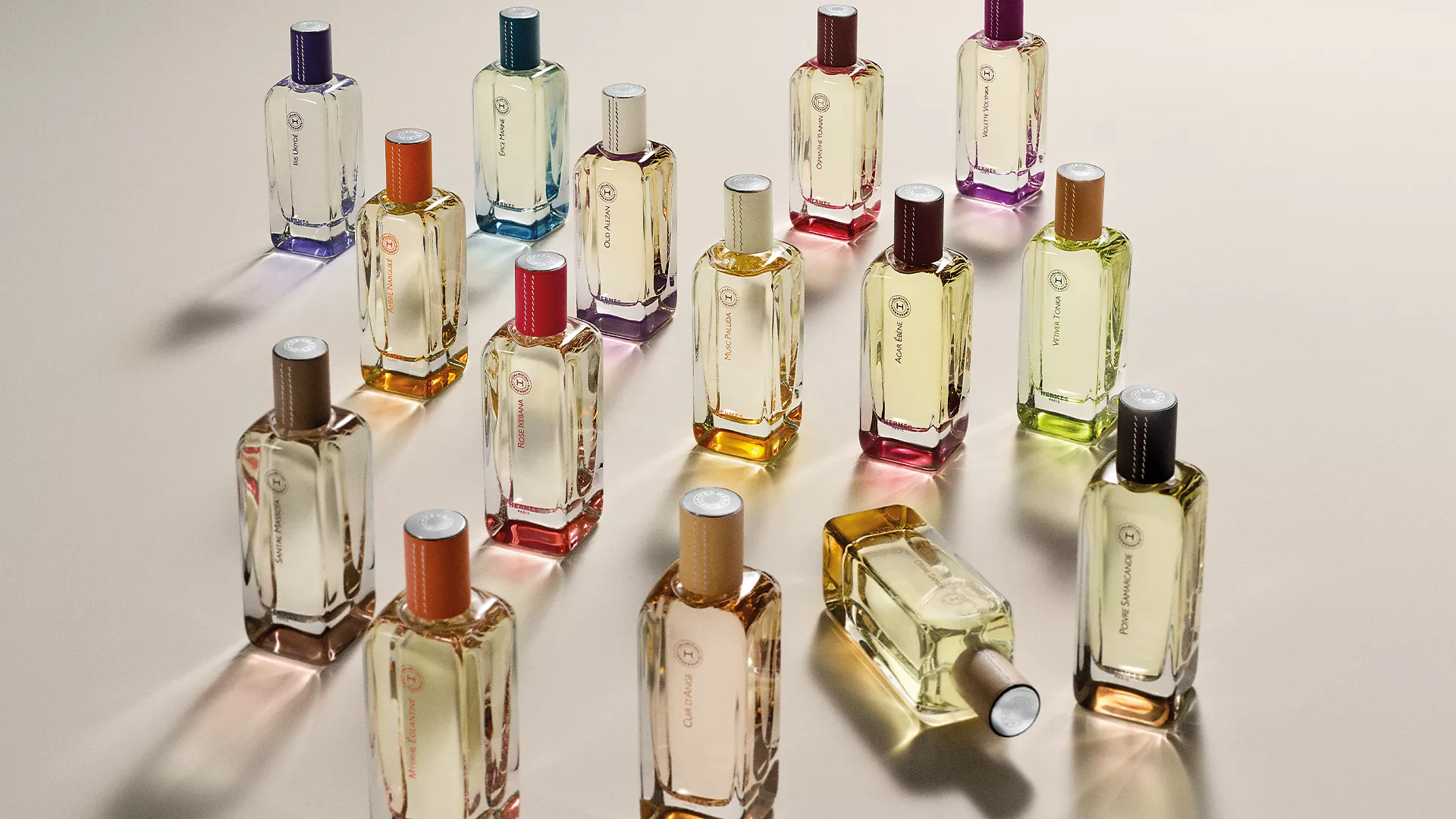
I spent a month in Cap Ferrat in June with one of the Hermès travel bottles of Musc Pallida in my bag, and somewhere along the way it became the perfume of that trip. I wore it often enough that the powdery iris and warm musk began to settle into the memory of the place itself. That was partly intentional. I have always loved the way scent can preserve a period of your life with startling precision, and I wanted to see what would happen if I gave one perfume an entire month.
By August, when I found myself back in Nice, the experiment had worked. Musc Pallida already smelled like Cap Ferrat to me, and I knew I wanted the full bottle. I bought the 100 ml at the airport duty free, where I had found the best Hermès pricing, and brought home a fragrance that by then felt much more personal than something I had simply discovered at a counter.
It also confirmed something I already knew about my taste. Give me iris, orris, musk, violet-like powderiness and soft woods, handled with restraint, and I am usually interested. Chanel Les Exclusifs occupies a large part of that world for me, as do Danner & Flemming’s Iris Altesse and Iris Trousseau, Les Indémodables Musc des Sables and Les Abstraits Belle Âme. None of them smells exactly like Musc Pallida, but they share a sensibility I recognize immediately. If those perfumes are already in your vocabulary, this is one I think you should know.
What Musc Pallida Actually Smells Like
Hermès reduces the composition to two materials: powdery Iris Pallida and warm, caressing musk. That description is accurate, but it does little to explain why the perfume is so compelling. Musc Pallida is not simply an iris perfume with musk underneath it; the entire structure seems built around changing the texture of the iris. Hermès describes Nagel’s idea as an encounter between Iris Pallida and musk, with the musk softening the iris in the way heat makes gold more supple. It is unusually fanciful language from Hermès, but in this case it comes surprisingly close to what happens on skin.

The iris is immediately recognizable, though it never becomes particularly cold or earthy. Some iris perfumes emphasize the rhizome’s rooty, almost carroty character, while others push it toward lipstick and face powder. Musc Pallida sits somewhere between the two. I smell violet powder, a trace of almond-like sweetness and a soft floral quality, all rounded by the musk into something creamy and warm. And I should say that I am very much a powder girl. I love Mizensir’s Poudre d’Or, and when powder is handled well, I find it incredibly beautiful. Here it never reads as baby powder or a literal vintage cosmetic compact. It feels finer and more integrated, with the musk keeping the iris close to the skin and giving it body.
That musk is what keeps Musc Pallida from becoming simply another expensive iris perfume. Nagel has spoken about the difference between historical animal musk and the synthetic musks used today, explaining that natural musk once contributed not only fixation and volume but also something animal and alive. With the original Musc Pallida and Cardamusc, she wanted to recover some of that sensation without making the perfumes overtly dirty. You can smell what she means here. Musc Pallida is clean, but not sterile; there is warmth and a faint skin-like quality underneath the polish. Nagel has compared musk in a composition to an invisible underskirt: take it away and everything becomes flatter. That may be the best explanation for what the musk is doing in Musc Pallida. It gives the iris shape, warmth and volume without ever competing with it.
The Story Began in 2018
The bottle I bought is the Eau de Parfum, but Musc Pallida did not begin as an Eau de Parfum. Christine Nagel first introduced the name in 2018 as an Essence de Parfum, a highly concentrated perfume intended to be dabbed onto the skin. It appeared during an important moment for Hermessence, the collection Hermès created in 2004 and describes as a series of encounters between materials rather than fragrances built around conventional commercial formulas.
Nagel’s thinking behind the original essence was particularly interesting. She had been looking at much older ways of wearing perfume, including the practice of putting a drop of musk or oud directly on the skin and then applying another fragrance over it. Her intention was to give the wearer the same freedom with Musc Pallida: wear it alone, or use it as a base beneath another Hermessence. She personally liked it underneath Agar Ebène, although she resisted turning layering into a set of rules.

The current Eau de Parfum takes that concentrated idea and gives it more space. It still wears close to the body, but it has enough diffusion to move with you, which is something I noticed constantly in Cap Ferrat. I would stop smelling it and then catch it again later, particularly from clothing or as I moved. That intermittent quality can easily be mistaken for poor longevity with musk-heavy fragrances because the nose adapts to them so quickly. On me, Musc Pallida never behaves like a powerhouse, but neither do I find it insubstantial. It creates a very specific radius around the wearer, which is exactly where I want a perfume like this to sit.
Olfactory Gold
There is also a reason Hermès puts the word Pallida in the name rather than simply calling this an iris musk. Iris is one of the stranger materials in perfumery because the smell perfumers value does not primarily come from the flower. It comes from the rhizome beneath the ground, which must be harvested, dried and aged before it develops the compounds responsible for that extraordinary orris aroma. It is a slow, labor-intensive material, traditionally prized for its violet-like, woody, powdery and buttery facets, which is why high-quality orris has long occupied a rather exalted position in the perfumer’s palette.

Nagel calls Iris Pallida “olfactory gold,” and Hermès says Musc Pallida began with her desire to create the impression of liquid gold. I usually become suspicious when perfume marketing reaches for precious metals, but here the idea is connected to a material with a genuine history of rarity and expense. More importantly, Nagel does something very specific with it. She has said she wanted to move away from an iris that felt overly powdery or distant and reveal its softer, more tactile character instead.
I find the “distant” part particularly telling. Iris can be beautiful and still keep you at arm’s length. I have that problem with Nicolaï’s Iris Médicis. I admire it, and I understand exactly what makes it beautiful, but I struggle to wear it because the iris feels cooler, more austere and more formal on me. Musc Pallida has none of that emotional distance. The musk changes the temperature of the material, softening the iris and giving it enough warmth that I want to keep wearing it. You still recognize the iris immediately, but it feels far more comfortable on skin, which may be part of the reason I emptied so much of that little bottle during one trip.
If You Love This Kind of Perfumery
I understand why Musc Pallida is compared with Chanel 1957. They share a polished, musky refinement, but side by side they are quite different. 1957 has that unmistakable Chanel radiance, while Musc Pallida is warmer, more powdery and more obviously iris-led. The connection, for me, is one of taste rather than formula. The same is true of Iris Altesse, Iris Trousseau, Musc des Sables and Belle Âme. None is a substitute for another, but they all belong to a style of perfumery I gravitate toward: beautiful materials, soft woods, musk, orris and texture over volume.
That is also why I think Musc Pallida can justify its price for the right person. At $435 for 100 ml, it is unquestionably expensive, especially for a perfume this restrained. But I do not judge value by projection or the number of notes in a formula. I care about how much I actually want to wear something, and during a month when I had plenty of perfume with me, I kept reaching for Musc Pallida. By the time I saw the full bottle in Nice, I already knew I wanted it.
Now the bottle has something I could never have bought at the Hermès counter. When I spray it at home, I smell Cap Ferrat almost immediately. The powdery iris, the warm musk, getting dressed there, the heat on my skin, all of it has become attached to that perfume. I bought Musc Pallida because I loved the way it smelled, but I wore it so deliberately because I wanted it to hold on to that month for me.







Leave a Reply