
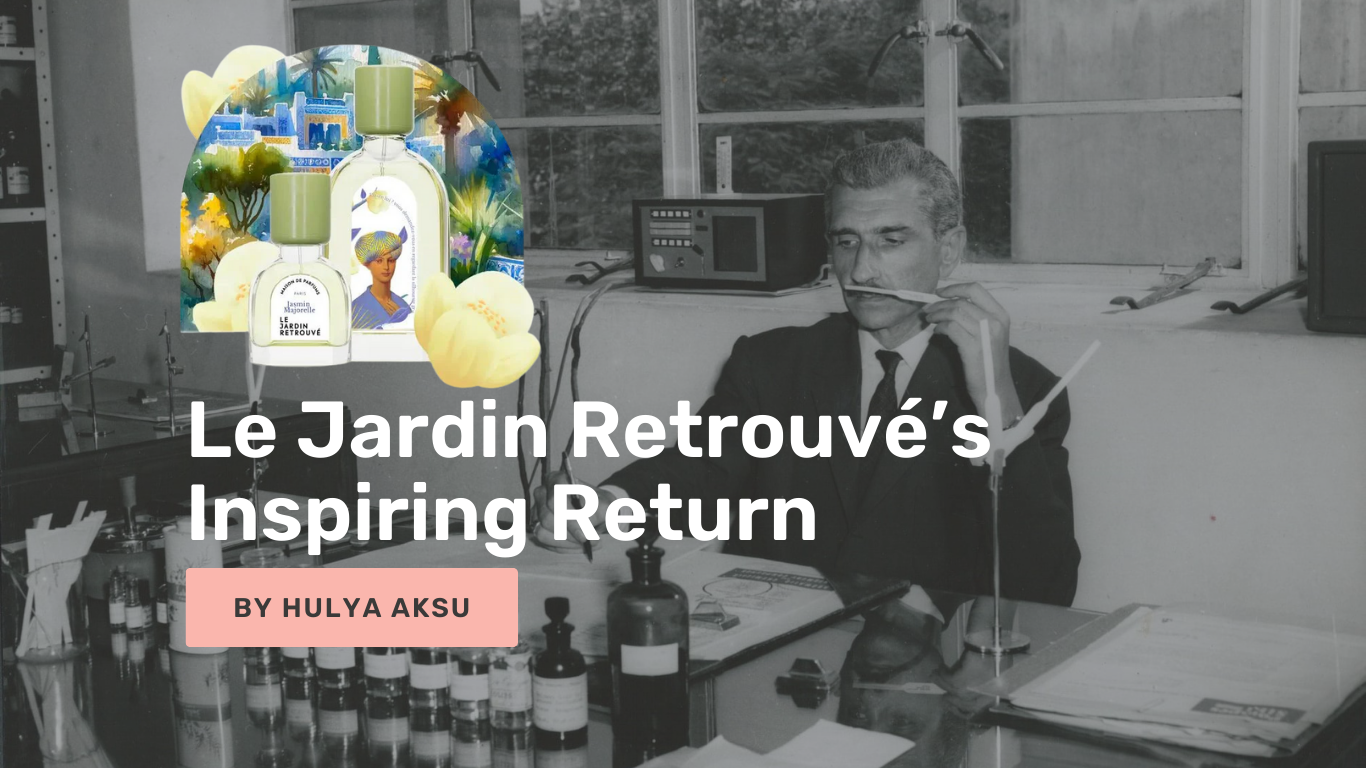
In the mid-1970s, fashion and beauty were brimming with ideas, while perfume’s public story still belonged to executives rather than the people who composed the juice. In 1975, master perfumer Yuri Gutsatz chose another path. He founded Le Jardin Retrouvé to put authorship, formula ownership, and craft back at the center. Four years later, as vice-president of France’s perfumers’ association, he delivered a sharp address, “Perfumer, you have no name,” arguing that an art without credited artists slips toward marketing first and creation second.
Defining Niche Before It Had a Name
That stance places Le Jardin Retrouvé at the roots of niche perfumery. In 1984, Gutsatz and Jean Laporte of L’Artisan Parfumeur were already debating what to call this new path for independent creators. Third-way perfumery. Parallel perfumery. The label came later. The intent was clear: restore creative freedom and give perfumers their names back.
A Family Revival in 2016

Fast-forward to 2016. After Yuri’s passing in 2005, the brand’s presence had faded. His son, Michel, and daughter-in-law, the artist and writer Clara Feder, decided the archive could not sit in storage. They had inherited roughly two thousand formulas. Rather than turn Le Jardin Retrouvé into a museum piece, they relaunched it as a living studio guided by two principles: loyalty to Yuri’s olfactory signature, and a balanced collection that can speak to many kinds of wearers.
From Archive to Modern Practice

They began with seven reissues from the 1975 to 1990 period. IFRA updates were necessary, yet the goal was to preserve the founder’s intent so longtime admirers would recognize the scents they remembered. One touchstone, Cuir de Russie, remained non-negotiable for personal reasons. It is an olfactory keepsake tied to Yuri’s father, born in Russia in the nineteenth century.
Collaboration with Maxence Moutte

The revival also embraces a modern process. Michel and Clara work with in-house perfumer Maxence Moutte. He studied the archive until he could speak the brand’s language fluently, then began to compose within clear guardrails: high proportions of natural-origin ingredients, vegan formulas, IFRA compliance, and documented mood-boosting effects from their supplier. In 2021 the house adopted a Road to Clean approach that goes beyond regulation, replacing bioaccumulative materials and aligning with strict clean-beauty standards, while keeping the synthetics that define classical French perfumery.
Building Direct Relationships

From the outset, Le Jardin Retrouvé bet on a direct relationship with its audience. In 2016, online-only perfume sales were far from the norm, yet they chose to meet clients where they already were. That required invention. Clara built an immersive universe around the idea of a “rediscovered garden,” writing each fragrance into existence while crafting visuals and sound to carry the scent’s mood through a screen. They introduced reimbursable discovery sets and generous mini sprays to remove friction from testing at home.
Lessons in Sustainability
The sustainability instinct was there early as well. Their 2016 Le Nécessaire system was fully eco-conceived and refillable, although the market was not ready. The lesson stuck. The 15 ml Petit Flacon became a bestseller for travel and scent wardrobing, and refills remain integral to the brand’s value proposition. Behind the scenes, Maxence develops concentrates with Givaudan, and Michel oversees bottling and packaging, keeping formula ownership and authorship in-house.
Continuity with Intent
“Avant-garde as a legacy” is not a slogan here. It is the throughline from a perfumer who refused anonymity to a family stewarding his ideas in a crowded, often noisy market. What follows is our conversation with Michel Gutsatz and Clara Feder on what it takes to carry that legacy forward today.
Inside Le Jardin Retrouvé with Clara and Michel
When you brought the house back, what guided your decisions about what to preserve, what to update, and how to reintroduce the brand to a very different market?
When we reintroduced Le Jardin Retrouvé in 2017, the market was very different from what it was in the seventies. We knew we had to choose 7 out of the 32 fragrances that Yuri created for his brand between 1975 and 1990. It was no easy task. Of course, Maxence, our present in-house perfumer, helped us tremendously, and he was soon joined by a few selected experts from around the world that we knew were interested in Yuri’s work. We had to be IFRA compliant and also wanted to keep the same olfaction, so our loyal clients wouldn’t feel left out or sad. Actually, we were surprised that we didn’t have to change that many ingredients, Yuri’s formulation being full of naturals and already compliant without even trying. One fragrance that we had to keep at all cost was Cuir de Russie, for it was the beloved olfactive memory of Yuri’s father, who was born in Russia in the 19th century.

Paper Art by Cristian Marianciuc, Illustration of bottles Kaya Bagamaz, Creative Direction Clara Feder ©Le Jardin Retrouvé
You publish your ingredients, credit your perfumers, and offer refillable formats. These are still rare practices in perfumery. Why do you think so many brands continue to hide their processes, and why has transparency remained non-negotiable for you?
Hiding the formula, the process and the name of the perfumer has always been part of the world of perfumery, since perfumes are never actually created by the designers that “sign” them. It’s a real problem when you think of it. Even today people think Tom Ford, Jean-Paul Gaultier or Giorgio Armani were perfumers. It’s a big confusion that the fashion world keeps alive. Others, like Creed, have led the world to believe that they were perfumers for centuries when in fact it all started in the seventies (they were a menswear brand). Yuri Gutsatz hated the hypocrisy of his industry: he famously gave a conference to the STPF (the French perfumers’ association) in 1979 entitled Perfumer, Your Name is Nobody where he berated his peers saying that CEOs, CFOs of all the composition houses were known but that nowhere did they list their perfumers… without which they would not exist.
Similarly the industry tradition is to list as “ingredients” on the packaging the list of allergens. Nothing to do with the actual formula: customers still believe this is the true formula. We believe in transparency, and this is why we list all main natural ingredients and all main synthetic ingredients on each of our product pages on our website.
We are a very small company, the son and daughter-in-law of an acclaimed perfumer who was the first to break free from the industry in 1975. He created his own fragrances with his own palette, advocating 50 years ago for the name of the perfumer to appear on his creations, therefore opening the way to all the niche brands to express themselves in the future. That’s why we have nothing to hide, and we also have the duty to set the example. Finally, we have our own in-house perfumers (Yuri of course and Maxence Moutte now), so all the formulas belong to us, which is not common at all in the industry: this gives us a lot of freedom.
What does your production process actually look like? From formula to filling to packaging, which parts do you oversee directly and where do you collaborate?
It all starts with Maxence and the both of us. Whether Maxence has a specific ingredient he feels inclined to work on (such as violet, which gave birth to Violette Kew) or we have a specific idea (such as taking Yuri’s last formula and giving it to Maxence to completely re-work, which was Immortelle Babylone’s idea).

Maxence creates the formula in accordance to very strict constraints: it must be 90 to 99 percent with natural origin ingredients, IFRA compliant, vegan, and it has to have a mood-booster certificate from our ingredient provider. We also ask him to pick the ingredients preferably from sustainable sourcing and fair trading.
We go back and forth between us three until we feel we are completely aligned. It’s creative and fun. Meanwhile, Clara is working with her team (artist, graphic designer and web designer) on the vocabulary, main ideas, moodboards. This translates the fragrance into words, sounds and visuals, which gives birth to videos, images, booth design, PR kit, labels and packaging. Then Maxence oversees the making of the concentrate at Givaudan. Michel oversees the bottling and the packaging.
Le Nécessaire is one of the few sustainable fragrance systems that feels both luxurious and practical. What prompted you to develop it and how has it changed how people use or travel with your perfumes?
Le Nécessaire was our first attempt to walk the talk and show the world what we were made of in 2016. It was totally eco-conceived, the ink was water ink, the cardboard was FSC and very light, all was refillable, and it took us so much time to find the right bottles at a time when the industry was only producing crimped bottles. It was very good for the planet, as well as for the wallet, because you could recharge your empty bottles almost twice for a very good price. It had also a luxurious feeling to it. Yet, the world was not ready, people were not interested and didn’t understand what it was about, and we were so small our voice couldn’t make itself heard. So, yes, it was a failure, and we stopped producing it.

We learned a lot from this. What was left of it is the Petit Flacon, a 15 ml. We were convinced that all customers would want to have small formats for travel, for the bag, for scent wardrobing. It is now a best-selling format, especially with customers online.
Your wellness line shares the same sensorial language and visual codes as your fragrance collection. How does it reflect your wider philosophy around scent, care, and daily ritual?
When Yuri launched the brand in 1975 with his wife Arlette, they were convinced that what customers needed was a brand that brought multiple products with the same fragrances in skin, cosmetics, bath, home. At the time it was a heresy. All major fragrance brands had separate scents for skin and home for instance. They were already thinking wellness, advocating for daily rituals with bath products, home fragrances, cosmetics and fragrances.

Wellness is therefore completely ingrained in the brand, because we take our name very seriously. “Le Jardin Retrouvé” translates as the Rediscovered Garden, a place where you recharge and feel good. A garden is also “the place where mankind ceased to wander” (Gilles Clément), a safe place, much needed today. A garden is a universal myth, and we all have one in our memory.
So if you combine all this, you have an incredibly powerful meaning: a safe place, full of colors and scents, where you recharge, where you feel the breeze and the sun, where you hear birds chirping and where you feel good. Wellness is center stage. In terms of visuals, it is rich, immersive and colored. If you think in terms of rituals, what you’re looking for in this garden is a good energy, or a shift that enables you to feel better, and you need a ritual to carry this if you want it to stand the test of time. This has led us to complement our offer with Oracle cards, meditation rituals, and of course to steer all our fragrances to being certified mood boosters.
Your storytelling avoids cliché and builds emotional resonance through memory, music, and personal reference. How do these narratives shape each fragrance and how do they influence the way your audience connects with the scents?
Some fragrances have been created a long time ago, from 1963 to 2000, by our founder Yuri Gutsatz, and some have just been created by our in-house perfumer Maxence Moutte, but they all have their special universe: a story written by Clara Feder; a visual created by Kaya Bagamaz under the direction of Clara; a special energy given by the ingredients’ properties, and by their mood-boosting certificates; a special energy card in the energy deck created by Clara and designed by Kaya, to help you connect your day to an energy and a scent. They even have small or big characters drawn by Kaya, and animation videos to accompany them.
Each fragrance is treated like a real immersive art project, encompassing as many senses as possible, all closely related to the perfumes themselves, and it is a constant back and forth between their stories, their visuals and the scents. And yes, we have an auditory signature, the birds chirping.

What we see is that most of the time, the audience perceives the love and care we give when we create these immersive universes, as opposed to the cold, heartless marketing prevailing in many spheres of society.
Michel recently said something many founders will not say out loud. That much of today’s niche pricing is unjustifiable. What is your view on pricing across the fragrance industry, and what do you think most customers are really paying for when they buy a luxury scent?
Two major moves are to be considered here.
- The move to high price fragrances, say above 200 euros a bottle, initiated by brands like Tom Ford and Amouage, soon followed by Byredo and Editions Frédéric Malle, and more recently by luxury brands with their prestige collections. Of course a new ultra-luxury market is now there, customers thinking high price means high quality and exclusivity.
- The dupe revolution. Why pay Aventus 220 euros for 50 ml when I can get a rather good quality dupe for 40 dollars for 50 ml. I think this opens up another new market, bringing to fragrance many new customers who would not buy the original but want to get a whiff of the true product without the packaging or the branding.
What does all this say about prices. The best kept secret of the industry is that perfume represents maybe five percent of the final retail price of the bottle. The actual perfume in a 50 ml, 200 euro bottle represents ten euros, and I am convinced it is closer to five. So all that is being said about expensive ingredients, artisan manufacturing, small batches, has a very limited impact on actual costs. The retail price is made mostly of distribution costs, and the wholesale price is essentially marketing costs, IP costs, and design costs.
So what does the customer pay for. The brand image first, the satisfaction of a desire second, status also. The real question in 2025 is whether customers will go on paying high sums when luxury itself is being questioned for raising prices. Is the brand story powerful enough to bring status to the customer who owns the real thing. Is there a hidden desire to be fulfilled that would give back meaning to a marketing-first world. This is what we put our faith in, with our mood boosters and humanistic approach. At the end of the day, many niche upstarts will fail because their storytelling is non-existent, and their intention is pure marketing.
You have chosen to offer smaller sizes, discovery sets, and accessible price points without compromising on formula quality or visual identity. What has this allowed you to do differently from other houses?
When we relaunched the brand in 2017, we already thought customers were changing. They were becoming versatile, changing their fragrances following their mood and the situation, and they would soon be looking for smaller formats, hence the 15 ml. We also knew that you cannot smell your screen, and that we had to offer generous 3 ml mini sprays, and discovery sets. We also offered gift codes with all of them to be used for the next purchase, allowing customers to get their discovery sets almost for free. Many niche brands copied this during and after COVID.

Clara and I try to anticipate new customer trends and bring them into the brand. For instance, we launched 125 ml mists at three percent dilution, priced at 48 euros, before the current mist craze. We also moved to mood booster fragrances in 2023, and oracle cards with positive energies, knowing customers would want fragrances that favor wellbeing, joy, relaxation, quality of sleep, and energy. We do it with our own poetry, and with science behind it rather than claims.
The term “niche” has been stretched to cover everything from celebrity-backed launches to luxury designer spin-offs. In your view, what should “niche” mean today, and what needs to be reclaimed?
The term niche, originally, means small and not mainstream. But the word was coined after Yuri created the house, because at that time there was no word to express a perfumer who had gone astray from the main industry. In 1984, there was a meeting at the STPF with Jean Laporte and Yuri Gutsatz where they were asked a specific question. How do you call yourselves. Parallel perfumery. Third-way perfumery. They were unable to give it a name, except that they shared the same passion for creation and for perfumers. The term came later, and then took years to get noticed.

Many brands that started as niche were later bought by large groups. The shift stayed relatively confidential, and only COVID plus social media changed the way people perceived fragrance. It became an affirmation of personality, which meant people wanted something more unique than the big brands they knew.
Today, niche is a word that has lost its meaning. People struggle to identify what belongs to large companies, how perfume is made, and many other aspects of the industry. They go for appearances, and the loudest voice in a social media world wins. Education is needed so people can build their own understanding and appreciation. A return to authenticity would leave many brands behind.
If you could change one industry rule, whether in formulation, marketing, or ethics, what would you challenge first. And how is Le Jardin Retrouvé already approaching things differently?
The lack of copyright for fine fragrances is damaging in the long run for the industry and for consumers. That is not for us to change, but it would be a great thing if it happened. Never forget this industry comes from a place where the name of the perfumer never appeared, and where a formula is considered an industrial creation and not an art. This is also because the big composition houses that shape the industry make their profit mostly from industrial perfumery.
We are also convinced consumers should be protected more from unsubstantiated claims. Naturalness is a claim, and it should be proven by third-party certification. We went that way under pressure from Chinese authorities, and the Koreans had us get third-party proof of vegan formulas. Transparency is another matter that needs to be further implemented.
What we, and a handful of other brands, have implemented in terms of transparency for the ingredients and sourcing, even for the perfumers’ names and where they belong, is crucial for the consumer to understand where their preferences go.
Le Jardin Retrouvé stands as a reminder that heritage can be lived, not staged. The family protects authorship and formula ownership, publishes ingredients, and invites the audience into a creative garden that feels intimate rather than manufactured. In a market that often confuses noise with value, this house chooses clarity. The result is not nostalgia. It is continuity with intent.
Elevated Classics Classification
Primary Category: Heritage
Secondary Tags: Family-Owned, In-House Perfumers, Formula Ownership, Transparent Ingredients, Sustainable Sourcing, Clean-standards Alignment, Mood-Booster Certification, Outsourced Production, Givaudan
Ownership: Independent, family stewardship
Notable Strengths: Archival depth, credited authorship, modern clean-process updates, accessible formats and refills, immersive storytelling tied to real creative work.





Leave a Reply