
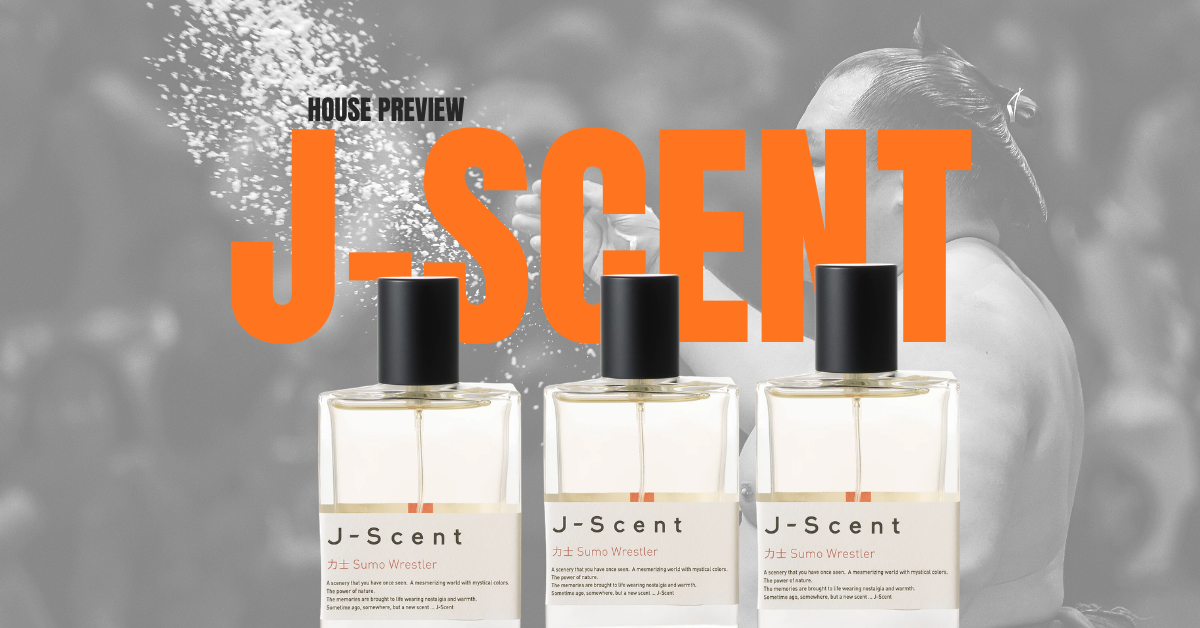
In Japan, scent rarely performs in the way Western perfumery expects it to. It does not project across a room or announce its presence before the wearer arrives. It exists in proximity, often at the threshold of perception, carried in objects, absorbed into fabric, or released through gesture. Its role is closer to atmosphere than adornment.

J-Scent, introduced in 2017 by the Japanese perfume house LUZ, operates within this sensibility. Developed and produced entirely in Japan, the brand works through an in-house structure that brings formulation, filling, and packaging under one system. The compositions are created through a collaborative internal process, with Hironobu Kobayashi working as an evaluator within the team. They stay close to the skin, working within the same quiet radius where scent is meant to be discovered rather than declared.
This distinction reflects a broader cultural framework in which restraint, seasonality, and material awareness shape daily life. Fragrance is not treated as an accessory layered onto identity. It operates within a system of quiet signals, understood through closeness rather than distance.
J-Scent positions itself within this framework with deliberate clarity. Rather than presenting a stylized version of Japan, the brand describes its intention as capturing “the atmosphere of everyday life in Japan… and emotions that quietly linger deep within people’s memories.” The emphasis is not on spectacle, but on recognition.
What becomes clear, however, is that this recognition is carefully constructed. The brand does not simply document the everyday. It edits it, distills it, and presents it in a form that remains legible across cultures. The ordinary is preserved, but it is also curated.

This orientation defines the structure of the collection. Materials that might otherwise function as background elements are brought forward and given full weight. Roasted tea, paper soap, rice powder, yuzu. These references are not abstracted into conceptual compositions. They remain identifiable, anchored in lived experience. As the brand notes, the aim is to “express familiar Japanese elements as they are, without exaggeration.”
On skin, this approach produces a distinct behavior. The opening rarely asserts itself through contrast. Volatility is reduced. The fragrance appears almost already settled, as though it has bypassed the stage of introduction. Citrus, when present, is diffused rather than sharp. Florals are rounded, held within a narrow range of expression. Development occurs gradually, with minimal directional shifts.

A tea-based composition illustrates this clearly. The initial impression carries a dry astringency, slightly bitter, recalling leaves steeped just past their ideal point. There is no rising steam, no lift. The sensation is quiet, almost matte. As it settles, the dryness softens into a muted warmth, with a faint sweetness emerging at the base. Projection remains restrained, forming a close radius around the wearer and holding within a more personal range of perception.
This continuity extends beyond the scent itself into the way the fragrances are conceived. J-Scent does not foreground a singular author. Instead, the work is developed by an internal collective known as TEAM LUZ, a group that includes perfumers, evaluators, planners, and directors. The brand frames this as a reflection of balance and harmony, positioning the composition as the result of accumulation rather than individual expression.
This model stands in quiet contrast to the author-driven narratives that dominate much of contemporary niche perfumery. It also raises a practical question. When authorship is collective, where does creative risk reside? In J-Scent’s case, the answer appears to lie in restraint rather than experimentation. The fragrances rarely attempt rupture. They refine.
The same clarity applies to production. J-Scent maintains an in-house manufacturing model in Japan, overseeing formulation, filling, and labeling within its own facilities. In an industry where production is often distributed across multiple partners, this level of control is notable.

At the same time, the brand’s definition of control is specific. It is centered on process rather than origin. Unlike vertically integrated houses that foreground cultivation or raw material ownership, J-Scent does not position itself around sourcing transparency. Materials are selected carefully, but their origins remain largely undisclosed, described as part of the brand’s internal identity.
This places J-Scent in a different category of craftsmanship, one defined by cohesion and execution rather than agricultural or material authorship. The result is consistency, though not necessarily the kind of traceable transparency that has become increasingly central to the broader conversation.
In the context of the global market, this positioning creates both clarity and tension. The brand explicitly rejects trend-driven development, stating a preference for intuition over data. “We trust our sensibilities rather than numbers,” the team notes.
The fragrances themselves support this to a degree. They do not follow the exaggerated structures that currently dominate the market. They resist projection, avoid density, and maintain a narrow emotional range. Their legibility, their clarity of theme, and their accessibility suggest an awareness of how they will be received across different contexts.
They travel easily.
Feedback from international audiences reflects this. These compositions often detach from their original references, attaching instead to personal memory. A mint note recalls something familiar but undefined. A citrus soda becomes a local equivalent. The brand acknowledges this, describing scent as something that “can cross borders and speak directly to the heart.”

This flexibility allows the fragrances to remain culturally grounded while adapting to individual perception.
There is discipline in this approach, though it does not resolve every contradiction. In a market where projection often defines presence, a fragrance designed for proximity requires a different kind of attention. Its impact depends on closeness, movement, and time. For some, this registers as refinement. For others, as absence.
J-Scent maintains a consistent scale across the collection, allowing the fragrances to exist within their intended range.
The experience, ultimately, is one of attention. These are compositions that unfold within a limited field, asking the wearer to remain present to small shifts in texture, dryness, and warmth. They do not insist. They remain available.
In that availability, a different idea of fragrance comes through. It stays close, allowing a more personal experience to develop gradually through wear.
A scent of Japan, not as image, but as structure.










Leave a Reply