
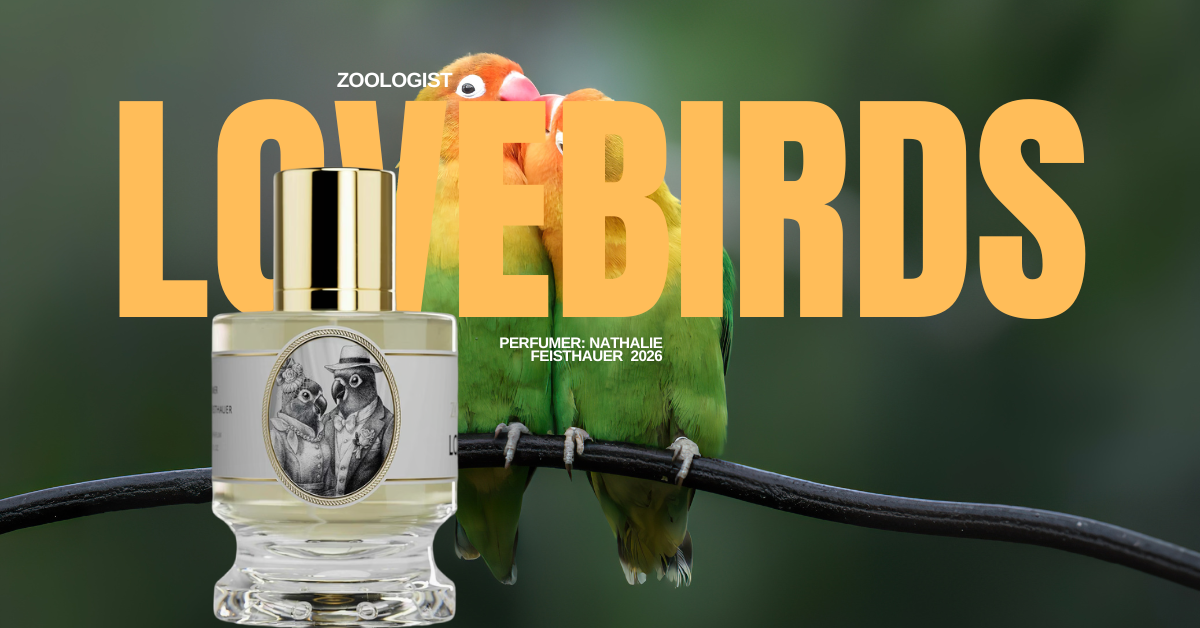
Zoologist Perfumes, founded in Toronto in 2013 by Victor Wong, is a radical house built on interpretation rather than imitation. Each fragrance draws from the animal world not as a literal reconstruction, but as a study of behavior, habitat, and emotional tone. The brand’s collaborations with independent perfumers have produced a catalogue that often resists easy wear, favoring concept, texture, and atmosphere over immediate appeal. Fragrances like Hyrax or T-Rex are often cited for their intensity and willingness to challenge the wearer rather than accommodate them.
It is worth stating that I have never been the natural customer for Zoologist. I have spent time with many of the fragrances and have always understood their intention. The creativity is evident, the identity firmly established, the risk-taking consistent. But my relationship to the brand has remained observational. I have admired the work more than I have wanted to wear it.
Lovebird marks a shift in that experience in more ways than one.
The Creator
The involvement of Nathalie Feisthauer is what initially drew me in. Her work carries a signature I recognize immediately. Even when the materials are vivid, there is control, proportion, and restraint. She understands how to guide a composition without overworking it, and that sense of measure is present from the very beginning here.

With Lovebird, it is the first time a Zoologist fragrance has aligned with my own sensibilities rather than something I was trying to interpret from a distance. It is also the first release from the house that I have wanted to lean into, to follow more closely on skin, and to wear rather than simply evaluate.
The Presentation
Before addressing the fragrance itself, the presentation deserves attention because it reinforces the brand’s commitment to detail in a way that feels increasingly rare.
From the moment it arrives, everything is deliberate. The branded tissue paper is folded with precision, clean lines and sharp edges, secured with stickers placed exactly where they should be. Nothing feels rushed or handled as part of an assembly line. It gives the impression that someone took the time to pack it properly.

The box opens like a book, revealing the paired lovebirds across its interior panels, immediately establishing the narrative. Inside, the bottle rests within a drawer-style compartment, creating a subtle moment of discovery as the label color is revealed. The concept is simple: the fragrance remains the same, while the label varies in rarity. It does not change the perfume, but it adds a small element of anticipation to the experience.
The artwork is expressive and fully integrated into the concept, not decorative but essential.
The bottle itself avoids generic cues. The perfumer’s name is printed prominently on the front, acknowledging authorship in a way that should be standard but rarely is. The magnetic cap closes with precision, and the atomizer delivers a fine, controlled mist.
Even the included samples reflect the same level of care, placed neatly within a small bag rather than added as an afterthought. At this price point, that level of execution is not guaranteed. Here, it is handled exceptionally well. The experience feels complete and considered from beginning to end.
The Online Criticism
Much of the conversation surrounding Lovebird has centered on whether it represents a shift toward broader appeal. Some of the criticism focuses on the collectible label concept, while other commentary suggests the brand is moving away from its more challenging work.
I find much of this criticism reductive and, at times, naive.
Zoologist is, ultimately, a business. Sustaining the level of creativity, collaboration, and material quality the brand is known for requires growth. It requires customers. That does not inherently signal a loss of identity.
There is also a tendency among online die-hards to dismiss anything more approachable as generic. Terms like “too friendly,” “soapy,” or even comparisons to cleaning products appear frequently. Much of that reaction seems tied to the presence of mint in the composition, which tends to trigger those associations.
Smell is subjective, but this does not read as a cleaning product in any meaningful sense. The mint functions structurally, lifting the composition and creating air, rather than dominating it.
It is also important to define what “mass appealing” actually means in the current market. Fragrances such as YSL Libre or Burberry Goddess represent true commercial appeal, compositions designed for immediate recognition and broad consumption.
Lovebird does not operate in that space.
It is more wearable within the context of Zoologist’s catalogue, but that does not make it conventional. The label concept, if anything, adds a layer of play. It is not a reason to purchase, but it enhances the experience once you do. I received the most common color, which ultimately felt beside the point. Like its namesake, the fragrance is meant to draw you in, to invite a closer interaction.
The Juice
Lovebirds inhabit warm, luminous environments, moving in pairs, defined by both energy and closeness. The fragrance reflects that balance.
The opening is immediate and full of movement. Kiwi appears first, bright and slightly tart, carrying a green nuance that keeps it vivid. Blackcurrant introduces depth beneath it, while citrus notes bring light into the composition without sharpness. Mint and clary sage shape the structure of the opening, lifting everything and creating space so the fruit feels open rather than dense.

As the fragrance develops, it moves into a more cohesive and softened heart. Passionfruit merges with the florals rather than standing apart from them. Ylang-ylang contributes a subtle creaminess, heliotrope introduces a gentle almond warmth, and lily of the valley maintains a fresh, luminous quality.
The texture shifts here, becoming smoother and more intimate, with a light powdery softness that feels composed and controlled.
The base remains close to the skin. Musk and ambrette form the foundation, supported by vanilla, tonka, and soft woods. The vanilla functions as warmth rather than sweetness, while the musk stays rounded and understated. Cedar and oakmoss provide quiet structure without pulling the fragrance in a dry or overly green direction.
What remains is a warm, continuous presence with traces of fruit and florals still perceptible. It is not designed to project across a room, but to be experienced at closer range.
This is not a confrontational fragrance, nor does it attempt to be. It does not rely on tension or abstraction to assert itself. Instead, it invites proximity, which aligns closely with its subject.
I do not see Lovebird as a departure from Zoologist’s identity, but as an expansion of it. It demonstrates that the brand can operate across a broader emotional range without losing coherence.

For those who have appreciated Zoologist from a distance, this may well be the point of entry.
It certainly was for me.
This does not feel like the end of anything. It feels like a continuation, one that allows both complexity and approachability to exist within the same house.
Elevated Classics Classification
Primary Category: Elevated Niche
Secondary Tags: Concept-Led Perfumery | Creative Direction by Victor Wong | Independent Brand | Perfumer Collaboration Model
Composition Partner: Nathalie Feisthauer





Leave a Reply