
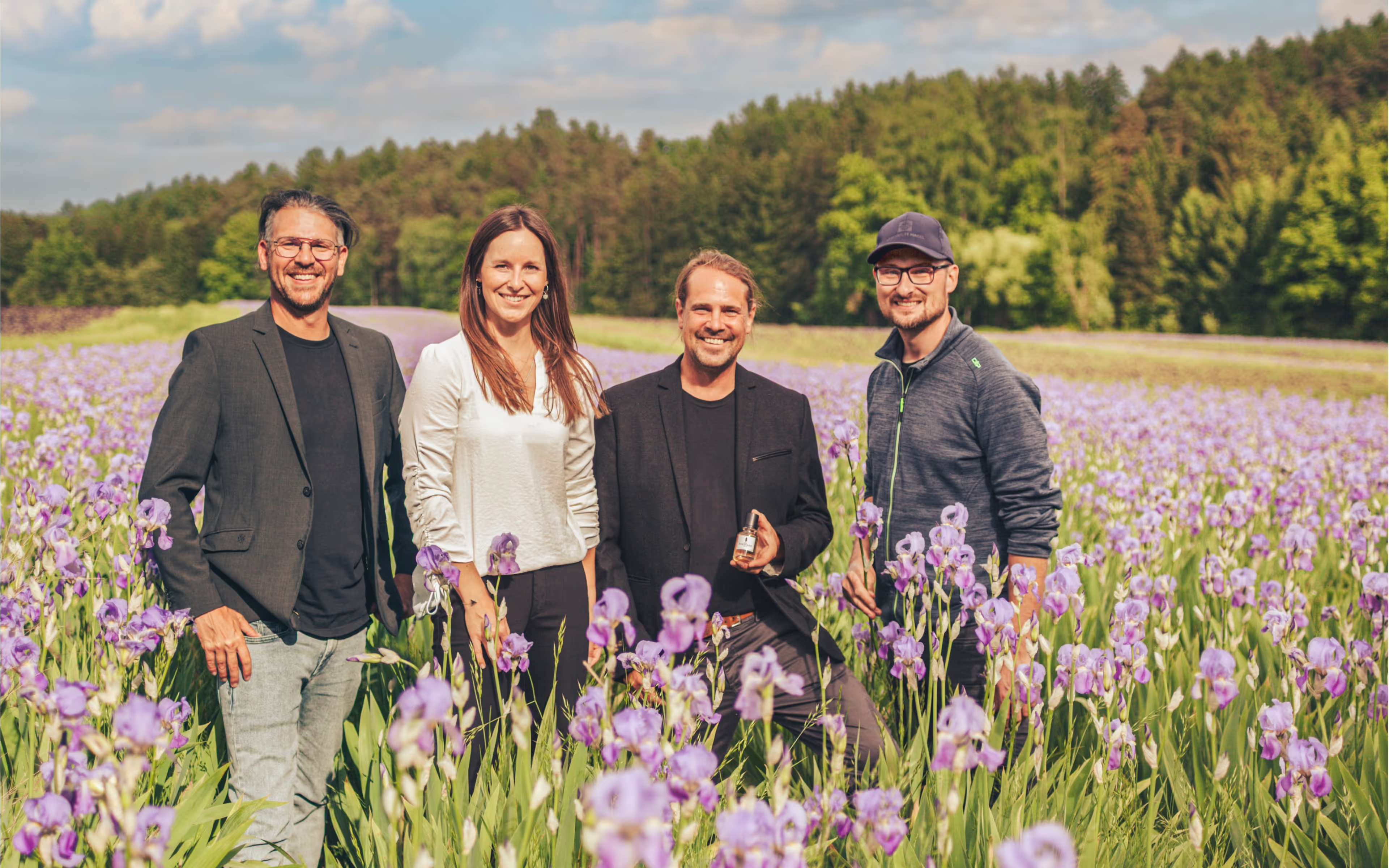
Danner & Flemming began with a field in Bavaria and years of work with iris, one of perfumery’s most demanding materials. What started as scientific research and cultivation slowly became something larger: a perfume house built around the team’s own harvest, their own processing, and a close collaboration with perfumer Antoine Lie.
In this Q&A, they speak about the physical reality behind iris, the limits of selling rare materials into the fragrance industry, the decision to create their own perfumes, and the meaning of luxury when it is tied to land, labor, time, and friendship.
Before the Brand Existed
Long before there was a perfume house, there was research, cultivation, and a field in Bavaria. After finishing your PhD and beginning work with iris, what did you believe you were building at that time? A scientific project, a business, or simply a way of working close to a material that fascinated you?
To be honest, I wanted all three. I wanted to continue working scientifically, because I love laboratory work with plant extracts and the intellectual challenge behind it. At the same time, I knew I had to earn money with it, because even the most beautiful project cannot survive otherwise. And above all, I always wanted to stay close to the raw material itself and work in the fields with my own hands, outside. I see that as a privilege in a modern world. But it was, and still is, uncertain whether we can truly unite all three aspects.

It immediately reminded me of an old Chinese proverb my botany professor told us in the first semester: “If you want to be happy for an hour, get drunk. If you want to be happy for a month, slaughter a pig. If you want to be happy for a year, get married. But if you want to be happy for a lifetime, become a gardener.”
I took that to heart.
Growing iris is slow and physically demanding. It requires planting, waiting, and maintaining the fields for years before anything can even be processed. What do you remember most clearly about those early seasons, when there was still no finished perfume and no guarantee there ever would be?
In those days, we didn’t even think of perfumes. It was almost 12 years ago. I remember the very first seedlings we received, in a sack, half-rotten and mushy. I had just convinced Christian Danner, our loyal farmer, to embark on this adventure with us, and then I was standing there with this dreadful material that we planted together in the cold and muddy October soil. Only about a hundred plants. I had little hope that anything other than weeds would grow.

But in spring, the first green tips of iris appeared, and that’s how everything began.
All of our Iris germanica, many tens of thousands of plants, are descendants of those few.
This project began with an unusual group: biologist, chemist, farmer, and a designer. How did this collaboration take shape in those first years, before the idea of becoming a perfume house existed?
This is, admittedly, a very unusual constellation. When I first met the farmer Christian Danner, I already knew he was the right person for an adventure like this. Contrary to the assumption that farmers in the countryside tend to be conservative, he had the openness, the courage, and the stamina to grow iris together with us. In the beginning, everything was very primitive. We had no equipment whatsoever and had to do everything by hand. But the practicality of the entire Danner family was the key to success. They don’t waste time talking; they get things done, solve problems smartly, immediately, and consistently. Only with people like that can a venture like this succeed.
While Christian focused primarily on making things work in the field, I was in the lab conducting experiments, and Theresa Hoess, a chemist, was also scientifically involved from the very beginning. She helped me with everything and is an absolute organizational talent. I’m more on the chaotic side. My friend Sebastian Rost joined later; he works as a designer at an agency. Together, we devised and implemented the plan for the brand. We wanted to do everything ourselves because we didn’t have much capital, and doing it this way made us feel much more connected to the brand. It truly is our baby, from the soil to the scent.
Building Something Real
You spent years refining cultivation and processing methods and eventually produced iris of exceptional quality. When you first realized the material you had grown was truly remarkable, what did that moment feel like?
I can remember that moment vividly. I had already run countless experiments to improve the yield of the fragrance molecules. And then there was this one experiment. Even before the gas chromatograph confirmed it, I could smell it: the irones, with their noble, woody-violet character, powdery and floral. And then, in the chromatogram, those towering peaks appeared, and I knew I had found it. Eureka.

When the enthusiastic feedback from renowned perfumers followed, it became clear that our iris was truly exceptional. It was an overwhelming feeling: the relief of knowing that all the work had not been in vain, and that I hadn’t disappointed the many people who had placed their trust in me.
The original hope was that the fields could be sustained by selling this iris into the fragrance world as a raw material. When it became clear that even outstanding quality would not command a price that could keep cultivation alive, how difficult was that realization?
Oh, it was a dark moment of realization, and it came very late, after we had spent years focusing solely on reaching our goal. Several major companies had shown interest in our raw material over the years, but of course we first had to produce meaningful quantities before anyone would take us seriously.

Eventually, we finally had those quantities. On an autumn day, Theresa and I loaded the entire harvest of one year, packed in sacks, onto a single pallet. We truly knew every single piece of iris in there personally. We had planted the seedlings more than three years earlier, weeded the fields, carried out the complicated harvest, sorted out stones, removed soil, washed everything, broken off new shoots, pre-dried the rhizomes, sorted them again one by one, sliced them, dried them in several stages, removed the roots, packed them into bags, aged them, and in the end, all of that fit onto one pallet, for which you receive only a few thousand euros.
That was the painful moment when we understood: this won’t work. And we could already see our blooming iris fields turning back into monotone cornfields.
Later that very same day, we decided to create our own perfume brand, to save our life’s work and those magnificent iris fields.
You had invested years of physical and intellectual work into something that suddenly had no viable economic path forward. How did you process that period personally? Did it feel like a professional setback, or something more emotional than that?
Yes, it felt like a painful defeat, personally, but also professionally. And the fact that I had drawn others into it made it all the more difficult to bear. We had spent so much time thinking about the technical aspects that we eventually lost sight of the fact that the whole venture also had to be financially viable. We simply kept pushing forward, stubbornly, without much reflection and without securing any real commitment from the big companies, hardly an intellectual masterpiece.
But we pulled ourselves together and decided to become the buyers and refiners of our own raw material. That decision gave us tremendous courage and strength, and who knows, perhaps we would have given up much earlier if we had thought things through more carefully.
Now, however, we are destined to succeed, because without the perfumes, the fields would not survive, and we know that. It is an adventure in every sense: productive, creative, and profoundly aesthetic, an adventure for all the senses, for the mind, and in summer, certainly for the back as well.
The Decision to Create Perfume
Many people in that situation would have stepped away. Instead, you chose to create your own perfumes as a way to preserve the material and the work behind it. Was that decision immediate, or did it take time to accept that you would need to step into a completely different role?
We knew it immediately, and in truth, we had no choice. But of course, turning that decision into reality took quite some time. Naturally, we had thought about it before. The idea itself wasn’t entirely new. But until then, we had always dismissed it as utopian. Who was supposed to pay for it? None of us came from the world of business; we were scientists, a farmer, and a designer. So who was going to handle the marketing, the sales, the legal matters? There were plenty of doubts.

During my studies, I also had to learn quite a bit about molecular orbitals of organometallic complexes, not that I remember any of it now, but it helped me face the challenges ahead. You can learn anything if you need to and if you want to; it is finally just a question of motivation. And we were very motivated.
Would it be fair to say that the house was born less from the ambition to launch a brand and more from the determination not to let years of cultivation disappear?
Absolutely! It’s almost a little embarrassing to admit, but we’re all children of the countryside. None of us ever had a perfume collection or lived anything close to a glamorous life. But we understood the necessity of deep value creation. And once you’ve spent some days in October crawling on your knees through two hectares of iris, soaked to the skin, pulling out weeds, you don’t simply give up and say, “Alright then, we’ll just do something else.”
And when you stand before a blooming iris field, the crickets chirping, the bumblebees drifting from flower to flower, and two hundred thousand fist-sized blue blossoms swaying in the wind, you’ll do a great deal to preserve it.
Once you committed to creating your own perfumes, what were the first practical steps toward becoming a perfume house rather than growers and researchers working behind the scenes?
First we had to gather enough courage, then bring the right people together, then raise money, then create a concept, to finally turn it all into reality. We also drew a lot of courage from Rémi Pulverail and Antoine Lie, both of whom were convinced that perfumes with an overdose of iris could become a success. And an influencer from our region, Leni’s Scents, encouraged us enormously as well. She helped us shape the concept and explained the market to us. On our own, we would never have had the courage to take this step.
Then comes the money, unfortunately one of the most important topics. And I’m proud to say that we didn’t take on any debt, and all our investors are part of the team. So we work for ourselves, not for external capital.
And then you enter a jungle of bureaucracy and countless small but crucial decisions about colors, bottles, labels, foam inserts, paper types, and so on. And eventually you smell Antoine Lie’s first draft and remember exactly why you’re doing all of this.
Entering a New World
None of you came from traditional perfume-house careers. You were scientists, cultivators, and collaborators working close to the material itself rather than inside the commercial fragrance business. When you decided to create your own perfumes, did it feel like entering a new industry entirely, or simply extending the work you were already doing in another form?
In the beginning, we were very unsure of ourselves and almost timid. Some of us didn’t even have private social media accounts, let alone any experience moving within this sophisticated universe of luxury. But with the courage that comes from desperation, you can achieve a great deal. We read, researched, and thanks to our strong connection to Leni’s Scents, Rémi Pulverail, and Antoine Lie, we were able to learn quickly and apply that knowledge to our project. In the end, all you need is common sense, strong motivation, and a good team. Then you can accomplish a lot.
You often describe lifting sacks of iris, working in the fields, and remaining physically involved in every stage. Why was it important to you to keep that closeness to the work rather than outsourcing once the brand began to take shape?
A wonderful question! All of us grew up in the countryside, surrounded by fields and forests, and we spent our entire childhood outdoors, something that shapes you profoundly. For me personally, there is nothing more beautiful than being outside, when the weather is good, and actually seeing, at the end of the day, what you have accomplished. And I can promise you: after such days, you sleep magnificently. That’s usually not the case after a full day of writing emails.

But that’s only half the truth. Admittedly, our labor is already paid for, and when you have little money and need to save, even our delicate academic hands have to get to work in the fields. Moreover, our development work in terms of processing is probably never truly finished. There are always issues with machines that need solving, or a step in the process that can be improved, rethought entirely, or adapted to new conditions. For example, when the soil isn’t dry enough and simply won’t fall off the plants. In those moments, you have to improvise, reflect, experiment, research, and find solutions.
Only people who are 100% involved can do that: people who are willing to work from sunrise to sunset when necessary. You can’t expect that from anyone external. And besides, we genuinely enjoy it. It creates such a deep connection to the product that the work never feels like “real work,” but rather like a passion, even though it is often truly hard.
The Material at the Center
Iris is often spoken about as a luxurious note, but rarely in terms of the labor and time behind it. From your perspective, what makes iris one of the most demanding and valuable materials in perfumery?
This is a highly multifaceted question, and the answer quite literally begins in the soil. Cultivating iris is a long process. It takes at least three years, and during that time the field must be carefully maintained, as iris reacts very sensitively to any competing vegetation. Then comes a highly weather-dependent and complex harvest. Machines must be modified and adapted, and processes developed that ultimately yield a clean product. The foliage is cut, the roots are undercut, the plants are lifted, sieved, washed multiple times; then new seedlings are produced by hand, around 50,000 per hectare. The rhizomes are pre-dried, cut, dried in three stages, the roots removed, and so on. Before a single sack of iris is finished, it passes through many hands, as beautifully mentioned above.

But even then, the iris must still be stored and processed so that irones can develop: the molecules that are later obtained through distillation or solvent extraction. And the yields are extremely low. From 1,000 kg of dried iris, equivalent to about 4,000 to 5,000 kg of fresh iris, one obtains roughly 1 to 2 kg of essential oil, beurre d’iris, through an extremely difficult and time-consuming distillation. This makes iris butter one of the most precious ingredients in perfumery.
I am not a perfumer, but in my view, iris gives every fragrance depth, sophistication, and an unmistakable sense of luxury. It is no coincidence that iris appears in almost every Chanel perfume, still the benchmark, in my opinion. Iris brings powderiness, structure, floral, woody, green, sometimes sweet and earthy facets all at once, and it modifies all other raw materials in a composition while adding longevity. These are already the qualities of iris when used in the small doses typically found in perfumes. But in the high concentrations we use in our fragrances, Antoine had to rethink everything entirely, because here the iris is not a luxurious modifier; it is the protagonist.
You cultivate several varieties, including one developed within your own project. When you smell them side by side, how do they differ in character?
Yes, we discovered an additional Iris germanica variation alongside the classic varieties Iris germanica and Iris pallida. It should also be mentioned that beyond the characteristics of the cultivar itself, the so-called terroir plays a major role. This is a French term borrowed from winemaking that describes the influence of all biotic and abiotic factors on the final product: the geology of the land, exposure, microclimate, neighboring plants, soil life, and so on. To stay with the wine analogy, a Pinot Noir from one of Burgundy’s top hillside vineyards will certainly produce a different wine than the same grape harvested three kilometers down the slope. It is exactly the same with our iris. In Bavaria, we have a very special terroir that iris seems to love, and you can smell it.

Our Iris pallida, the protagonist in Iris Altesse: The resinoid smells warm, powdery, vanilla-like, woody, and sweet. The iris butter is floral, earthy, powdery, slightly green, mineral, and very typical of iris: highly complex and powerful.
Our Iris germanica, the protagonist in Iris Poulsard: The resinoid is very woody, slightly fruity, and to me reminiscent of hay, straw, and fresh winter air. The iris butter is barely powdery, quite untypical for iris. Instead, it is fruity, berry-like, woody, with hints of cocoa and coffee and just a touch of graphite. Fascinating.
And our variation Iris germanica Danner, the protagonist in Iris Trousseau: The resinoid is very dark, chocolatey, fruity-floral, and liqueur-like. The resulting iris butter is extremely powdery, perhaps the most powdery and intense iris butter in the world, with creamy, fruity, sweet violet notes and a subtle nuttiness. Extraordinary and unique.
Each iris is allowed to shine in a single perfume, in a concentration never seen before.
Because you control cultivation and processing yourselves, your relationship to the material is unusually direct. Has that closeness changed the way you think about perfume as a finished object?
Absolutely! Although it depends greatly on the perfume itself. I don’t want to pit natural and synthetic ingredients against each other. Both have their place. But my heart naturally belongs to the naturals, as does the heart of most perfume lovers. It’s no coincidence that on fragrance forums, you’ll see vanilla, rose oil, and sandalwood listed as beloved ingredients, rather than the less sexy Cashmeran, Iso E Super, or ethyl vanillin.
Natural ingredients are infinitely more complex and infinitely more difficult to produce. Even behind the cheapest citrus oil lies an enormous amount of work: cultivation, often years of care and waiting, then frequently manual harvesting and labor-intensive processing under challenging conditions. This is followed by analyses, purification steps, and so on. It is incredibly complex, and the ingredients come from every corner of the globe, produced by people who pour passion and hard work into creating these raw materials.
And for that reason, every natural ingredient deserves the utmost respect and should be enjoyed with all the senses.
Working with Antoine Lie
When you approached Antoine Lie, you brought him not just an idea but a material with a place, a history, and years of labor behind it. What kind of conversation did you want to have with him from the beginning?
We had known Antoine Lie for quite some time and already knew that he’s a fantastic person, someone you can speak plainly with, and who speaks plainly in return. Throughout the entire project, it was always important to us that everyone felt comfortable and that we maintained a genuinely friendly, trusting relationship. After all, you’re living through an intense period together, so why make it unnecessarily difficult? And Antoine is the kind of person you warm to instantly and with whom you quickly feel a genuine sense of friendship.

We also knew that Antoine has a very clear ethical compass: he has no interest in cash grabs or purely marketing-driven brands, but he is absolutely drawn to ingredient-focused, artistic, and avant-garde projects. So he was enthusiastic from the very beginning. And because he had never worked with such high iris concentrations or with such unusual iris varieties, he gladly embraced the challenge. And he always believed in our success, because he knows the market well and recognizes that, as a brand, we have a truly genuine and honest unique selling point.
He has spoken about the freedom to work with iris in unusually high concentration. Why was it important to you that the perfumes demonstrate the true presence of the material rather than a symbolic use of it?
This question goes right to the heart of our brand. The first reason is simple: as a small, unknown, young house in a market where new brands seem to sprout like mushrooms, we must distinguish ourselves. We are fortunate to work with a magnificent, iconic raw material that we cultivate ourselves and that carries an extraordinary story. That must be our signature, and you cannot build a signature on symbolic quantities.
When we proposed to Antoine to work with an overdose of iris, he double-checked with us to make sure he truly had complete creative freedom. And so we ended up with, for example, 4.1% iris in the perfume oil of Iris Poulsard, an absolutely insane amount when you consider that 0.1 to 0.2% is standard. That’s twenty to forty times more. It allowed Antoine to work in a completely different way, like an artist whose palette is no longer constrained by cost.
But the other reason is an emotional one. We have spent more than ten years working tirelessly, and wholeheartedly, on iris cultivation and on processing the rhizomes. We have developed such a deep relationship with this material and know the nuances of the extracts and the butter so intimately that it would feel almost sacrilegious not to let this raw material shine at the heart of our perfumes. Giving this extraordinary ingredient the stage it deserves also gives us, indirectly, a form of recognition for our work, and that feels very good.
And besides, what is a slice of cake without proper cream? Not a little, but a generous amount. You rarely have it, but when you do, you go all in. Otherwise, in my opinion, you might as well skip it.
How did the dialogue unfold between you, as cultivators and scientists, and him as a perfumer during development?
Oh, that part was actually very simple, because Antoine speaks plainly, and so do we. We had very little idea of how a perfume brief or the whole creative process is supposed to work. So it played in our favor that our brief was as straightforward as it gets: “We have three varieties of iris, each with its own characteristic scent. Please build a perfume around each one, placing the unique beauty of each iris at the center. And use as much iris as you wish.”

What can a perfumer say to this brief? Antoine said yes. And you don’t get a perfumer like Antoine Lie just like that. You have to entice him, touch his artistic soul, and tempt him with challenges he has never encountered before. And he must believe in the project, even when success is not guaranteed, because he puts his name on the perfumes he creates. We are in the same boat, we speak the same language, and we treat each other with respect. It truly couldn’t be more harmonious.
The same is true with Rémi Pulverail and his team. After such a short time, it feels far more like friendship than business.
From Field to Bottle
Your production is deliberately limited, almost closer to a vintage release than a conventional perfume launch. Is this scale simply a practical reality, or is it also part of how you define what you are doing?
In fact, our limitations are mainly due to the restricted cultivation volume and the extremely labor-intensive processing after the harvest. And with a three-year growth cycle, you ideally need to know three years in advance how much iris you will need, which is incredibly difficult. Scaling up can therefore only happen slowly and only to a certain extent. There is just one distillation per year from a single harvest, and once that material is used up, there simply are no more perfumes. For now, this is a purely practical reality.
Of course, we could hire workers, buy huge machines, lower the unit costs, produce many tons of iris, and then try to sell vast quantities of Danner & Flemming fragrances three years later, but even writing that down feels profoundly wrong. Naturally, we need to grow a little so that everyone involved can one day make a living from this work. But we will never escalate. We will keep everything at a scale we can personally oversee and control.
We have the great privilege of working with our hands, our minds, and our hearts at the same time. That, to me, is the core philosophy of our brand. If we didn’t work this way, the brand simply wouldn’t exist in its current form. And all of us want to be in the fields ourselves, to process the harvest with our own hands, to carry the sacks, to drive to France and deliver the bottles in person, to talk to the people there. What would we gain if, in the end, we were sitting behind a desk all day, or, if things went very well economically, lying in a deckchair? We would all just be bored.
You have compared your work to winemaking, where cultivation, harvest, and refinement remain closely connected. Do you see each release as tied to a particular harvest or moment in time?
Our current fragrances will certainly remain limited, simply because the amount of work behind them makes it impossible for things to be any other way. And the idea of producing a limited perfume vintage each year from a naturally limited harvest makes perfect sense to us, because it reflects our work exactly, and through its rarity and uniqueness, it creates true luxury.
We’re thinking about a future collection in which we might slightly reduce the iris concentration in order to make the fragrances a bit more widely available. But that’s still a long way off.
We are currently planning a fourth fragrance, no one knows this yet, and it too will be created as a millésime, vintage, edition with an iris overdose, focusing on specific facets of the iris once again.
After years of uncertainty and work, what did it feel like to finally hold the finished bottles in your hands?
To be absolutely honest, we didn’t have that one defining moment. Instead, it was countless small partial successes and setbacks. We celebrated each of them, by the way. But when the final product was finally there, the bottle together with the vial of iris essence and the iris slice assembled in the packaging, with the labels and the tissue paper and everything, our families and all of us were running around like a flock of hens, packing and shipping, with not a single moment to realize anything. Simply great!

Only when the first rush began to slow down and we were able to sit down for a moment did it slowly dawn on us that this had now become reality, that we had actually done it. What can I say: a feeling of euphoria you probably only experience a few times in life, but only briefly, because the next order came in right away.
Value, Labor, and Luxury
Having experienced firsthand how difficult it is to sustain the cultivation of precious raw materials, do you feel the perfume world properly values the agricultural labor behind its most celebrated ingredients?
Absolutely not! There may be a few exceptions, brands that genuinely uphold these values and actually implement fair sourcing in practice. Les Indémodables, for example. But otherwise, while almost every perfume description lists natural ingredients, they are usually used only in very small amounts. They are advertised, yes, but the true soul of naturals is rarely acknowledged.
Anyone who has ever taken part in a rose harvest, which can only be done by hand, will think very differently about rose oil. Or consider hand-pollinated vanilla, which must ripen on the plant for nine months and then ferment for many weeks or even longer. All of it manual labor, unseen, unappreciated, and unreflected upon, often because it takes place in poorer countries.

It is absolutely clear that this agricultural work, the very foundation of everything we love about perfumery, must be brought into focus, must be paid fairly, and must be valued. Because this kind of small-scale, family-run agriculture, where cash crops are cultivated, plays an extremely important role in fighting poverty worldwide and, in many cases, also helps preserve natural resources.
You describe yourselves as an approachable luxury house shaped by material, time, and physical work rather than marketing constructs. After everything you’ve lived through to reach this point, what does luxury mean to you now?
I didn’t grow up rich, nor poor, but my parents always made a great deal possible for me. We didn’t have expensive handbags or designer clothes at home, but from an early age I spent a lot of time in France with my parents. We lived well there, and it shaped me deeply: excellent food, beautiful, picturesque places, sitting in a café with a fresh croissant, elegant people, wonderful scents, good wine.
For me, therefore, luxury has always meant quality, not simply a brand label. And today, quality almost always means that craftsmanship and manual work must play a central role, because no machine can replace the work of true masters; at best, it can complement it. And when craftsmanship, manual work, and quality are involved, the result can never exist in unlimited quantities. The product becomes scarce, and that scarcity combined with quality, for me, is an essential attribute of luxury.
All these elements naturally mean that such a product must have a certain price, one that reflects the many steps of work carried out by many people and their savoir-faire.
And luxury, for me, is also drinking a glass of real Poulsard with my partners after the iris harvest, as the sun sets.
Your story is also one of shared effort: families helping, long seasons together, friendships formed through work. How important is that human closeness to the identity of the house?
That is absolutely the core of it! Without our close friends, family, and team, nothing would work. Take the Danner family, for example, our farmers. Their dedication and hard work are absolutely essential. And here is just one example of their friendship: a few years ago, when the financial situation wasn’t great and I was worried whether everything would work out, and feeling guilty because I had involved them and they had invested so much money and time, I didn’t say a word about it. Yet the farmer took me aside and told me that they wouldn’t be angry if things didn’t work out, and that they knew I was doing everything I could. He just felt my struggle. I still get tears in my eyes thinking about that moment.

And then there is Theresa, who has been by my side for ten years, never too proud to do anything, helping in the fields, organizing everything, holding everything together, making every trip a joy, and constantly bringing new ideas. And Theresa’s family, who drive for hours during peak times to help us in the fields or pack bottles. And Seppo, my longtime friend, who designs everything and edits reels in the evenings after his full-time job. And so many of our colleagues and friends who always step in to help.
Without people like this, a project like ours simply wouldn’t work, and even if it somehow did, it wouldn’t be any fun.
Looking Forward
Now that the first release has succeeded, how do you define success for Danner & Flemming going forward? Is it growth, stability, preservation of the fields, or something more personal?
We are aware that our initial success may not last forever. That’s why our priority is to achieve stability and build a solid reputation among perfume enthusiasts who will, hopefully, continue to choose our creations regularly in the future. A bit of growth is necessary. We need it to make a living, but we have no desire to become a large, impersonal brand. We enjoy what we do far too much for that.
The preservation of our fields is deeply important to us, and they are, after all, the very foundation of our brand. If we can sell enough perfume, the fields will continue to thrive as well. Personally, I find it immensely fulfilling to be involved in every step from the field to the finished bottle, and that is something I absolutely want to continue doing in the future.
If the house remains small, materially focused, and rooted in your own cultivated iris, would that be enough?
This could work for us. As I’ve mentioned before, true luxury is rooted in genuine scarcity, not an artificial one. If we continue working with our current capacities, as we intend to, and if we can transform all the iris we cultivate into perfume, then we can make a living while remaining small and exclusive.
We can imagine cultivating other perfume raw materials in the future, but only on a small scale and solely for our own fragrances. For now, the iris keeps us more than busy, and we are far from having exhausted all the possibilities for creating different iris perfumes. We have many ideas.
When someone wears one of your perfumes, what do you hope they sense about the years of work, risk, and care behind that scent?
That they will sense exactly that. I hope that the people who wear our fragrances are aware of the effort and dedication of all the individuals whose work is contained in every single spray. I hope they don’t wear our perfumes thoughtlessly, the way one might wear an always-available designer scent that is simply expected to perform, which is absolutely fine, don’t get me wrong. But when our perfumes are appreciated as the result of years of hard work, research, creativity, and a deep passion for raw materials, and when they are enjoyed to the fullest, like a glass of truly exceptional wine, to draw that parallel once more, then I am overjoyed, and so is everyone who contributed to them.
Elevated Classics Classification
Primary Category: Artisanal Perfume House
Secondary Tags: Field-to-Bottle Perfumery, Vertically Integrated Raw Material Production, Independent, Founder-Led, Material-Focused, Small-Batch Production, Millésime-Style Release, Agricultural Luxury, Creative Collaboration with Antoine Lie
Composition and Production Note: Danner & Flemming is built around Bavarian-grown iris cultivated, harvested, processed, aged, and prepared by the team themselves. The perfumes are composed by Antoine Lie using the house’s own iris materials in unusually high concentrations, making the brand’s identity inseparable from the field, the harvest, and the processing work behind the raw material.
Raw Material Focus: Bavarian iris, including Iris pallida, Iris germanica, and the house’s own Iris germanica Danner variation.
Elevated Classics Assessment: Danner & Flemming represents one of the clearest examples of material-led luxury in contemporary perfumery: a house born from cultivation, scientific research, and the determination to preserve a rare raw material rather than from a conventional brand concept.







Leave a Reply