
I have just celebrated the first anniversary of Elevated Classics, and with it a year of speaking to founders, creative directors, perfumers, heritage houses, and independent makers from all over the world. What began as a passion project has turned into a front-row seat to the inner workings of an industry that is equal parts artistry and commerce.
Over twelve months of interviews, research, and travel, I have started to see patterns repeat themselves. Certain themes keep surfacing, from how brands position themselves, to how the market responds, to the quiet forces shaping what we all end up smelling. As Elevated Classics enters its second year, I want to share the thoughts and predictions that have emerged from this first year in the field.
Here is where I see the industry heading.
The Great Convergence: Designer and “Niche” Are Now the Same Lane
The line between designer and niche has blurred beyond recognition.
Designer brands have upgraded their formulas and complexity to justify higher prices. Niche brands, especially those with investors, have softened their edges to reach a broader audience.
Behind the scenes, the same four or five fragrance conglomerates , Givaudan, dsm-Firmenich, IFF, Symrise, plus a few others are creating, compounding, and manufacturing for both. The same famous perfumers can spend one week developing a designer scent, the next crafting a so-called niche release for an independent label.
Parfums de Marly is a perfect case study. Marketed as niche, it has always made loud, sweet, mass-appealing scents, the kind of crowd-pleasers you would expect from a mainstream launch, but priced at $400 a bottle. Not because of rare raw materials or fully in-house production, but because the brand narrative frames it as worth that.

Now compare that to Valentino, a mass-production fashion house selling great smelling, widely distributed fragrances, with limited edition releases, now for $200 a bottle. They sell out online in minutes. These Valentino perfumes are often made by the same perfumers, using the same manufacturing facilities, and drawing from the same ingredient suppliers as the $400 niche bottles.
This is the market now. Designer and niche are no longer just blurring, they are running in the same lane, wearing different price tags and stories. With the recent price hikes in designer fragrance, they are converging into a single category.

Designers are producing “les exclusives” style collections that are not fundamentally different from their other perfumes, except in packaging and marketing, and without cannibalizing their cheaper lines. These high-end releases exist to compete directly with niche brands. If the same juice can be made in the same factory, a change in marketing collateral is all it takes to capture more of the luxury buyer.
At the same time, niche brands do not want to lose the mass market, so they are creating smoother, more approachable scents. The once-separate lanes are now a single, crowded road.
AI as the Default and the End of Apprenticeship
Forget the polite claim that AI will only assist perfumers. It will replace most entry-level jobs, the positions where future masters learn to refine their craft. Without that apprenticeship stage, we lose the slow, human development of artistry.
AI formulation tools can produce trend-aligned, cost-optimized blends in hours. This will lead to safe, predictable, formulaic perfumery. Artistry will still exist, but it will be rarer and it will not come from the training grounds that once produced the greats.
$600 Plus Pricing Without Better Juice
As designer and niche fully overlap in scent quality, some brands will raise prices simply to distance themselves from the middle. This is a positioning play, not a sourcing upgrade.

Think Louis Vuitton’s $160 lipstick logic applied to perfume. Heavier caps, thicker glass, a more elaborate box. The juice inside could easily have been last year’s $250 release.
Some niche brands will move into the ultra-luxury category, making that a trend to watch. There will always be affluent buyers who do not want to own what they perceive as “regular” people’s purchases. For this group, paying exorbitant prices is not just about the perfume, it is about signaling wealth, exclusivity, and belonging to a smaller, more rarefied circle.
Heritage Revivals: Romance Meets Reality
Many French perfume houses did not survive WWII. Some collapsed financially, but many Jewish-owned companies were seized under the anti-Semitic laws of the Nazi occupation and in the post-war aftermath. Families were forced out, their assets and brands transferred to non-Jewish owners, often without fair compensation.

Today’s revivals, such as Houbigant, Maison Violet, and Bienaimé, are born either from a genuine love of perfumery or from the instant credibility that comes with a heritage name. I predict that in the early stages, these brands will lean heavily into their history, releasing archival-inspired scents, using vintage-style packaging, and telling romantic origin stories. But heritage alone does not pay the bills. Over time, I expect they will need to launch more mainstream, mass-appeal perfumes to generate consistent revenue and survive in today’s market. The vintage formula style, while beautiful, is too niche to sustain large-scale profitability.
International Players: Amouage as the Blueprint
For decades, the French dominated the conversation around luxury perfume. Today, that is no longer the case. Some of the most influential moves in the fragrance world are coming from outside France, and Amouage is one of the clearest examples.

Founded in 1983 at the request of Sultan Qaboos bin Said al Said and brought to life by Prince Sayyid Hamad bin Hamoud al-Busaidi, Amouage was created to showcase Oman’s perfume heritage and to serve as a cultural ambassador. Its first fragrance, Gold, crafted by Guy Robert, was originally intended as a diplomatic gift rather than a commercial product.
From the start, Amouage invested in vertical integration. They built facilities in Muscat to handle everything from raw material sourcing to blending, bottling, and packaging. In the early 2000s, new leadership began adapting the brand for global tastes, hiring Western creative directors and gradually expanding distribution.
The brand has since moved into a new phase and in 2025, L’Oréal acquired a minority stake, a move that many see as a step toward eventual full acquisition. Amouage now reports strong profit margins and expanding global sales, making it a role model for how a heritage-rooted, vertically integrated brand can scale without losing its origin story.
Other international players are watching closely. The success of Amouage proves that high-end fragrance with cultural authenticity can compete on a global stage. Brands like Nishane are following a similar path in marketing, but without the same production control, putting them closer to the Parfums de Marly model. We will likely see more regional brands attempting this kind of global initiative, adapting local heritage for the international luxury market.
Gourmand Dominance
Sweet sells, and it is not slowing down. The future is neo-gourmand. Pistachio with sea salt, sesame with vanilla, matcha with cream. Comforting, edible notes modernized with twists to keep them from feeling juvenile.
The Young Male Buyer: Impact Over Nuance
Among young male consumers, perfumes that shout will keep winning. Top-note heavy, linear, and packed with synthetics for projection and longevity.
They want something that makes itself known instantly and stays loud for hours. The slow-burn beauty of a Meo Fusciuni, which unfolds over hours like a novel, will be lost on this crowd. They want the bullet points, not the full book.
Clean Girl 2.0 Becomes the It Girl
The minimalist, musky-aldehydic “clean girl” aesthetic made famous by fragrances like Le Labo Another 13 and Santal 33 is starting to feel dated. The next wave will keep the freshness but replace the quiet laundry-musk mood with something brighter and more extroverted.

Expect to see juicy, fruit-lifted florals take center stage, scents that open with ripe, photogenic notes and unfold into easy, wearable compositions. Miu Miu’s Miutine is a good example of this shift. It takes the idea of a daily, signature scent and injects it with ripe fruit and playful florals, making it more visible, more social-media-ready, and more “it girl” than its understated predecessors.
FOMO Limited Editions
Scarcity sells. You do not need groundbreaking juice, just hype and a sense of rare access.
Take Valentino Born in Roma Rendez-Vous Ivory. It was a flagship, widely released fragrance that sold out online and in stores almost immediately. A Reddit thread captured it best: “Sold out fast online and in store. I really hope they get more in stock.” Social media lit up with clips of empty shelves and disappointed buyers, turning it into a full-scale viral event.

Then there is Commodity’s Milk Orchid, dropped in collaboration with Perfumerism’s Emma. It sold out in presale within minutes. TikTok was filled with videos of fans lamenting that they missed it, and fragrance forums overflowed with raves, regrets, and pleas for a restock. The frenzy around the launch was as powerful as the scent itself.
This is only the beginning. Expect to see more limited release presales in the future, timed to create maximum hype and urgency. In a market driven by impulse and FOMO, scarcity is becoming one of the most effective tools for generating sales and social buzz.
Social Media and YouTube as the New Gatekeepers
Social media and YouTube are now the most powerful drivers of perfume hype. A single viral video or trending post can move inventory faster than any traditional ad campaign. Creators have become the bridge between brands and buyers, shaping how launches are received and even influencing which scents become cult favorites.
But this space is getting crowded, and not everyone gaining popularity has the knowledge to back up their influence. I recently watched a YouTube creator review five Serge Lutens perfumes, only to ask who Christopher Sheldrake was, and then say they would “have to look into him.” If you do not know the long-time creative force behind the brand, what kind of research is going into your content?
There are still creators I value deeply. ScentZatura, for example, never shows his face but delivers well-researched, historically informed, and carefully presented insights into perfume houses. He is proof that quality and substance still have an audience.

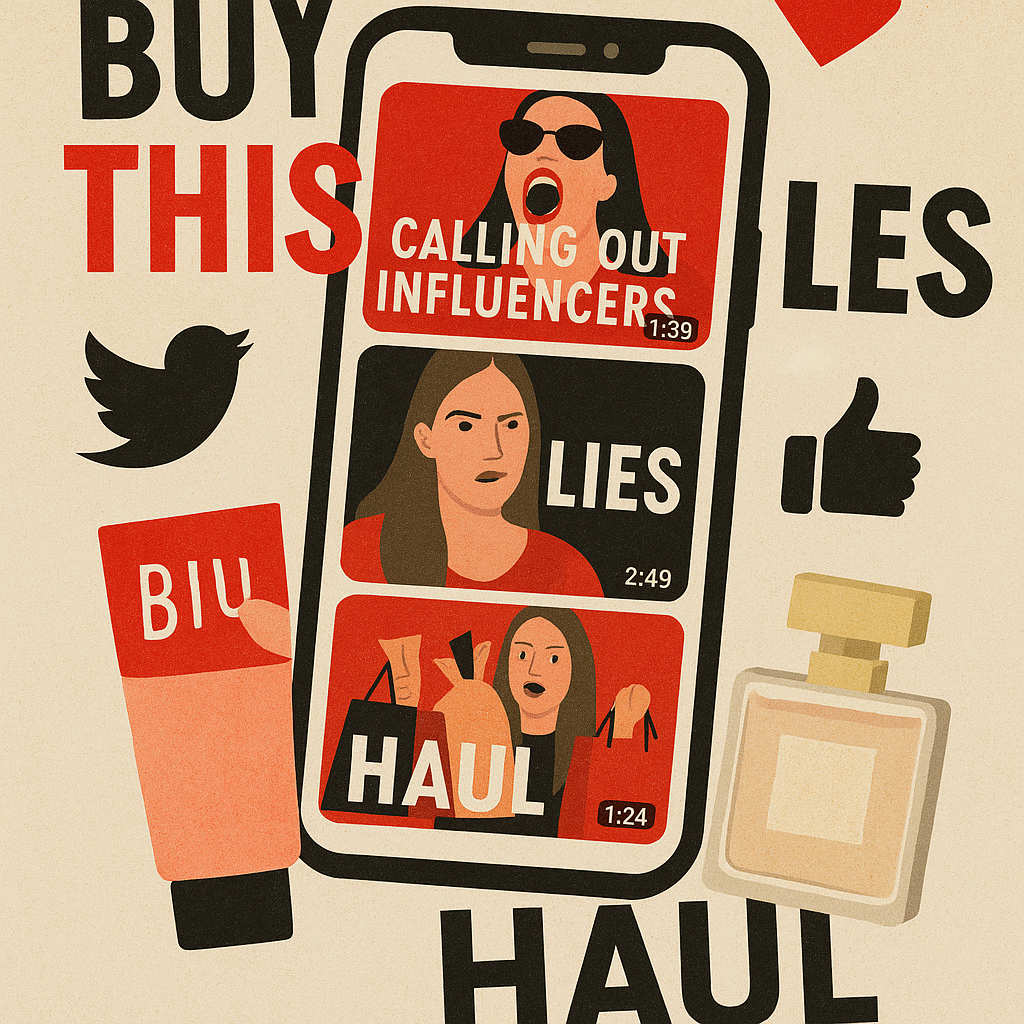
Yet the flood of content also comes with questionable practices. PR packages arrive, and within a week the same influencers are telling their followers to “buy this, buy it now.” A month later, the same bottle appears in a declutter video, framed as “finding it a better home.” This cycle erodes trust, but the algorithms reward constant content, not consistency or integrity.
I expect more noise to flood in, but I hope the creators producing valuable, well-researched content will stay the course. The industry needs their voices now more than ever.
Slow Perfumery as the Outsider
Vertically integrated houses like Les Indémodables are rare and intentional. They control extraction, formulation, bottling, and packaging, and they choose to grow slowly.

They do not want to be mainstream. Their audience is the informed consumer, a small slice of the market. And here is the hard truth: most people will never look for transparency. If I have to dig for weeks to confirm whether a brand makes its own juice, the average buyer will give up instantly.
Most consumers will happily buy their Delina or the latest Quentin Bisch creation and never think about where it came from. And they will be thrilled with it.
The GLP-1 Factor: Collecting for the Dopamine
A year ago, I was the first to connect the gourmand surge to GLP-1 users replacing the pleasure of eating with the pleasure of smelling. Many others have since written along the same lines. But I now believe everyone is all looking in the wrong place, myself included. My prediction was wrong. It is not about taste replacement at all. The real driver is dopamine, the thrill of the hunt, the purchase, and the satisfaction of adding to a growing collection. This is not just a change in fragrance preferences. It is a shift in how people spend their time, attention, and money.
If it were only a matter of preferring one perfume style over another, the market would barely notice. But sales spikes and online frenzy show that these consumers are chasing the high of acquisition. They want the story, the chase, and the satisfaction of ownership.
GLP-1 usage is exploding among younger consumers. Prescriptions for users aged 12 to 25 rose between 68 and 659 percent from 2020 to 2023, with the highest growth among young women. In 2025, nearly 38 percent of Gen Z say they plan to incorporate GLP-1 medications into their health routines.

This collector mindset is spreading to other luxury categories. The global pre-owned luxury watch market is valued at $27 billion and is projected to grow by 10 to 12 percent annually over the next decade. Surveys show that 20 percent of Gen Z plan to buy a luxury mechanical watch in the next year, with many targeting discontinued or rare models. The motivation is the same as in perfume: the excitement of the hunt, the victory of acquisition, and the pride of display in a curated collection.
We are moving into a collecting economy where the pursuit and the acquisition matter as much as, if not more than, the product itself. Perfume is part of that, but so are watches, handbags, sneakers, and other status objects that deliver an emotional payoff before they are even used.
The Consumer Does Not Care and That Is the Point
Perfume is a capitalist industry. The incentives are clear: make what sells. Consumers reward hype, FOMO, and instant gratification. Very few reward transparency, heritage preservation, or vertical integration.
And that is why the market will keep serving exactly what sells, whether it is crafted in a small lab in Grasse, built by AI in Paris, or filled in a factory halfway around the world.
One of the biggest assets I have in life is my ability to spot patterns and predict trends before they happen. Marking the first anniversary of Elevated Classics felt like the right time to share my observations and forecasts with you.
Tell me, what do you see coming in the year ahead? Which of these predictions do you agree with, and which would you challenge?




Leave a Reply