
Two of the greatest houses in French perfumery are confronting the same problem: what do you do with a masterpiece when the world around it has changed? Their answers could hardly be more different.
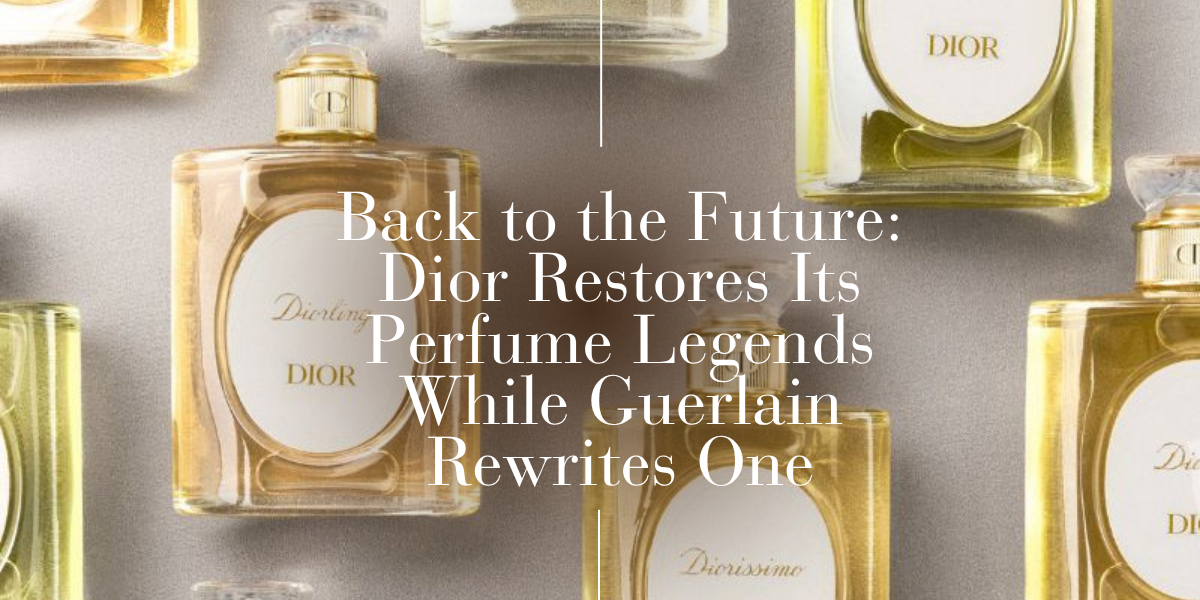
Just when I thought Guerlain’s new L’Heure Bleue was going to be the most interesting perfume heritage story of the fall, Dior announced something remarkable. Francis Kurkdjian, Dior’s Perfume Creation Director, has spent four years working through the house archives on Dioriginals, a project involving 13 historic Dior fragrances. Rather than simply reformulating them for current regulations, Dior says the objective is to restore their earlier olfactory identities, using contemporary materials and technology to recover characteristics that have been lost over decades. The collection launches October 1.

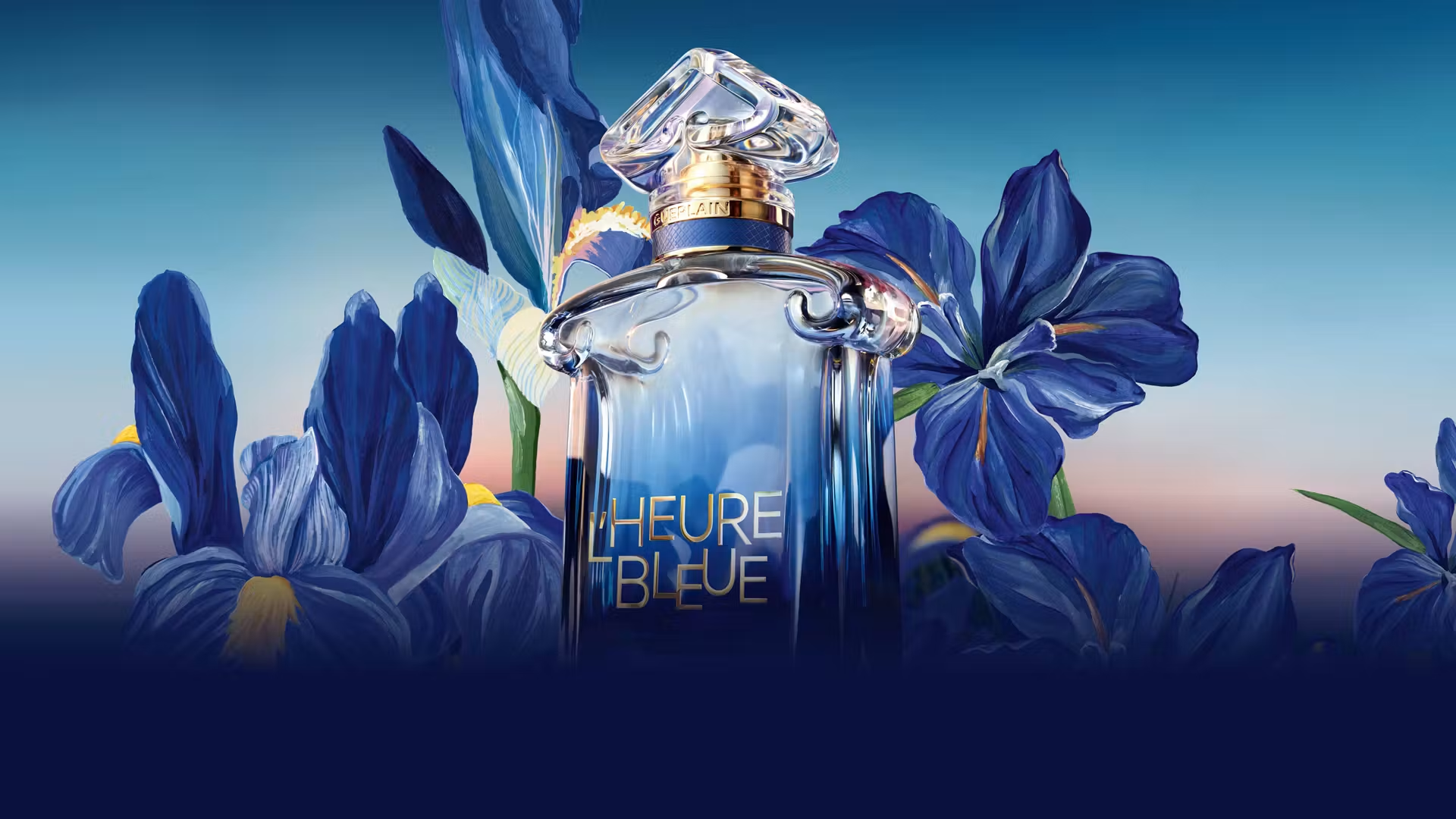
The timing makes this particularly fascinating. Only days earlier, fellow LVMH house Guerlain formally introduced Delphine Jelk’s new L’Heure Bleue, a contemporary interpretation of Jacques Guerlain’s 1912 masterpiece. The historic fragrance remains in the collection, but it now continues specifically as L’Heure Bleue 1912, while the new creation carries the name L’Heure Bleue.
The two houses are dealing with the same fundamental problem of perfume heritage, but they are taking almost opposite routes.
Dior Tries to Recover What Was Lost
Perfume does not age through history as neatly as a painting or a book. Natural materials change, suppliers disappear, safety standards evolve and certain ingredients can no longer be used at the concentrations they once were. A fragrance can therefore remain on the market for decades under exactly the same name while the formula changes underneath it.
Kurkdjian found that some of Dior’s classics had moved far enough from their earlier forms that he described them as having become eroded over time. Regulation and ingredient availability were part of the reason, but not the whole story. According to his account of the project, some changes had also been made for commercial reasons.

His approach was unusual. The Dior team first reconstructed earlier versions of the fragrances as closely as possible to use as olfactory references, including materials that could not necessarily be used in a commercial fragrance today. From there, the studio worked with currently permitted materials and modern perfumery techniques to reproduce the effect of those historical references.
Kurkdjian summarized the challenge perfectly: “I used modern ingredients to make them feel old.”
That is an important distinction. Dior is not claiming that a perfume manufactured in 2026 can literally be the same liquid sold in 1956. It is attempting to use what perfumers know now to recover what decades of reformulation gradually changed.
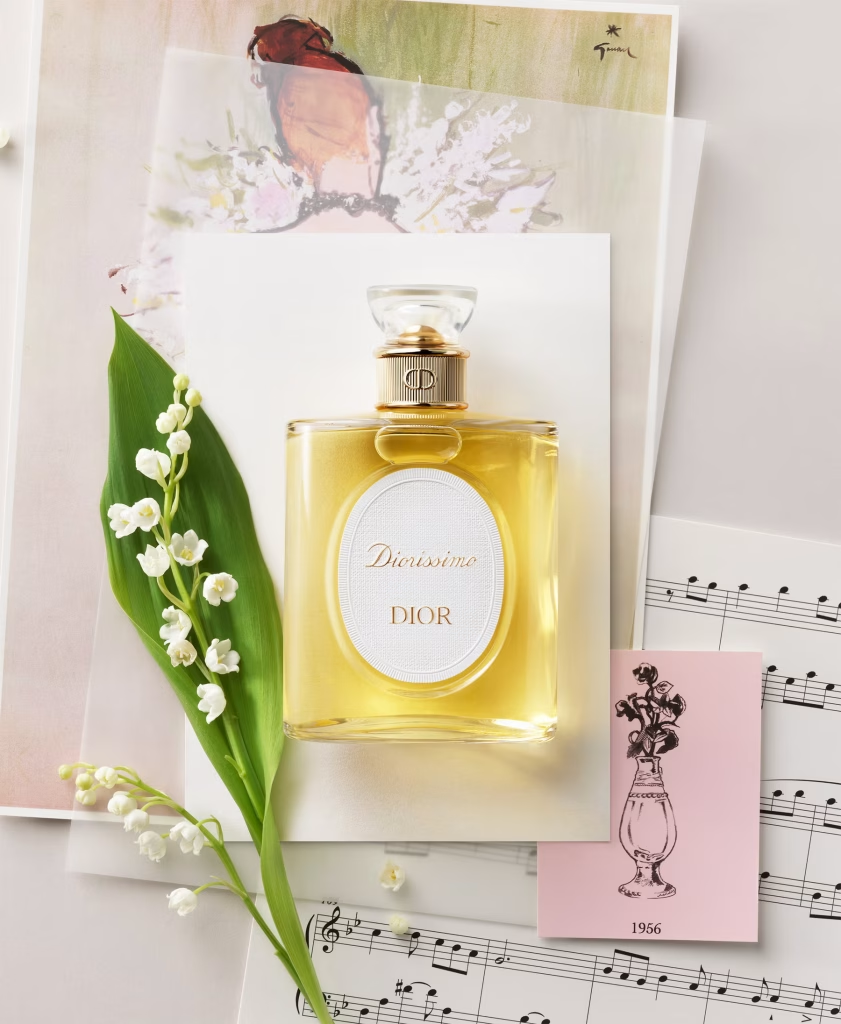
Some of the examples are extraordinary. With Roudnitska’s Eau Fraîche, Dior rebuilt the citrus and basil-tarragon structure while removing later additions. For Diorissimo, Kurkdjian reconstructed the white lily-of-the-valley floral accord and worked with a different quality of jasmine to regain more of its earlier character.
I am particularly interested in Diorella. Dior restored an apricot-like fruity quality that had disappeared from later versions, and Kurkdjian reportedly found that moving the perfume closer to its 1972 identity made it smell surprisingly contemporary. There is something wonderfully counterintuitive about that. Going backward does not necessarily make a perfume smell older. Sometimes it reveals how modern the original composition was in the first place.
The fragrances are also returning in a revived version of Dior’s historic Ovale bottle, reinforcing the idea that this is being presented as an archive restored rather than simply another packaging cycle.
THE 13 DIORIGINALS AT A GLANCE
| PERFUME | HISTORIC RELEASE | PERFUMER |
|---|---|---|
| Diorama | 1949 | Edmond Roudnitska |
| Eau Fraîche | 1955* | Edmond Roudnitska |
| Diorissimo | 1956 | Edmond Roudnitska |
| Diorling | 1963 | Paul Vacher |
| Diorella | 1972 | Edmond Roudnitska |
| Dioressence | 1979* | Max Gavarry |
| Jules | 1980 | Jean Martel |
| Dune | 1991 | Jean-Louis Sieuzac and Dominique Ropion* |
| Dolce Vita | 1995 | Pierre Bourdon* |
| Dune Pour Homme | 1997 | Olivier Cresp and Jean-Pierre Béthouart |
| Higher | 2001 | Olivier Gillotin and Olivier Pescheux |
| Forever and Ever | 2002* | Authorship of the earliest edition is not consistently documented |
| Higher Energy | 2003 | Nathalie Gracia-Cetto and Carlos Viñals |
Guerlain Is Doing Something Very Different
Now consider what Guerlain has just done with L’Heure Bleue.
Jacques Guerlain created the fragrance in 1912, and it has remained one of the defining works of the house for more than a century. Delphine Jelk’s 2026 L’Heure Bleue, however, is not an attempt to reconstruct Jacques Guerlain’s perfume. Guerlain explicitly describes it as a new interpretation.

The new composition introduces an exclusive iris tincture developed after three years of research at Guerlain’s Orphin manufacture. Iris and orange blossom remain central, with vanilla providing the familiar Guerlain warmth, but the treatment is fresher and more aerial. The house has also retained the historic fragrance in Les Légendaires rather than removing it from the market.
What makes the decision provocative is the naming. The historic perfume is now identified as L’Heure Bleue 1912. Delphine Jelk’s new interpretation gets to be simply L’Heure Bleue.
Guerlain is therefore treating L’Heure Bleue as an idea capable of being interpreted again. Jacques Guerlain gave us his version of the blue hour in 1912. More than a century later, Delphine Jelk is being allowed to give us hers. The historical perfume survives, but the famous name moves forward.
Dior is doing almost the reverse. Rather than asking what Diorella or Diorissimo should become in 2026, Kurkdjian is asking how much of what they once were can still be recovered.
Same Owner, Two Bets on the Future
This is the part I find most interesting. Dior and Guerlain are both LVMH houses. LVMH itself describes its operating structure as decentralized, with its Maisons retaining autonomy and their own identities, so there is no reason to assume these two projects were conceived as part of one coordinated perfume strategy.
But step outside the corporate structure for a moment and look at what LVMH now has in the marketplace. At Dior, one of the world’s most important luxury groups is funding a four-year project to recover historic perfumes and asking consumers to appreciate the work of Edmond Roudnitska, Paul Vacher and the other perfumers who helped build the house’s olfactory identity.
At Guerlain, the same group owns a house that has just handed one of perfumery’s most famous names to a contemporary perfumer, preserved the historic version alongside it and invited the customer to accept both.
Whether anyone at LVMH intended it this way or not, it looks remarkably like a hedge. One house is betting that heritage itself still has value. The other is betting that heritage can be more useful when it gives the present permission to create something new.
That brings us to the question luxury companies are going to have to answer sooner or later: how much does the new customer actually care about the past?
For decades, luxury has sold history almost as effectively as it has sold handbags, watches and perfume. A house founded in 1828 or a fragrance created in 1956 carries authority simply because it survived. But a younger customer may not necessarily have the same emotional attachment to Edmond Roudnitska, Jacques Guerlain or the idea that a perfume should smell as it did 70 years ago. Perhaps provenance and authorship will matter enormously. Perhaps the famous name, beautiful bottle and perfume they enjoy wearing now will matter more.
Same owner. Two very different bets. Now we get to see which idea of heritage the perfume customer wants.





Leave a Reply