
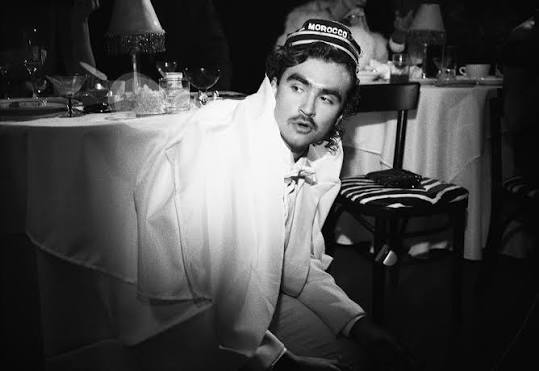
El Morocco has a great story, serious perfumers and some of the most elaborate packaging I have encountered this year. After buying the $135 discovery set, I am convinced the marketing is not simply the brand’s greatest strength. It may be the product.

I bought the El Morocco discovery set because the concept caught my attention, which is worth admitting because the marketing worked on me exactly as intended. El Morocco is the first in-house fragrance project from Flower Shop Perfumes founders Lillian Shalom and Isaac Lekach, who built the brand around their fascination with the famous Manhattan nightclub that opened in 1931 and became synonymous with café society, celebrities and its unmistakable zebra-striped banquettes. They collected memorabilia, studied the history and turned all of it into a fragrance world filled with cigarettes, cocktails, gossip, old New York, vintage typography and famous patrons. As a branding exercise, it is exceptionally well conceived. The problem began when I stopped looking at El Morocco and started smelling it.
They Sold the World Before They Sold the Perfume
The launch itself was clever. LuckyScent introduced the discovery set with a video that focused heavily on the presentation and the story, and the $135 set sold out quickly before becoming available again. At that stage, the full-size perfumes were not even available to buy. Only later did the 75 ml bottles appear online at $245 each. That sequence tells you quite a lot about the strategy: El Morocco did not initially ask consumers to fall in love with a perfume. It asked them to fall in love with El Morocco.

I can admire how well that was done and still dislike the product. The discovery set contains five 2 ml samples inside a large, heavy metal case inspired by an old cigarette case, along with a pocket square. The case is far too bulky for ten milliliters of perfume and mine was so difficult to open that I actually broke a nail trying to get into it. Then there is the pocket square, which reads more like a cheap polyester scarf than anything I would consider a luxury accessory. I have no idea what I am supposed to do with it and certainly would not wear it. It feels like another prop included because the brand needed one more historical detail, and at $135 I would much rather have received the same five samples in a beautiful, sensible box for considerably less money.
That is where the pricing becomes difficult to ignore. You are not paying $135 because five tiny perfume samples are worth $135. You are paying for the metal case, the mechanism, the accessory, the design work, the story and the marketing that made the set desirable before you smelled anything inside it. The full bottles follow the same logic. At $245 for 75 ml, they arrive in white porcelain vessels inspired by match lighters from the original club, with blue lettering and a zebra motif. I understand the reference perfectly well. I just think they look like ceramic vessels that might arrive at a restaurant holding tequila. Historical inspiration does not automatically make an object beautiful, and an unusual bottle does not make the perfume inside more interesting.
The Perfumes Are the Weakest Part
What makes the collection more disappointing is that El Morocco hired very good perfumers. Alexis Grugeon, Laurent Le Guernec, Céline Barel, Rodrigo Flores-Roux and Yann Vasnier are serious names, so this is not a case of amateur perfume hiding behind expensive packaging. The fragrances are professionally made, polished and entirely wearable. They are also, with one exception, extraordinarily ordinary to me. 154, Gala, Highball for Lucius B. and Lulu’s Back in Town all come with distinctive names and elaborate stories, yet once I wore them, I kept thinking that I had smelled variations of these ideas many times before from many other contemporary neo-niche brands. Nothing smelled badly made. Nothing offended me. They simply gave me very little reason to care.

Two Cigarettes in the Dark was the only one that came close to delivering the world being advertised. Its smoky woods and darker character gave me some sense of a nightclub after midnight, and the name, atmosphere and perfume at least felt connected. I still did not want a full bottle, but I could understand the idea without needing the marketing copy to explain it to me. The rest were far more memorable as concepts than as fragrances, which is a strange position for a perfume house to be in.
The clearest indication of how little they interested me is that I never even finished the samples. I buy perfume, study perfume and routinely wear something several times because I want to understand it properly, so abandoning samples I had paid $135 for is not something I do lightly. I simply stopped reaching for them. At a certain point, continuing to test them felt like a waste of my time, which was especially irritating considering how much I had already paid to discover them.
The Industry Is Becoming Too Good at Selling Mediocre Perfume
This is why El Morocco interests me beyond one bad purchasing experience. It represents something I increasingly dislike about the fragrance industry. We already have an oversaturated market, yet new brands continue to arrive with elaborate founder stories, cinematic campaigns, collectible packaging, historical narratives and social-media-ready objects before anyone has established whether the perfumes themselves give us anything particularly new or worthwhile. The creative energy increasingly seems to go into finding a concept that can be marketed, photographed and explained rather than creating a perfume that can stand on its own.

El Morocco happens to be very good at the marketing part, and I mean that without sarcasm. The zebra is recognizable, the nightclub gives them an endless archive of material, the packaging is impossible to confuse with another brand and the launch created demand before the full bottles were even available. They understand exactly how fragrance is sold now. The problem is that strong branding does not make mediocre perfume less mediocre. It simply makes mediocre perfume easier to sell, and the industry does not need more beautifully packaged fragrances whose principal contribution is giving consumers another object to photograph.
I would not be surprised if El Morocco becomes successful. Parfums de Marly demonstrated how powerful a recognizable fantasy can be when it is attached to fragrance, and El Morocco is clearly attempting to build its own version around old New York nightlife. I am less convinced that a defunct Manhattan nightclub has the same long-term aspirational pull as the endlessly reusable imagery of French royalty, palaces and horses, but perhaps it does not need to. People may simply like the zebra, the bottles and the idea of decadent café society. Commercially, that may be enough.
What I object to is the assumption that commercial success and good perfume are the same thing. They are not. El Morocco may become highly recognizable, sell extremely well and build a loyal following while I continue to think the perfumes themselves are mediocre. Both things can be true.
I remember the nightclub, the zebra, the case, the scarf and the bottles because the marketing made sure I would remember them. The problem is that I do not care about any of it. What I wanted to care about was the perfume. That is the part I barely remember.





Leave a Reply