
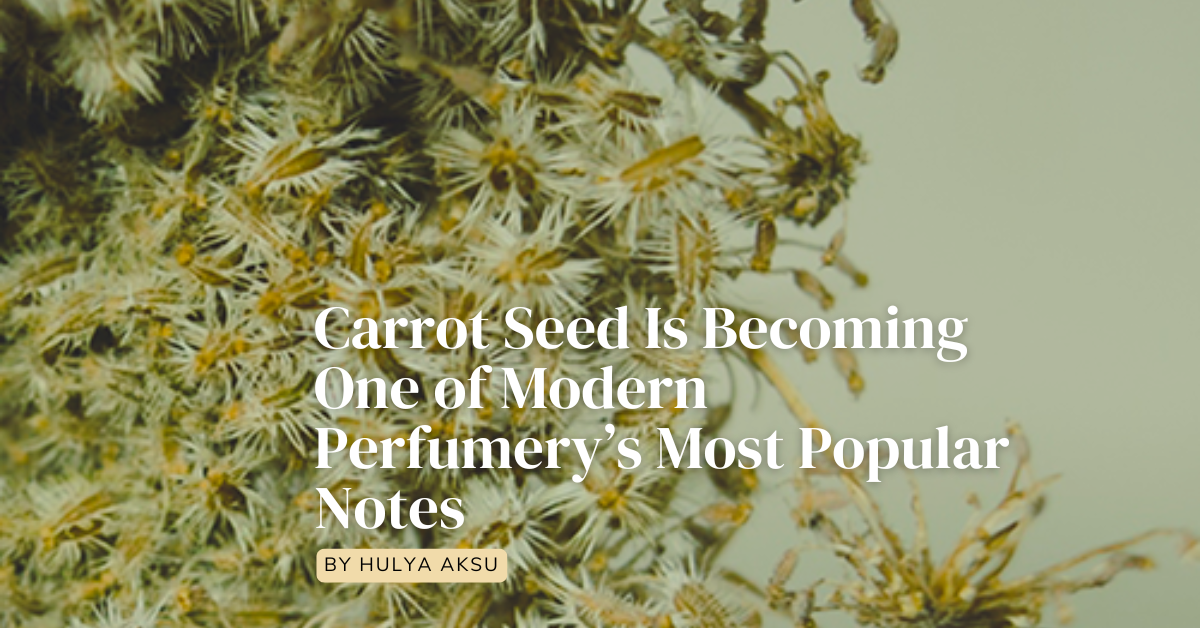
How an unlikely ingredient, carrot seed, became one of modern perfumery’s most intriguing signatures
Perfume lovers often expect fragrance to smell beautiful in obvious ways. Roses bloom. Jasmine glows. Vanilla comforts. Even the darker materials of perfumery, oud or patchouli, come with reputations that precede them.
Carrot seed does not.
The first time many people encounter it in a perfume, the reaction is closer to curiosity than recognition. The scent is not floral in the traditional sense, nor is it overtly woody or gourmand. Instead it sits in an ambiguous territory that perfumers sometimes describe as grey: earthy, rooty, slightly dusty. There is a powdery softness that feels almost cosmetic, but beneath it lies something vegetal and quietly warm.
Carrot seed smells less like a flower and more like the idea of a plant still connected to the soil.
For much of its history in perfumery, carrot seed played a modest role, a supporting material used to add nuance to compositions built around more glamorous ingredients. Recently, though, that quiet character actor has begun stepping forward. A growing number of modern fragrances place carrot seed closer to the center of the formula, revealing a material whose understated complexity feels remarkably contemporary.
The Supporting Note
Carrot seed essential oil comes from the seeds of Daucus carota, the wild carrot plant, and has long been part of the classical perfumer’s palette. Traditionally, it appeared almost invisibly in formulas, used to reinforce the root-like character of iris, to lend an earthy dimension to green structures, or to blur the edges of sharp woods and spices.

In many iris‑centered perfumes of the twentieth century, perfumers relied on rooty and earthy facets, sometimes including carrot-like nuances, to deepen the powdery elegance of orris without drawing attention to any single raw material. In this context, carrot seed was never meant to be noticed directly. Its role was largely structural: adding texture, a suggestion of soil and root, beneath the polished surface.
For much of the last century, this was how the ingredient was treated: useful, versatile, and respected in technical circles, but rarely discussed in the romantic language of perfume marketing.
Then something changed.
Feels Modern
The renewed interest in carrot seed coincides with a broader shift in perfume aesthetics. Over roughly the past decade, the mainstream has begun to drift away from the heavy, dessert‑like sweetness that defined the early 2000s. Gourmands remain popular, but many contemporary and niche fragrances now aim for something quieter and more intimate.
The way we talk about perfume has evolved too. “Skin scent” has become a familiar term, describing fragrances designed to sit close to the body rather than dominate a room. These compositions lean on musks, smooth woods, and airy synthetics like ambroxan to create an aura that feels personal rather than performative.
Carrot seed fits beautifully into this new language.
Its powdery, slightly granular texture echoes the effect of orris butter, the luxurious material obtained from aged iris rhizomes. Orris is among the most expensive ingredients in perfumery, commanding very high prices per kilogram due to its long aging process and low yield. Carrot seed cannot reproduce orris exactly, but it can echo that same rooty softness while contributing its own warm, vegetal nuance.

For perfumers working within the vocabulary of skin scents, carrot seed offers a way to build depth without weight. It adds texture rather than volume, giving a fragrance an inner landscape without increasing its loudness.
There is also a cultural shift at play. Many fragrance wearers now crave a sense of naturalism and lived‑in ease. Materials that feel botanical, earthy, or slightly imperfect can be more compelling than glossy, candied accords. Carrot seed, with its grounded realism, answers that desire.
It smells like something that actually grows.
Presence on the Shelf
The beauty of carrot seed becomes most apparent once you start noticing it across different bottles. In a personal collection, a handful of perfumes can illustrate how adaptable it is.
In Diptyque Vetyverio, carrot-like, rooty tones emerge alongside rose, spices, and vetiver. On skin, the vetiver feels less like polished wood and more like the whole plant—root and soil included, slightly dusty, dry, and alive with green tension.
A different facet appears in Nicolai Iris Médicis Intense, where a carrot‑toned nuance deepens the powdery elegance of iris. Wearing it can feel like stepping into a quiet Parisian salon: filtered light, pale fabrics, the soft aura of cosmetics. The rooty note keeps the iris grounded, preventing it from drifting into pure abstraction.

Then there is Maison d’Etto I-Dream, where perfumer Rodrigo Flores-Roux brings a subtle carrot-like warmth into the opening alongside clary sage and cypress. The fragrance moves through milk, leather, and vanilla, yet that earthy softness remains a gentle thread, giving the creamy accords a suede-like finish instead of pure sweetness.
In Astrophil & Stella Madame M, a carrot seed effect takes on yet another personality within a gourmand structure of cacao, benzoin, and tonka bean. Rather than amplifying the sugar, it introduces dryness and powder, giving the fragrance a more refined, almost cosmetic restraint.
These perfumes share little stylistically, yet carrot seed, or materials that echo its character, adapts to each of them. Sometimes green, sometimes powdery, sometimes quietly warm.
Luxury of Restraint
Once, luxury in perfumery meant immediate opulence: dense white florals, heavy resins, towering aldehydic bouquets. These were fragrances that announced themselves long before the wearer entered the room. Today, luxury often looks different. It can be quieter, more introspective, and less concerned with dramatic entrances. It may be found in the quality of materials, in the nuance of blending, in how a scent seems to merge with a person’s own skin.
Carrot seed embodies that shift. It lends depth, warmth, and a faintly mysterious softness that you feel more than you can neatly describe. At first encounter, the ingredient can smell humble, almost mundane. And yet, in the hands of a skilled perfumer, it becomes something unexpectedly refined.
A reminder that beauty in perfume does not always come from the obvious places. Sometimes it grows underground.







Leave a Reply