
Granado’s story is as layered as its perfumes. Founded in Rio de Janeiro in 1870 by José Antônio Coxito Granado, the house began with land. On his property in Teresópolis, Granado cultivated citrus fruits, herbs, and flowers. This was Brazil in the late nineteenth century, when plantation culture shaped the country’s economy. Though Granado’s holdings were modest compared to the vast coffee and sugar estates, they echoed the same reliance on the land. The fruits of his orchards became tinctures, aromatic waters, and syrups. These remedies, blending Brazil’s biodiversity with European apothecary tradition, earned him prestige and soon the title of Official Pharmacy of the Brazilian Imperial Family.

For more than a century, Granado remained in the hands of the founder’s descendants. It grew into a respected pharmacy chain, producing soaps, powders, and cosmetics alongside its medicines. But by the late twentieth century, the story nearly ended. Brazil’s turbulent economy and the rise of modern drugstore chains left Granado looking dated and struggling.
The turning point came in 1994, when Christopher Freeman, an English entrepreneur who had made his home in Brazil, acquired the company. What could have been the quiet decline of a heritage brand became instead a rebirth. Freeman modernized production, revived packaging, and repositioned Granado as a house that honored its history while looking forward. In 2005 his daughter, Sissi Freeman, joined as Marketing Director. With her leadership, Granado leapt onto the international stage. Today the brand has boutiques in Paris, London, Lisbon, and New York, alongside nearly a hundred stores in Brazil. Pop-ups at Liberty in London and Galeries Lafayette in Paris present Granado with carnival colors and tropical motifs rather than the cool minimalism many perfume houses adopt.

Perfume is now central to Granado’s growth. In London stores, fragrances represent more than seventy percent of sales. Collaborations with world-renowned noses like Cécile Zarokian and Quentin Bisch have produced scents that feel both Brazilian and global. The Freeman family has also steered the company toward sustainability, pioneering vegetable-based soaps, abolishing animal testing, and securing Zero Waste certification at its factory in Rio de Janeiro’s countryside.
Against this backdrop, 2025 brought three new launches that I recently purchased for myself: Rosa Sublime, Apotecário, and Citrus Brasilis. I love all three for different reasons, and together they show how Granado’s past and present intertwine.

Rosa Sublime
Born as a poetic tribute to the rose, one of perfumery’s most iconic flowers, Rosa Sublime is Granado’s most romantic launch of 2025. Created by Quentin Bisch, it opens with cassis, nutmeg, and davana before revealing a lush floral heart of rose, geranium, and jasmine. The base is warm and textured, with saffron, amber, and sandalwood giving the rose a velvety, almost tactile richness.
On skin, Rosa Sublime reads as romantic but not fragile. It is commanding, with a slow reveal that rewards patience, like a flower opening at dusk. For me, it also echoes Granado’s beginnings: a house once tied to the cultivation of land now shaping its heritage around another cultivated icon, the rose.

Apotecário
If Rosa Sublime looks to the rose, Apotecário looks backward in time. It is a fragrance that deliberately honors Granado’s origins. In 1870, José Antônio Coxito and João Bernardo Granado worked side by side in their Rio de Janeiro apothecary, blending elixirs and toiletry products. This perfume channels that world, glass jars, tinctures, and the alchemy of raw materials transformed into remedies.
Apotecário opens with a sharp spark of bergamot, cardamom, and black pepper, the kind of aromatic lift that feels both medicinal and invigorating. The heart is built on leather, black tea, and cypriol, evoking the darker corners of the apothecary shelves. The base is a complex weave of tonka bean, patchouli, and myrrh, balancing smoke, sweetness, and resin.
On skin, Apotecário is rich and layered, moving from spice to smoke to a lingering leather-amber warmth. It feels intellectual yet sensual, a perfume that wears like a reflection of Granado itself, rooted in history, but reimagined for the present.

Citrus Brasilis
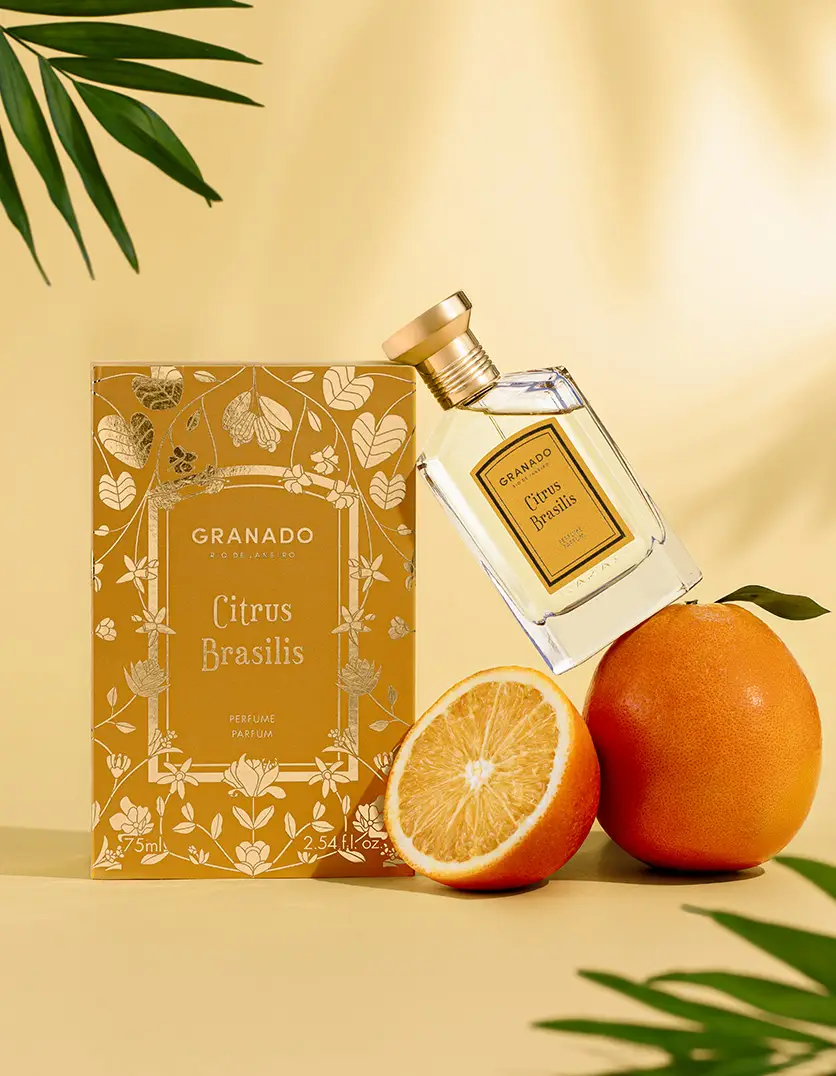
Citrus has been part of Granado’s story since the very beginning. In the 19th century, José Antônio Coxito Granado cultivated citrus trees on his land in Teresópolis and turned their fruits into aromatic waters and syrups, including orange blossom water and compound lemon spirit. Citrus Brasilis reclaims that legacy with a contemporary freshness. Also created by Quentin Bisch, the perfume was inspired both by the memory of an orange tree in his own backyard and by the apothecary formulations that made Granado’s name.
Citrus Brasilis feels as carefully crafted as it is bright. The opening sparkles with mandarin, lemon, and bergamot, a pure rush of sunshine. The heart blends mint, jasmine, and kumquat, giving the citrus a refreshing twist without losing its softness. Musk, violet leaf, and patchouli form a gentle, lingering base that grounds the fragrance while keeping it airy.
On skin, Citrus Brasilis is joyful, energetic, and immediately transporting. It reads not as a fleeting cologne but as a full-bodied citrus composition, layered and sophisticated. To me, it feels like wearing a piece of Granado’s orchard history, reimagined as a modern fragrance.
What stands out to me beyond the compositions themselves are the details: the bottles are beautiful, the longevity and sillage are strong without being overwhelming, and the pricing feels fair for the quality. Most importantly, these fragrances don’t smell like everything else on the market.
Have you tried Granado? Do you know these new perfumes, or Quentin Bisch’s work more broadly? I’d love to hear your take.
Elevated Classics Classification
Primary Category: Heritage Brand
Secondary Tags: Family-Owned (Freeman stewardship), International Expansion, Plantation-Era Origins, Collaborations with Master Perfumers, Sustainable Practices, Brazilian Biodiversity Focus






Leave a Reply