
I came to Joel Martínez through someone I trust when it comes to perfume: my brother. We share a deep love for classical French perfumery and its discipline, the kind of flawless construction that leaves nothing unresolved. But where I tend to be cautious, he is more willing to venture toward the margins, toward work that does not follow familiar European structures. Over time, I have learned that when something holds his attention despite that resistance, it is worth looking more closely.
Joel Martínez was one of those moments.
There is no shortage of beautiful perfume in the world. Anyone with sufficient means can commission an exceptional composition. You can sit across from some of the most gifted perfumers alive, refine a formula until it is impeccable, and surround it with a story carefully shaped for credibility. Often, that story reaches backward into ancestry or rediscovered archives. There is nothing inherently wrong with this model. It is how much of modern perfumery operates.
But there are people who choose a different path.
The work does not begin with the perfume. It begins elsewhere, with the plant itself, with the place where it grows, and with the realities that shape it long before extraction is even possible. Seasonality, access, permission, time. These are not constraints to work around, but conditions to work within. Some forms of knowledge only reveal themselves this way, slowly, through proximity and patience.
That is the space Joel Martínez occupies.
I reached out to him directly. At the time, he was traveling through India. We stayed in touch loosely as he moved between places, with brief confirmations that he was working and would return to the questions when he could. The answers came later, written during his travels.


Around that time, he sent me Viento Puelche, the fourth creation in his ongoing series Los Siete Mestizos. It arrived with a handwritten note, a beautifully weighted bottle, and a cap carved from natural material, irregular and unmistakably made by hand. Small wooden elements accompanied it, pieces connected to the same natural world as the perfume itself. I placed them in my vitrine among the bottles that, over the years, have come to mark turning points in my own understanding of scent.
I will return to the perfume itself later. It deserves its own space. But even before wearing it, something was already clear. This was not an object designed to impress immediately. It carried a sense of origin that felt inseparable from its form.
Joel Martínez does not operate from within perfumery as it is typically practiced. His work grows out of phytotherapy, ethnobotany, and years spent traveling through Chile and South America, working with distillers, herbalists, academics, and local communities. He describes 432 as an aromatic research laboratory, and the term feels precise. These perfumes are not conceived as products first. They are outcomes of process.
What struck me most, reading his responses and handling the work itself, was a consistent sense of responsibility. Toward materials. Toward people. Toward the consequences of scale. His batches remain small not because scarcity sells, but because expansion carries costs he is unwilling to externalize. Some of his liquids are unfiltered not as provocation, but as fact. The plants he works with arrive with histories that cannot be erased by refinement.
This kind of work exposes the limits of much contemporary perfume storytelling, where provenance becomes aesthetic rather than lived, and nature is invoked without accountability. Joel does not perform rebellion. He practices it quietly, through structure and restraint.
What follows is a conversation that became one of the most rewarding journeys into perfume knowledge I have had in years. Joel’s answers appear in his own voice.
The Interview

Founder of 432 | Aromatic Explorations
Presented in the founder’s own voice. Edited only for clarity.
Background and Personal Path
Your work reveals a level of botanical knowledge that is rare in mainstream perfumery. Before we speak about the fragrances, I would like to understand the person behind them.
Can you share your background and the experiences that led you to start working with native South American plants and natural extractions?
There are three paths in my life that intertwine in this adventure, some of which began when I was a child in the city where I grew up: Arica, a port and valley in the north of the Atacama Desert, an old Peruvian city that, for political reasons, became Chilean. This is why I feel half Chilean and half “cholo.”
In Arica, I spent many afternoons as a child wandering through plant nurseries and olive groves. It was my most beautiful distraction, and from there began my interest in the plant world, beyond traditional botany, which I later deepened during my studies as a phytotherapist and herbalist.
The connection with plants is, for me, spiritual and reverential. They clothe us, feed us, give us wood for fire and for houses. Sacred plants allow us to travel to the deepest parts of our being. They are medicine. They gift us beauty.
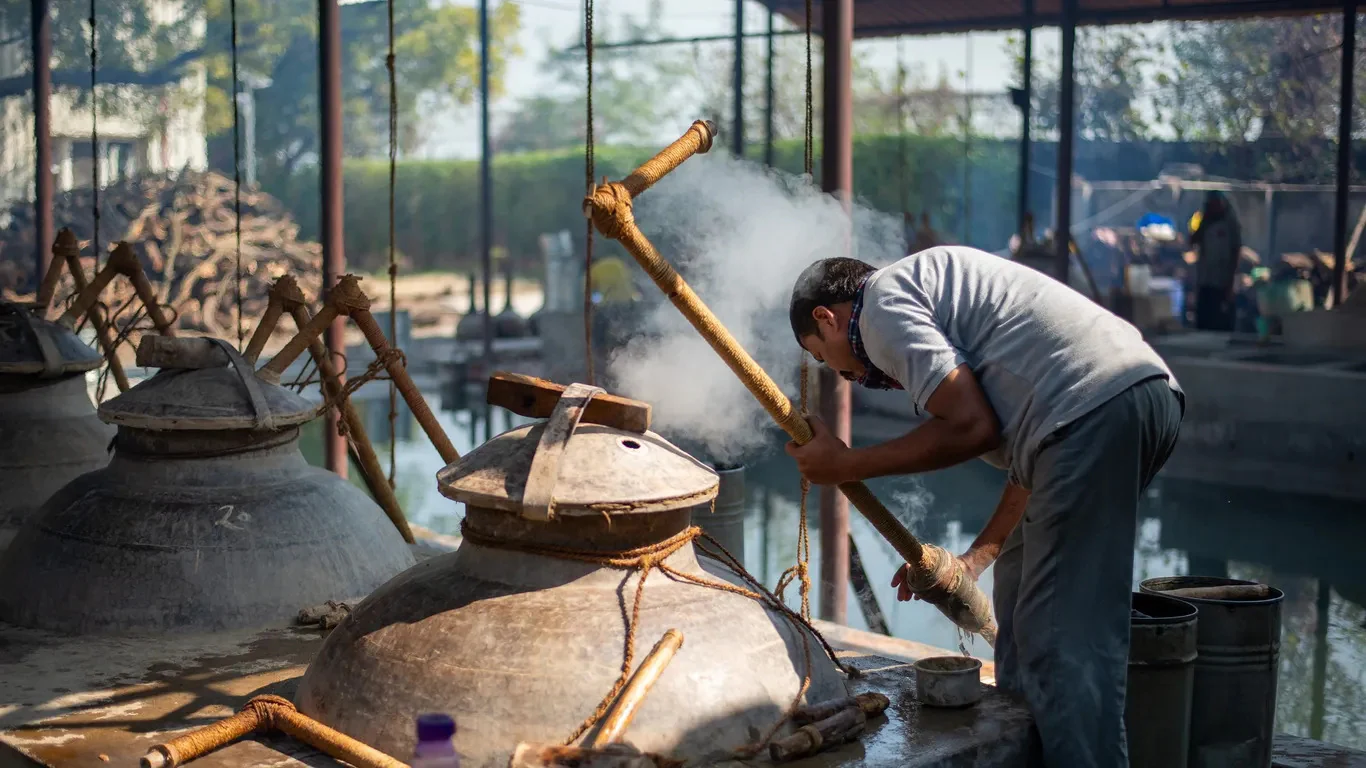
When I began working with plant-based medicine, alembics appeared. Copper appeared. This metal so close to Chile and Peru, countries that produce approximately forty percent of the world’s output.
Copper stills and extractions, which I initially began for medicinal purposes, opened my world to the beauty of aromas, volatile molecules, and the hedonistic, beautiful pleasure of aromatic extractions.
This mixed, blended, and became mestizo with my work in the world of travel, tourism, and experience design, which has been my life for the last fifteen years. Traveling across Chile, unexplored corners, getting to know various communities deeply, and working with clients from all over the world. Once, I even got to be a tour guide for Sir Paul McCartney.
On the other hand, there is my interest in philosophy and art history. I have written books of poetry and studied Aesthetics at the Catholic University of Chile.
It is a mix of interests: distillations, botany, experience design, travel, art, and shamanism. From that, 432 emerges.
Creative Philosophy
Many perfumers begin with classical training or working on commercial briefs. Your approach looks very different. What shaped your philosophy and convinced you that fieldwork and ethnobotany were the right foundation for your creative identity?
The evolution of my work has been natural. It blends distillations in the Andes Mountains, training in Grasse, the South American aroma encounters we hold annually in the Paraná rainforest, Latin American art, and mentorship from perfumer Marina Barcenilla at her School of Creative Perfumery.
I am not very knowledgeable about perfume brands, and I have never much liked commercial perfumes. I find them boring and predictable.
Fieldwork and ethnobotany have pushed me to develop my work, and the positive reception has maintained my enthusiasm.
From Obsession to Company
At what moment did 432 shift from a personal idea to a real company? What convinced you that this concept could grow beyond a private research project?
When I see that this work, which is so “exotic” and outside tradition, connects with clients from all over the world who are willing to buy, pay for international shipping, and enjoy the creations, it generates in me the enthusiasm to keep researching, traveling, and never stop reflecting.
A tribe is formed. Clients with whom I share ideas and who show me their interest. The idea that it is possible to fund this passion pushes me to make 432 more than a private madness.
Building the Company
You describe 432 as an aromatic research house rather than a traditional perfume brand. How is the company structured behind the scenes and who is involved in the work with you?
We are a small circus. In Spanish, we say somos pocos pero locos — we are few but crazy.
I am accompanied by Margarita Echenique in art and design, the artist Cristopher Olguín in craftsmanship, and now filmmaker Ximena Faunes is joining.
We also have the important logistical support of Olfativo, a Chilean company that takes care of us with logistics, technical and laboratory consulting, and the administrative support we are not capable of handling ourselves. They are our co-pilots.

Besides the perfume collections, we are developing a documentary about the aromas of the southern part of the planet and their protagonists. We are also interested in investing in the conservation of native aromatic plants that are in danger of extinction, among them the Lucumillo, a micro-endemic Myrtaceae that lives only in an eighty-kilometer stretch in the entire galaxy.
Process and Scale
Your process requires travel to remote landscapes to source materials that have never been used in perfumery. How do you balance this with the practical needs of producing, bottling, and distributing a fragrance line?
The balance lies in making limited editions, slow perfumery, and choosing my distributors to be my allies, people who understand that we are not a fast-food factory or a fragrance-by-the-kilo operation.
Priority lies in the fieldwork.
Cultural Responsibility
Several of your ingredients carry cultural or spiritual meaning in Indigenous communities. How do you approach conversations around respect, permissions, and cultural representation as part of your work?
It is fundamental for us to work with local suppliers, to get to know them, and for them to understand our work. We learn from them, and for them, the work of the documentary film is financed mainly by perfume sales.
A circular economy and a slow, ethical perfumery are the foundation of our vision.
Relating to friends from the communities themselves is the joy behind the brand, and it is what makes our launches slow compared to traditional perfumery. We feel proud that the communities feel proud of our work.
It is a virtuous circle, both ethically and economically.
Sourcing and Raw Materials
Melinka, Arrayán Rojo, and Canelo Negro all begin with plants deeply rooted in Chilean and Patagonian ecosystems. Can you describe what a sourcing trip looks like?
Ahhh, you will have to wait for the documentary.
Well, it has been different for every perfume. In Melinka, for example, I had a relationship with a distiller of Ciprés de las Guaitecas for almost three years before starting the project: Mrs. Cecilia Leviñanco. She sold me extractions for me to study.

Then I traveled with Jessica, my life partner, to meet her and learn from her. She initiated me into the secrets of this ancient tree. I stayed at her house. We went sailing together, went to gather seafood with her husband, and began a friendship.
Later, we returned to film. We were on her island, in Patagonia, in a small town where only a few families live. A paradise.
All the experiences prior to creating a work are different, organic, and full of respect.
Working Without References
You often work with plants that have no history in perfumery. What does your process look like when there is no reference point?
It is a slow process, because plants, besides their aromatic facets, have symbolic and cultural layers, and are almost always medicines used ancestrally.
It is a process that mixes theoretical study, fieldwork, and, in parallel, the extractions. There are many people indirectly involved, and in the end, I am alone in my workshop, making tests, dilutions, using various extraction methods, and dreaming of a result that I almost always intuit from the beginning of the process.
Academic Collaboration
Do you collaborate with botanists, conservation experts, or academic institutions?
I receive a lot of support from herbalists and scholars of the raw materials that interest me.
I am always supported by PhD Erica Salazar from the Institute of Plant Genetics (INIA) at the University of Chile. She is my teacher, as are those whose research is published and whose books are part of my library.
Regarding the Lucumillo, the heart of the seventh Mestizo, I am working with the University of La Serena, which has a conservation plan for this aromatic shrub from the Pacific coast.
Aesthetic Choices
Your bottles contain unfiltered, dark, resinous liquids. Is this necessity or philosophy?
It is rebellion.
Creative Direction
Your fragrances feel like landscapes rather than character studies. How do you begin a new project?
I begin inspired by the main raw material I want to work with, which will always be the heart of the creation.
Then intuition comes in, the history of perfumery, and the wild territories inhabited by the protagonist plant.

The Seven Mestizos saga, for example, was designed completely two years ago. I defined the plants, the olfactory families, and the raw materials that would accompany each protagonist. It was already in my head when I began.
I dream about them. I receive advice. I work on the craft over time. Some new notes come in, others leave.
My challenge is for the result to communicate beauty, rebellion, luxury, and mystery.
Composition vs. Nature
How do you decide when to stay faithful to a raw material and when to shape it into a classical structure?
It depends on the flexibility of the protagonist.
Some materials, like the Tepa in Viento Puelche, are very aggressive. This allowed me to take it to a more docile, light, and ozonic point, confident that it would not get lost. It becomes omnipresent. It does not respect top, middle, or base notes.
The Ciprés de las Guaitecas, on the other hand, is soft, balsamic, and solemn, which forced me to ensure that the narrative remains balanced and does not take the spotlight away from the main actor.

Teaching Through Raw Materials
Why include raw extraits in the subscription boxes?
I like that we do not forget where this art comes from.
Perfumery comes from a parallel kingdom that intertwines with ours: the plant kingdom. Perfumery does not come from laboratories. It comes from the smoke of plants, from the medicine of their aromas.
That is our inspiration.
Ethics and Sustainability
How do you ensure ecological responsibility when working with ancient or sacred materials?
Our editions are small and very non-invasive. We look for fallen trees or environments of high abundance.
We follow protocols where pruning happens in different places within the same regions, always with the permission and support of local people.
Interpretation and Meaning
How do you think about responsibility when these materials are worn by people outside their original cultural contexts?
I believe we open bridges between cultures.
We communicate beauty beyond the norm, beyond the status quo of perfumery. What we do is art, and it is open to interpretation.
We are not dogmatic, but we are very conscious of the responsibility of communicating the beauty and power of the raw materials and the territories we evoke.
Distribution
Where are your perfumes currently sold, and how do you choose your partners?
I choose stores where I feel comfortable, where I know my brand will be cared for.
We are in Cruz y Valencia and Liquo in Santiago; Sillage in Barcelona; Niche Kuwait; Osmotique in Buenos Aires; the Explora Hotel in San Pedro de Atacama; and Loberías del Sur Hotel in Patagonia.
The idea of slow perfumery also means having coffee with store owners, building trust. Availability has grown organically.
Scale and Growth
Will limited production remain part of the brand’s identity?
Volume is determined by my distillation capacity, the availability of my suppliers, and my desire to remain an artisan.
I choose this lifestyle to be happy, to stay in contact with nature, to spend days in the mountains, and to have time with my family.
I am happy producing the way I do today.
Looking Ahead
What excites you most about the future of 432?
I am very motivated finishing the saga of the Seven Mestizos.
A floral, an animalic, and a beautiful fruity fragrance inspired by the Lucumillo are coming.

I am also opening a new collection called Travel Notebooks, perfumes made in new lands with new techniques and unexpected protagonists.
And I am collaborating with a beautiful brand from the United States. If all goes well, 2026 will be an incredible year for 432.
What do you hope someone feels the first time they wear a 432 fragrance?
“Such beauty. I have never smelled this before, and it forces me to simply enjoy.”
“I feel like I am on a journey accompanied by plants of power that take care of me.”
“I wear an aromatic talisman. A new language.”
“I feel well-accompanied on this journey.”
That is what I would like.
Elevated Classics Classification
Primary Category:
Artisanal, Perfumer-Led
Secondary Tags:
Independent, Chile-Based, Research-Driven, Botanically Sourced, Field-Distilled, Ethnobotanical Practice, Small-Batch Production, Slow Perfumery, Founder-Led, Sustainability-Oriented
Estimated reading time: 15 minutes






Leave a Reply