
I have a complicated relationship with the word niche.
There was a time when it told you something useful. A niche perfume house existed outside the machinery of the big fashion and beauty companies. Distribution was limited, the perfumer was often given more room to experiment, and the fragrance itself was the reason the company existed. You sought these perfumes out because they were not sitting on every counter.
Today, “niche” can mean almost anything.
When I continually see an expensive perfume house deeply discounted across gray-market sites, I become skeptical. Gray-market availability alone is certainly not proof that a company is overproducing. Parallel imports, regional pricing differences, distributor changes and excess retailer inventory can all put legitimate bottles into those channels. But when supposedly exclusive brands appear everywhere, year after year, at prices dramatically below retail, it changes the way I look at the original price tag.
There are houses I simply do not spend my perfume budget on for that reason. Xerjoff, BDK, Parfums de Marly, Mind Games, Creed, Montale, Nishane, Roja, Maison Crivelli, Bond 9 and Mancera are among them. That is my own buying philosophy rather than a declaration about the quality of every perfume they make. I have more than enough fragrance choices without paying luxury prices for brands whose distribution and marketing model doesn’t appeal to me.

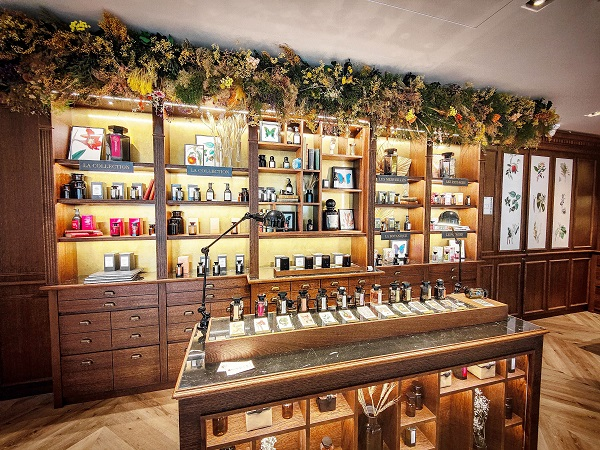
Which brings me to L’Artisan Parfumeur. Strangely, I had never really explored the house. I knew its history. I knew the names of its famous perfumes. I knew its importance. But knowing a perfume house intellectually and spending an hour smelling your way through its collection are very different things.
A delayed flight in Nice finally gave me the opportunity.
Before “Niche” Became a Marketing Category
L’Artisan Parfumeur was founded in France in 1976 by Jean Laporte, a chemist and botanist who became one of the early figures in what we now call modern niche perfumery. Even the origin story feels wonderfully unlike the corporate fragrance launches of today.
According to the house, Laporte was challenged to create a banana fragrance to accompany a friend’s banana costume for a ball at the Folies Bergère. The experiment helped push him toward creating his own perfume house. Two years later came Mûre et Musc.
Released in 1978, the perfume paired blackberry with white musk, an unusual idea at the time. Instead of treating musk merely as something buried in the base of a composition, Laporte made its clean softness part of the perfume’s identity. The house itself describes the blackberry-white musk accord as unprecedented.
L’Artisan’s importance becomes clearer when you look at the perfumes it went on to produce. This was a house willing to give perfumers room to explore unusual materials and ideas, often years before those ideas became familiar elsewhere. You can see that most clearly in what came next.

In 1994, Olivia Giacobetti created Premier Figuier for L’Artisan Parfumeur, widely credited as the first modern fragrance built around the smell of the fig tree. Giacobetti treated the subject as more than sweet fruit: leaves, sap, wood and the creamy quality we now immediately associate with fig fragrances. The idea became so influential that fig is practically its own subgenre today. Luca Turin later described Premier Figuier as the perfume that put Giacobetti on the map.

Then there is Bertrand Duchaufour’s Timbuktu, released in 2004.
Inspired by West Africa and built around incense, woods, vetiver and green aromatic effects, Timbuktu became one of Duchaufour’s defining compositions. Turin awarded it five stars in Perfumes: The A-Z Guide and described it as a masterpiece of what he called “nouvelle parfumerie.” Duchaufour would eventually become house perfumer for L’Artisan, giving the brand an unusually strong connection to one of the most respected perfumers of his generation. That is serious perfume history.
Then Came Puig
In 2015, Puig acquired L’Artisan Parfumeur along with Penhaligon’s. It was the end of L’Artisan as an independently owned perfume house, although Jean Laporte himself had left the company decades earlier. Usually this is the point in a perfume-house story where I become suspicious.
Oddly, Puig does not bother me in quite the same way some other beauty conglomerates do. I cannot give you an entirely rational explanation for that. Perhaps it is because I still see distinct identities within houses such as L’Artisan, Penhaligon’s and Comme des Garçons Parfums rather than one giant fragrance aesthetic imposed across the portfolio. Whatever the reason, corporate ownership wasn’t enough to make me dismiss L’Artisan.
And standing in that small shop at the airport in Nice, with a delayed flight and nowhere else I needed to be, I finally gave L’Artisan the kind of attention I probably should have years ago. I smelled everything that interested me, slowly and without distraction. I even asked the salesperson to leave me to it and simply bring over the testers I wanted. No notes on my phone, no launch story in my ear, no one telling me what I was supposed to smell. Just the perfumes. Just my nose.
I left with two bottles, which brings me to a fatal flaw in the way I shop for perfume. I am actually very good at taking my time in a store, smelling carefully, going back and forth, noticing what I like and what I don’t. Then, at the very end, I somehow panic. I buy something I hadn’t really planned on buying, forget the one I was most excited about, or convince myself that the perfume I kept returning to can wait. It is a remarkably consistent pattern.
Mûre et Musc Extrême: Elegant, but Does It Still Feel Special?
I bought Mûre et Musc Extrême partly because I wanted a piece of L’Artisan’s history. Created by Karine Dubreuil-Sereni in 1993, it takes the blackberry-and-white-musk idea of the original Mûre et Musc and gives the fruit more presence, with blackcurrant bud, red berries and bergamot around that familiar musky core.
And I should be clear: I think it is an elegant perfume. The blackberry is juicy without becoming candied or syrupy, and there is a tart, slightly green quality running through it that keeps the fruit fresh. The musk is soft and clean, and everything is beautifully controlled. It wears close to the body and has that quality of a perfume you could put on almost anywhere and never feel overdressed.

That understated elegance is, in fact, what many longtime admirers seem to love about it. Reviews repeatedly describe Mûre et Musc Extrême as gentle, comforting, sensual and remarkably easy to wear. One of the more interesting observations I found was from a wearer who initially dismissed it as simply “safe,” only to discover that other people continually commented on how good she smelled. Her point was that the perfume almost disappears into the wearer rather than declaring itself as perfume. Elsewhere, admirers describe the blackberry as crisp and tart rather than gourmand, with a green astringency that prevents the fruit and musk from becoming overly sweet.
I understand all of that. I actually agree with much of it. My problem is that I kept waiting for something more.
There is nothing clumsy here and nothing I particularly dislike. I enjoy wearing it. But once the blackberry settles into that soft white musk, I don’t find much that surprises me. And for a perfume connected to such an important moment in the history of L’Artisan, I expected to feel a little more excitement.
There is also a larger problem that has nothing to do with the quality of the perfume itself. We are smelling it more than thirty years after Extrême appeared and nearly fifty years after Jean Laporte introduced the original Mûre et Musc. Fruity musks are now so thoroughly embedded in modern perfumery that it is difficult to encounter the idea with the nose of someone smelling it in 1978.
That may be the most interesting thing about wearing it today. Mûre et Musc Extrême is elegant, beautifully composed and extremely wearable. I can understand why it has remained in the collection for so long. But I also think its own influence has worked against it. The combination no longer feels unusual because variations on fruit and clean musk now surround us.
Abyssae: This Is More Like It
Then I sprayed Abyssae, and this one stopped me. Hello, baby. Come to mama. Now this was what I had been waiting for.
Created by Daphné Bugey in 2022, Abyssae belongs entirely to the Puig era of L’Artisan Parfumeur. Its “33” refers to the number of trials it took Bugey to arrive at the finished composition. The house currently highlights eucalyptus globulus, Damask rose and Cashmeran; some fragrance databases also list fig. On paper, none of this sounds particularly revolutionary. On my skin, it is beautiful.

The eucalyptus appears first, cool and aromatic, with that camphoraceous breath that can easily become medicinal in perfume. Here it doesn’t. The rose arrives almost immediately and changes the temperature of the composition. It has body, but it isn’t a thick jammy rose. There is moisture around it, something green and almost watery.
Then the Cashmeran begins doing what Cashmeran does so well when it is handled properly. It creates texture more than an obvious “wood” note: warm, musky, slightly mineral, softly woody.
The eucalyptus keeps it cool and aromatic, while the rose and Cashmeran give it warmth and depth. It feels fresh without smelling citrusy or aquatic, and woody without becoming dry or heavy. This is the kind of perfume that makes me want to keep smelling my wrist. It feels distinctive, beautifully balanced and, most importantly, interesting.
I understand the comparisons some wearers make to Le Labo’s Thé Noir 29. There is a related dark, woody, fig-adjacent texture in the drydown, although Abyssae feels cooler, rosier and more aromatic to me. What interests me most is the tension between the eucalyptus and rose. One could easily dominate the other. Instead, they keep correcting each other.

More significantly, Abyssae won the Fragrance Foundation France’s 2023 award for Best Fragrance in the niche “Affiliated Brand” category, meaning a niche brand attached to a larger group. The jury included perfume journalists and fragrance-industry evaluators.
So What Does Niche Mean Anymore?
L’Artisan Parfumeur turns 50 in 2026, which makes this a particularly good moment to ask the question. It began as something genuinely unusual: a chemist creating perfumes outside the traditional machinery of the grandes maisons, following materials and ideas that interested him rather than trying to fill a predetermined market segment. Along the way, the house introduced ideas that would later become part of mainstream perfume language and gave major perfumers room to make work we are still talking about decades later.
Today it belongs to a multinational beauty company and sells around the world. So, is it still niche?
Technically, there is no governing body deciding these things. “Niche” is not an appellation like Champagne. A brand does not suddenly lose the word when it reaches a certain size, enters a department store or gets acquired by a larger company. Maybe that is why I find the label less useful than I once did.

What matters more to me now is whether I can still feel a point of view. Does the perfumer seem to have had room to make real choices? Does the perfume have an idea behind it beyond simply filling another slot in the launch calendar? Does it justify its price? Does the house still contribute something to perfumery beyond participating in the luxury-fragrance business?
And, most importantly, do I want to keep smelling it?
That is probably the question I trust most now. Strip away the heritage, the storytelling, the bottle, the distribution strategy and the word niche itself. What is left on the skin? With L’Artisan, the answer for me is mixed, which is probably more interesting than either loving or dismissing the house outright. Mûre et Musc Extrême made me appreciate the history more than the perfume itself. Abyssae made me want to go back and smell the collection again.
So yes, I think I will keep buying L’Artisan Parfumeur. At full retail? Probably not. But if I have another delayed flight and spot that little duty-free shop again, I already know I’m going in.






Leave a Reply