
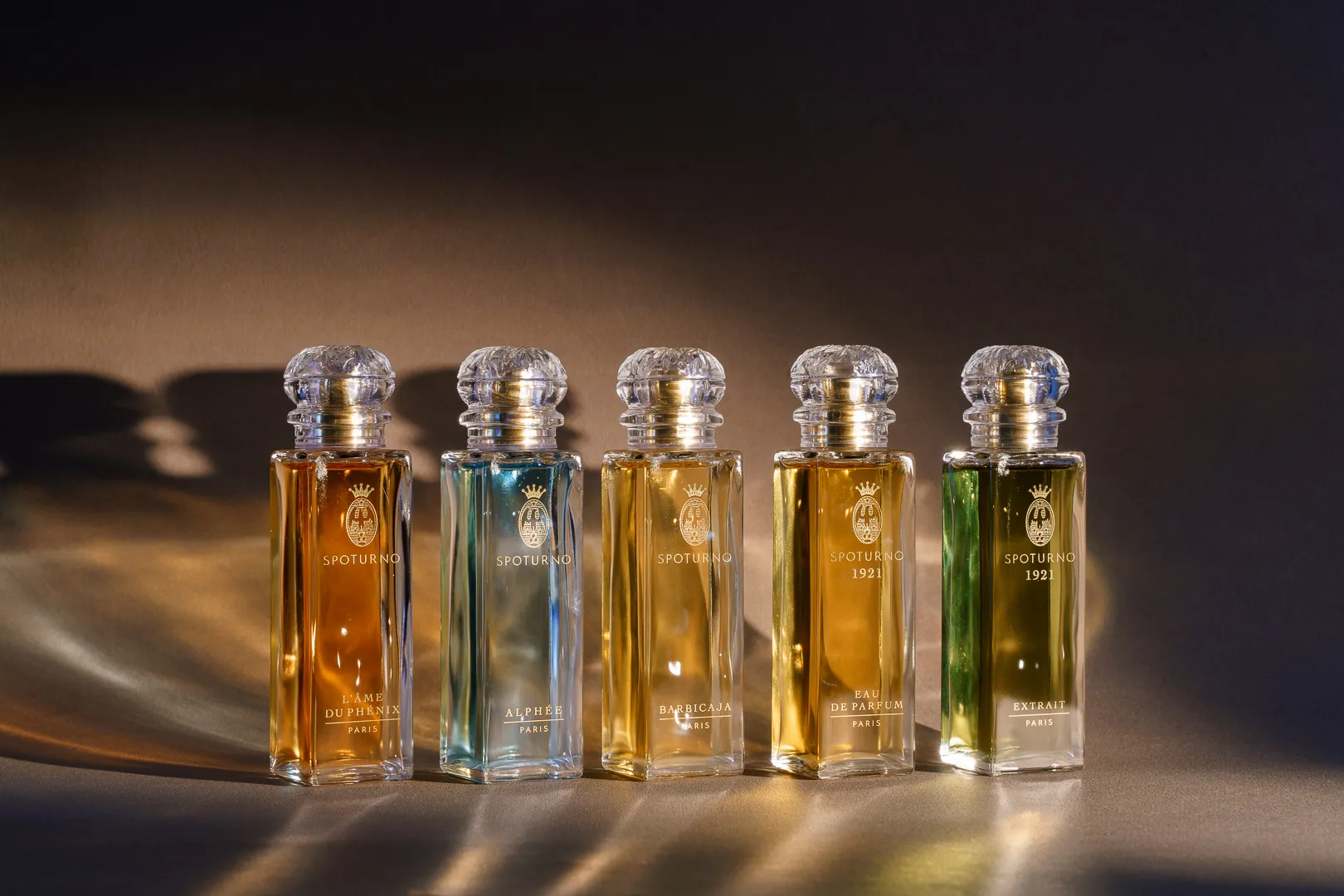
I had smelled Spoturno 1921 before I understood it.
It first came to me through the discovery set, the way many perfumes now enter our lives: in a small vial, at home, measured against other impressions. I knew it was beautiful. I could sense the quality. But I also know my own way of reading perfume. A first spray gives me information. A few days of wearing gives me the truth. Some perfumes need skin, weather, clothing, fatigue, conversation, and time before they reveal their full shape.
Then I went to Paris.
This April, I traveled with my dear friend Tova, who had come from Los Angeles to join me. We have known each other for more than thirty years, since our younger days in cosmetics, when beauty was already part of the language of our friendship.

Our interview at Maison Spoturno was scheduled for two o’clock, so we arrived early at Galerie Vivienne and sat down for lunch at a café inside the arcade. The setting already felt cinematic: old glass overhead, polished stone underfoot, the soft indoor light of Paris held inside one of the city’s most beautiful covered passages.
Then, in that very Parisian way life sometimes arranges itself better than fiction, Christopher Sheldrake and Véronique Spoturno appeared at the table beside us. They apologized gently as they passed, settled in next to us, and suddenly the people we had come to interview were having lunch within arm’s reach. We said hello, became unexpectedly shy, and after a few minutes decided to give them space before the interview.

There was something quietly charming about that moment. Sheldrake has a presence that is difficult to miss: dynamic, precise, magnetic, with a voice that seems to move at its own measured rhythm. Véronique carried a different kind of force: warm, honest, and deeply connected to the family history she has chosen to bring forward. Before I had even entered the boutique, the house already felt human to me.
Inside Maison Spoturno, that feeling deepened. Véronique spoke about her family history with warmth and precision, tracing the line from Corsica to François Coty to the boutique we were standing in. Christopher Sheldrake spoke about 1921 with the calm clarity of the perfumer who had composed it, explaining how freshness, flowers, vanilla, and tonka were built to move together.
When we arrived at 1921, Véronique explained why the date carries so much weight. It marks the year François Coty re-bought the Barbicaja domain in Corsica, and it also evokes the birth of the first oriental olfactory family in perfume history. For her, 1921 is family history and perfume history meeting in the same number.
Sheldrake described the fragrance beautifully: “a bridge between the past and the present.” He said it was created in the style of the 1920s, with a large floral bouquet of rose, jasmine, and orange blossom, a great deal of freshness in the top notes, and that freshness filled with vanilla and tonka bean.
The Bridge Between Past and Present
Spoturno 1921 opens with green-gold light. Lemon, bergamot, mandarin, Damascus rose, and orange blossom create a polished brightness that feels aromatic, floral, and quietly formal. The citrus does not cut sharply through the composition. It moves like light through old glass, clear at first, then warmer as the perfume begins to gather around the skin. The opening gives 1921 lift, posture, and air.
The Floral Architecture
The heart brings lavender flowers, jasmine grandiflorum, ylang-ylang, and an ambergris accord into focus. The floral bouquet is handled with remarkable discipline. Jasmine gives breath. Ylang-ylang adds a golden curve. Lavender gives the perfume an aromatic thread, a composed brightness that keeps the florals from becoming too plush. The ambergris accord adds glow and diffusion, giving the heart a soft, luminous movement.

Rose and orange blossom remain present from the opening, so the perfume never loses its floral identity. They seem to echo through the heart rather than disappear: rose for shape, orange blossom for radiance, jasmine for sensuality, ylang-ylang for warmth. The flowers feel dressed, but alive. Silk brushing against skin, powder warmed by the body, petals arranged with intention.
The Ambered Base
The base is where 1921 becomes most addictive. Sandalwood, vetiver, civet accord, musks, tonka bean, myrrh, and vanilla create a soft ambered warmth with a classical sensuality. The vanilla feels folded into the bouquet, giving the perfume a satin lining rather than a gourmand sweetness. Tonka brings a powdered roundness. Myrrh adds a resinous shadow. Sandalwood and vetiver give structure, while musk and civet accord bring the perfume closer to skin.

What I love is the proportion. The sweetness has rhythm. The flowers have breath. The woods hold everything upright. The perfume is sensual because it is composed, and composed because it understands sensuality.
There is also a ritualistic quality to 1921 that makes sense when you see how the house is extending it. During our conversation, Véronique showed the new 1921 body powder, a project she said took more than two years of work. She described it as a forgotten ritual, a way to relearn how to take time for oneself. Sheldrake noted that 1921 is especially suited to talc, while other fragrances in the collection may lend themselves to oils or soap.

That choice reveals something about the perfume. 1921 has the softness of powder already within it: a veil, a finish, the feeling of skin prepared with care. It belongs to the world of dressing tables, silk slips, travel flacons, folded tissue paper, and the private rituals of beauty that happen before anyone else sees us.
Véronique said it was important for the house not to arrive with twelve fragrances, but with “four treasures.” You can feel that philosophy in 1921. It does not behave like a launch designed to fill a market slot. It feels like a central object in the house’s emotional architecture, the perfume that holds the family name, the Corsican memory, the Coty echo, and Sheldrake’s quiet technical command.

I had gone to Maison Spoturno that day planning to buy a bottle to take home. As a Turkish woman, I carry a very specific instinct about a friend’s new store: you do not leave empty-handed. You buy something. You wish abundance into the space. You bring good energy through the door. I had even planned to bring Véronique a small nazar boncuğu, the blue evil eye bead we use for protection, to discreetly hang somewhere in the boutique. I forgot it in the rush of Paris, but the impulse says something about how the visit felt to me. I was entering the new home of someone I genuinely wanted to protect and celebrate.

Véronique, of course, beat me to it. She gifted me Spoturno 1921 before I could buy it. I insisted on paying. She would not allow it. So I turned to Christopher Sheldrake and asked which perfume he thought suited me. After our conversation, after smelling through the collection together, he answered without hesitation: Barbicaja. That is the bottle I bought.
Now, when I wear 1921, I do not think only of notes. I think of Galerie Vivienne at lunchtime, Tova beside me, Véronique’s warmth, Sheldrake’s measured voice, and the strange generosity of a Paris afternoon that gave me more than I had planned to bring home.
On my skin, Spoturno 1921 is an oriental floral with a green aromatic opening, a classical bouquet, and a soft balsamic base. It is luminous, powdered, warm, and deeply composed. It carries history as a living material. The perfume wears with grace: freshness at the opening, flowers at the heart, ambered warmth at the base, all held together with the quiet discipline of French perfumery.
It smells like green light under glass, powdered flowers, ambered silk, and a memory carefully carried from one century into another.







Leave a Reply