
After years of studying perfumers and compositions, a bottle from Le Galion led me to the designer whose work had been present in my family for decades.
Every perfume collector remembers the fragrances that changed the direction of a collection. We recall where we first smelled them, who introduced them to us and why they stayed. The bottle is often absorbed into the memory without receiving the same consideration. It stands on the dressing table, faithfully performing its task while the fragrance inside receives our full attention.
For many years, that was true for me. I learned the names of perfumers long before I learned the names of bottle designers. I followed the work of Edmond Roudnitska, Jacques Polge, Jean-Claude Ellena and Dominique Ropion. I read about raw materials, studied reformulations, traced the histories of old French houses and interviewed the people who compose the fragrances themselves. When I admired a bottle, I admired it instinctively. I rarely stopped to wonder who had conceived it, why its proportions felt so satisfying or what had been required to produce it.

That began to change with Le Galion. When I interviewed Nicolas Chabot, I was drawn to the perfumes and to the history he had restored, but I kept returning to the bottle itself. Its ridged glass, architectural shoulders, gate-like detailing and substantial cap gave it the assurance of something made to last. It reminded me of the heavy cocktail glasses used in grand hotels, objects whose weight and proportion quietly signal quality before anything has been poured into them. The bottle carried that same old-world elegance: polished, composed and unmistakably expensive.
One bottle became three, and together they began to resemble a small collection of objects from another age. The ridges caught the light beautifully, the caps settled into place with a satisfying weight, and each bottle brought a sense of ceremony to the simple act of applying perfume. I loved reaching for the cool glass and seeing the three of them standing together, as handsome on the shelf as they were pleasurable in the hand.

Le Galion has worked with important bottle designers throughout its history, including Julien Viard in the 1930s, Pierre Dinand in 1972 and Serge Mansau later in the decade. In 2022, exactly fifty years after Dinand’s earlier commission for the house, Pierre and his grandson Jules Dinand redesigned the bottle once again, drawing from Le Galion’s geometric and Art Deco vocabulary. I did not know any of this when I acquired my first bottle. I simply knew that someone had thought carefully about how it should look, feel and endure.
An Afternoon at Galerie Vivienne
My appreciation of bottle design deepened through Spoturno. My introduction to the house began when its founder, Véronique Spoturno, agreed to an interview, sent me the discovery collection and joined me for a conversation over Zoom.
We spoke about her family history, the development of the perfumes and the long process of building a house that could carry its heritage into the present. The conversation is still available to watch, although at the time I never imagined our next meeting would take place in Paris.
During Paris Perfume Week, Véronique invited me to visit Spoturno’s new flagship in Galerie Vivienne. Christopher Sheldrake was there that afternoon. I found myself standing beside one of the great perfumers of our time, asking him to walk me through the collection as he lifted each bottle, sprayed the fragrances and explained them one by one.
I remember thinking that I should be taking notes, asking more intelligent questions or at least behaving as though this were an ordinary professional appointment. Instead, I was quietly pinching myself. The deep green walls, the bottles arranged along the glass counter, the fragrance hanging in the air and Sheldrake speaking about the compositions still have the soft edges of a dream.
Véronique chose 1921 for me. After smelling through the collection and asking about the perfumes I loved, Sheldrake recommended Barbicaja. The two bottles came home with me carrying far more than perfume. They held the memory of Galerie Vivienne, Véronique’s generosity and the surreal pleasure of having Christopher Sheldrake explain his work while standing beside me.
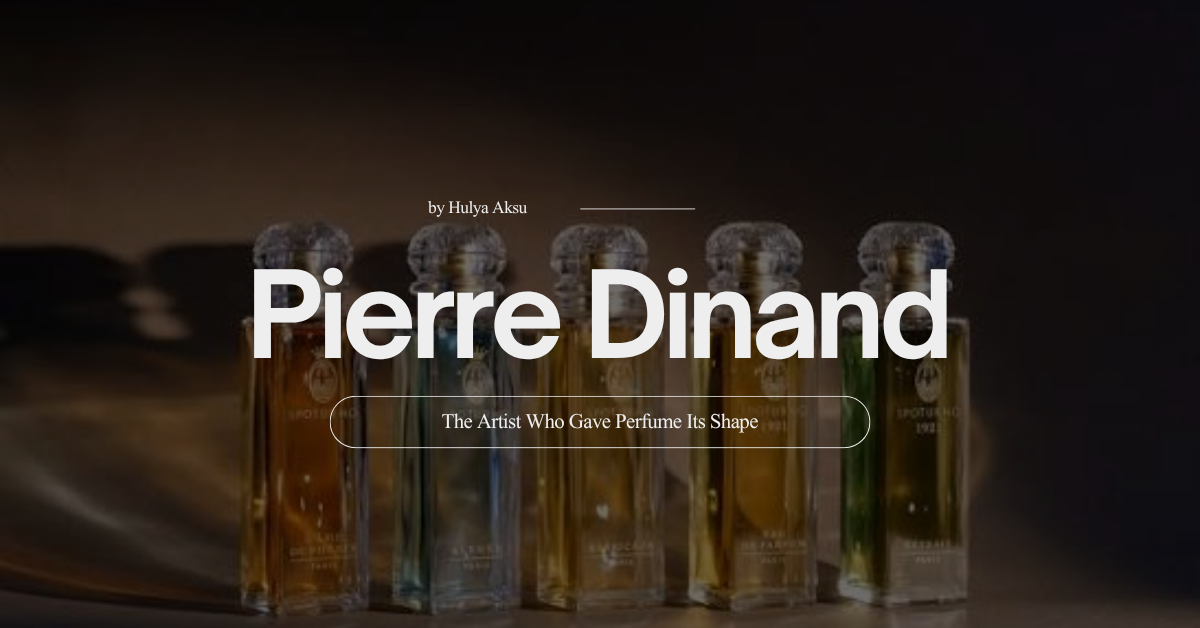
I usually discard perfume boxes. These remain. The bottles sit proudly inside their carefully constructed presentation, preserved almost exactly as they arrived from Paris. Spoturno describes its slender 60-millilitre flacon as the work of Pierre and Jules Dinand, made in Parma by Luigi Bormioli and finished with a gold pump and a glass cap engraved with laurel leaves. The cap itself required considerable technical skill.

I learned that detail only after I had lived with the bottles for some time. The connection to Le Galion suddenly became clear. Without realizing it, I had been collecting the work of the same designer, responding to his sense of proportion, weight and permanence before I knew his name.
The Designer I Had Known All My Life
The discovery made me reconsider how narrowly many of us experience perfume. We learn the notes, follow the perfumers and anticipate each new release, yet the object in our hands can remain strangely anonymous. Before a fragrance has revealed anything of itself, someone has determined the weight of the glass, the angle of its shoulders, the resistance of the cap and the way the bottle rests in the palm. These decisions shape the ritual of wearing perfume and often become inseparable from our memory of it.

Pierre Dinand’s work had been present in my family for decades. My mother owned Lancôme Magie Noire and Calvin Klein Obsession. I owned Dolce & Gabbana Light Blue. Their shapes were so familiar that I had never considered them authored objects. They belonged to bathrooms, dressing tables, department-store counters and family memories. The bottles seemed simply to exist, as though no individual had first imagined their curves, calculated their proportions and solved the considerable technical problem of producing them by the millions.
Dinand’s portfolio confirms all three among his designs, alongside Rive Gauche, Opium, Eternity, Amarige, Ysatis, Calandre, Eau Sauvage, and Eau d’Hermès, and an astonishing number of other bottles that have populated the visual history of modern perfume. He is often described as “the man with a thousand bottles,” a title that becomes less extravagant the longer one studies his career.

What makes the discovery especially satisfying is that his work has not remained confined to childhood memories or discontinued bottles. It sits proudly in my collection today. My three Le Galion bottles, along with Spoturno 1921 and Barbicaja, have made Dinand’s design language part of my daily life. Neela Vermeire Créations has moved higher on my wish list now that I understand who designed its bottle. There is something wonderful in realizing that the man who shaped the fragrances my mother wore continued working with the independent houses I am discovering now.
From Angkor Wat to Madame Rochas
Pierre Dinand was born in Paris in 1931, the son of an engineer, and began his art studies in the city in the early 1950s. Military service took him to Indochina, where an officer allowed him to study at the Royal Art School of Cambodia. He later worked with archaeologists at Angkor Wat, spending more than a year studying temples and sculpture. Architecture would remain central to the way he thought about objects.
His entry into packaging design came by an indirect route. After returning to France, he worked briefly in the automobile industry, then joined a chemical company preparing to introduce a new product. Dinand considered the proposed packaging so unattractive that he redesigned it himself. The result led to a promotion and eventually to a position with the advertising agency Contact, whose clients included Rochas.

The commission for Madame Rochas placed him inside the world that would define his career. Released in the late 1950s, the bottle used a stopper made from plastic and metal rather than the customary glass. Dinand was subsequently hired by Rochas, and perfume bottles became his profession. By the middle of the following decade, he had met Yves Saint Laurent, Givenchy, Balenciaga, Guerlain and Dior. In 1968, he founded Ateliers Dinand with his sons and several former colleagues. Over the next thirty years, the studio expanded internationally and became one of the defining forces in fragrance packaging.
Dinand spoke of the perfume bottle as a small house, a structure that gives the fragrance a physical home. The comparison explains the architectural quality of his work. He was concerned with silhouette, of course, but also with engineering, materials, moulds, closures and manufacture. A drawing had to survive contact with machinery, production limits, cost and the human hand.

His industrial background allowed him to introduce materials and techniques rarely used in perfume packaging at the time. For Paco Rabanne’s Calandre, he wanted the bottle to recall the metal grille of a Rolls-Royce. Because genuine metal presented manufacturing difficulties, he turned to ABS plastic, a material then associated largely with the automobile industry, and had it galvanised to create a metallic appearance. The reference supplied the bottle’s design and the fragrance’s name.
Bottles That Became Cultural Memory
Dinand’s best-known work for Yves Saint Laurent demonstrates how powerfully a bottle can establish the world of a perfume. Rive Gauche, introduced in 1971, appeared in a blue, black and silver cylindrical container that carried echoes of industrial packaging and Pop Art. Dinand traced its form to a vase by Jean Dunand that he found at the Saint-Ouen flea market. The bottle’s metal construction and graphic bands gave the fragrance a modern identity that was legible from across a department-store counter.

The story of Opium is even more remarkable. Dinand had first developed the design in another context, drawing upon the form of a Japanese inrō, the small case traditionally suspended from a kimono sash. When Yves Saint Laurent saw the reworked proposal, he immediately recognized the reference. According to Dinand’s account, the object inspired the name Opium. In this instance, the bottle did more than contain the perfume or translate an established brief. It helped call the fragrance into being.

For Calvin Klein’s Eternity, Dinand and Klein visited Tiffany & Co. while studying the visual language of wedding gifts. Crystal, silver and religious forms informed the cut-glass bottle and the cap shaped with a stylized cross. The name referred to a ring once owned by the Duchess of Windsor, engraved with the words “For Eternity.” Bottle, story and name were conceived as parts of the same idea.

That union was fundamental to Dinand’s philosophy. A perfume became memorable when the fragrance, the bottle and its communication spoke coherently. His designs could be restrained or theatrical, geometric or sensuous, but they were rarely generic. The curve of Amarige, the dark spiral of Magie Noire, the rounded intimacy of Obsession and the clean verticality of Light Blue each created a distinct physical identity.
A Second Career Among Independent Houses
Dinand’s twentieth-century commissions would have secured his place in design history, but his career did not conclude with Obsession, Amarige or Light Blue. After selling his shares in Ateliers Dinand in 1995, he continued to work. He was later joined by his grandson Jules Dinand, and the pair became increasingly involved with independent founders and artistic perfume houses. Dinand’s official biography records that he was still working with Jules from their Paris studio at the age of ninety-three.

The smaller scale of these houses offered a different kind of freedom. A global fashion launch required a bottle that could be manufactured in vast quantities, distributed internationally and understood quickly by a broad audience. Independent perfumery could accommodate stranger shapes, more personal references and projects in which the bottle became part of the house’s artistic proposition.
Map of the Heart
Among Dinand’s most daring later designs is the bottle for Map of the Heart, the Australian house founded by Sarah Blair and filmmaker Jeffrey Darling. The anatomical heart lies asymmetrically on its side, its veins and chambers translated into a sculptural glass form. Despite the complexity of the shape, it was conceived to sit naturally in the hand.

Blair has described Dinand as an important mentor throughout the production process. She and Darling had imagined a bottle with the tactile quality of a river stone brought back from Nepal. When the first mock-up arrived, Dinand had captured the feeling with remarkable accuracy, despite not having heard the private conversation that inspired it.
Vilhelm Parfumerie
For Vilhelm Parfumerie, Dinand created a heavy, low-slung disc of spun glass, finished with saffron-yellow details.

The color and texture refer to a piece of Bakelite found at a Paris flea market. Its combination of rounded glass, strong geometry and vivid color has given Vilhelm one of the most immediately recognizable silhouettes in contemporary niche perfumery.
Neela Vermeire Créations
Neela Vermeire Créations officially credits Dinand with designing its bottle in 2012. The flacon, with its strong base, clear geometry and ribbed architectural collar, gives physical form to a house whose fragrances bring Indian history and cultural references into conversation with French perfumery.

It now occupies a place on my wish list for two reasons: the perfumes themselves and the pleasure of adding another chapter of Dinand’s work to my collection.
Artists, Founders and New Houses
Dinand’s later portfolio also includes work for Miles Wambaugh, whose Son of a Gun appears among the sculptural projects in his official archive, as well as bottles for Les Sœurs de Noé, Jean-Michel Duriez, and Glasshouse Fragrances. These commissions demonstrate the breadth of his late career, although the documentation surrounding some projects is less extensive than it is for Map of the Heart, Vilhelm, Neela Vermeire, Le Galion and Spoturno. Attribution should be made confidently; the stories and symbolism attached to each design require the same care.
Returning to Spoturno
Spoturno belongs to this contemporary chapter. By the time I learned who had designed its bottle, it was already one of the most treasured objects in my collection. I had admired its long proportions, protected its presentation and connected it permanently with an afternoon in Galerie Vivienne. Learning its authorship did not create the attachment. It gave me the language to understand it.
The bottle also brings Dinand’s career into the present with unusual clarity. The man who designed objects for the houses that shaped my mother’s dressing table later worked with his grandson on a bottle for a new independent house, founded by the great-granddaughter of François Coty. The flacon is made in Italy, crowned with technically ambitious glass and engraved with laurel leaves. It holds fragrances composed by Christopher Sheldrake and now sits on my shelf beside Dinand’s redesign for Le Galion. History rarely arranges itself so neatly.

Before meeting Véronique and hearing what it took to build Spoturno, I thought mainly about the perfume and the perfumer. Now I see the bottle as part of the authorship. I think about the designer who imagined it, the glassmaker who produced it, the engineers who made it functional and the craftspeople responsible for every surface that meets the hand.
Pierre Dinand did not compose the perfumes inside my bottles. He gave them a body, a posture and a place in the physical world. His work had been in front of me for most of my life. I simply had not learned to see it.







Leave a Reply