
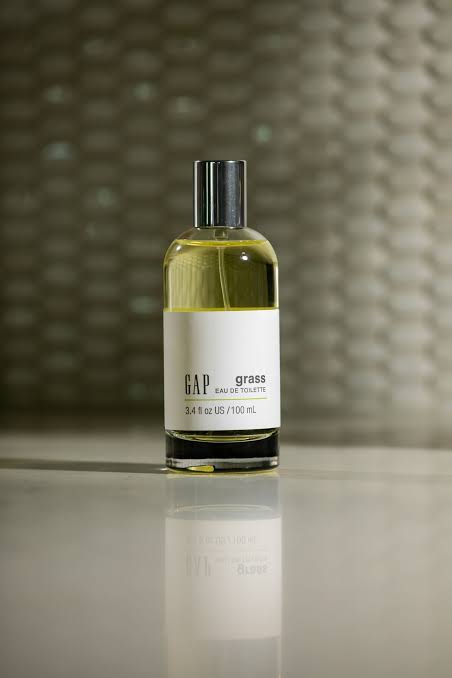
Gap is relaunching four of its best-known fragrances from the 1990s. For those of us who wore them, the return comes with equal parts curiosity and suspicion.
I used to wear Gap Grass.
In the 1990s, buying perfume at the Gap felt perfectly normal. You could walk in for a T-shirt and leave with a fragrance that became part of your identity for the next year. Grass was especially distinctive because the name was almost a complete description. It smelled green, wet and unmistakably like something growing.

Launched in 1994, the original Grass combined green leaves and apple with cut grass, cucumber, water lily, clover and white musk. It was fresh without being bland and unusual without becoming difficult. More than anything, it committed fully to its subject. Grass smelled like grass.
Gap is now bringing it back as part of a new fragrance collection arriving July 30. Grass will be joined by Dream, Heaven and Om, along with a new perfume called Harmony. The fragrances will be sold as 20 percent eau de parfums, priced at $20 for 10 ml, $52 for 50 ml and $20 for a five-piece discovery set.

The prices are sensible, particularly in a market where almost every revival arrives with an inflated story and a luxury price attached. Gap appears to understand that these perfumes were never rare objects. Their appeal came from being affordable, recognizable and easy to make your own.
The formulas, however, have changed.

DSM-Firmenich perfumers Honorine Blanc and Nicole Mancini developed the new collection with the Gap Beauty team. Blanc, who worked on the original Gap fragrances, created the new versions of Dream and Om, as well as Harmony. Mancini is responsible for Heaven and Grass.

Dream now combines Italian bergamot, jasmine and cedarwood. Om returns with ginger, sandalwood and cedar. Heaven has been rebuilt around pear, vanilla, patchouli and an amber molecule. Harmony, the only entirely new perfume, features apricot nectar, gardenia and amber.
Grass has undergone the most noticeable revision. The 2026 version replaces the original lawn, cucumber and clover profile with green mandarin, matcha and Virginia cedar. Mancini has explained that the first Grass was about being outdoors and smelling a freshly cut lawn, while the new perfume approaches nature through the language of wellness, meditation and restoration.

Grass did not need a wellness concept. Its charm was its literalness. It smelled like wet blades of grass, cool cucumber and the green residue left inside a lawn mower. It was slightly peculiar and completely recognizable.
Matcha is certainly easier to place within the current fragrance market. Green tea has become part of the contemporary beauty vocabulary, carrying associations with calm, self-care and expensive minimalist packaging. It may produce a lovely perfume. It may also turn Grass into a modern green-tea fragrance that happens to be wearing a familiar name.
Of course, recreating a commercial perfume after more than 30 years is complicated. Available materials have changed. Regulations have changed. The musks used in the 1990s are not necessarily the musks a perfumer would choose today. Gap has also converted the fragrances from eaux de toilette into more concentrated eaux de parfums, so an exact reproduction was probably never the objective.
Still, reviving a fragrance is different from borrowing its reputation. The original does not need to be preserved molecule by molecule, but it should retain the character that made people remember it.
I will be buying Grass first. I want to know whether I recognize any part of the perfume I wore, or whether Gap has made an entirely new fragrance and given it an emotionally valuable name.
Did you wear one of the original Gap fragrances? Were you a Grass, Dream, Heaven or Om person?






Leave a Reply