
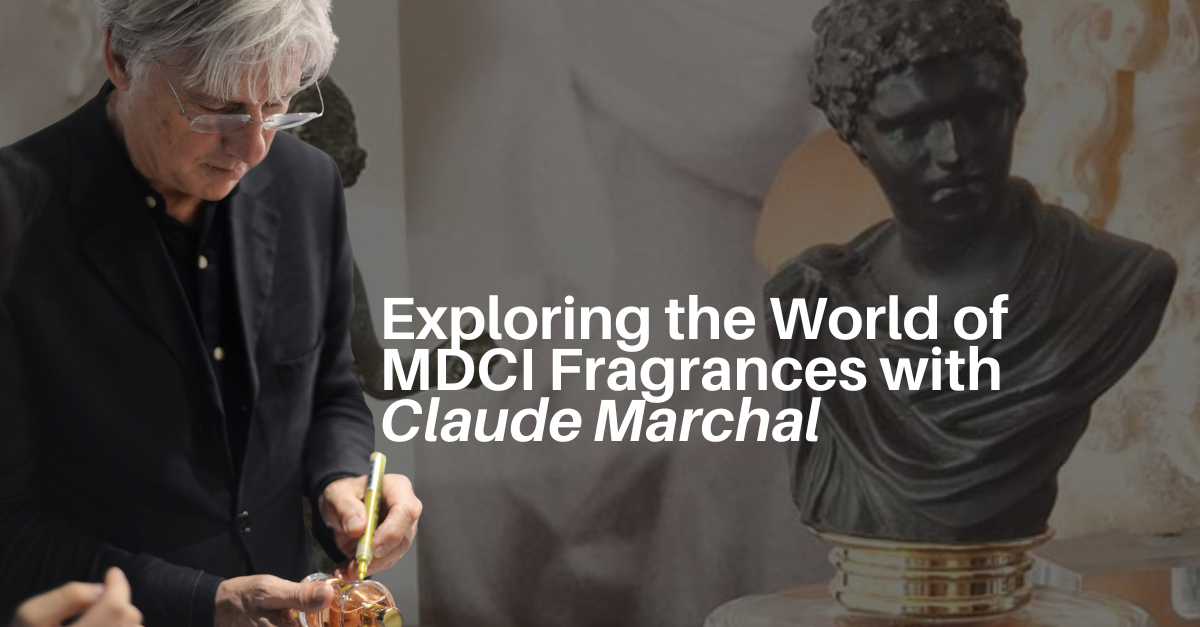
Parfums MDCI is the kind of fragrance house that exists because one person insisted on doing things differently. Claude Marchal founded it in 2003 after a long career that began far from perfumery. He was born in Alexandria, spent time at the École des Beaux-Arts, moved into business school, and eventually joined Dassault, where he worked between France and the United States. His path into fragrance began later, when he joined a large French cosmetics and pharmaceutical group that owned several perfume brands. That role gave him a close look at how commercial fragrance is produced and also showed him how much creativity gets lost along the way.

MDCI became his answer to that world. He wanted a small, independent house that valued materials, collaboration, and careful production. Before the first perfume existed, he designed the classical figurine stoppers that would become the signature of the brand, drawing from the art and antiques he grew up around. That same level of intention carries through today. Concentrates are produced at Art et Parfum in Cabris, the laboratory created by Edmond Roudnitska. Everything else, from bottling and finishing to boxing, logistics, and management, takes place in the family workshop run by Marchal, his wife, and their daughter. Production is limited to the capacity of their own workshop, allowing them to preserve their independence, reactivity, and attention to the details that make their products different and special. The name itself stands for Marchal Dessins et Créations Indépendantes, a quiet declaration of the artistic independence that defines the house.

The house works with respected perfumers like Pierre Bourdon, Francis Kurkdjian, Stéphanie Bakouche, Bertrand Duchaufour, and Cécile Zarokian. Even Patricia de Nicolaï, who creates exclusively for her own maison, made an exception for MDCI. In her interview with Persolaise she put it simply: Claude Marchal is “a hard person to say no to.”
Below is our full conversation with Claude Marchal.

The Interview
Origins and Turning Point
HA:
You were born in Alexandria and later studied architecture at the École des Beaux-Arts before entering the business side of fragrance. It’s an unusual path toward perfumery, one that bridges art and structure. What makes a person wake up one day and decide to start a perfume house? How did that idea take hold for you, and where does someone even begin with a dream like that?
CM:
Actually I spent only three weeks at the Beaux-Arts. It was fun, but it was not for me, so I followed a friend’s advice and prepared for a good business school. My first job was with Dassault, the company that makes the Falcon executive jets as well as the Mirage and Rafale fighters. For five years I was the interface between the Paris head office, their American subsidiary, and their clients.
It was obvious that this was an ideal job for an engineer, but not the best choice for me. I left when a large French pharmaceutical and cosmetics group needed someone to handle their business in the USA. I stayed with them for quite a few years, handling everything under the sun, including fragrances. It was stressful and sometimes felt like an absurd comedy, but there were moments of adventure and possibility. After five years in a stuffy Paris office, with an hour of traffic every morning and evening, I resigned. With the help of that same company, I moved to the USA.
After signing a contract with a major fragrance and cosmetic group for the USA and several other territories, I partnered with them as their exclusive agent. It went very well for years until the company tried to force me back into the ranks as an employee. I won my case, but found myself at fifty years old in the USA, without any income, married, father of a little girl and another one on the way. That was the wake up call. If I wanted total freedom, this was the moment to create my own line.
Leaving the Corporate World
HA:
Before MDCI, you worked in fragrance export and distribution and have spoken about being frustrated by how formulaic the industry had become. What did you see inside that world that made you want to build something different, something that felt closer to beauty than to marketing?
CM:
From day one I was shocked by how tacky so many things were, with a few exceptions. Everything was driven by cost. Marketing ideas were weak. Decision makers looked only at budgets. Creativity was limited and often nonexistent. It became clear that I would never be able to do something beautiful within that structure.
Founding Vision and Independence
HA:
The name MDCI comes from Marchal Dessins et Créations Indépendantes. Independence is embedded directly into the brand identity. When you founded the house in 2003, what did independence mean to you? And how has that meaning evolved as the niche perfume landscape has grown more crowded, more commercial, and more confusing for consumers?
CM:
In 2003 it meant total freedom. No interference on the creative side and the ability to decide exactly how the brand should be distributed. I have never been as happy as I have been since becoming independent. At the same time, we run a very tight ship, which guarantees that the brand stays true to its identity.

Back then, the number of true niche houses was extremely small. Today, new brands appear constantly, often created without any solid concept or knowledge, relying on marketing words like natural or revolutionary. Others are launched by large groups presenting themselves as authentic and artistic while everything is subcontracted and monitored by marketing people. We stay far from that.
From Idea to Bottle
HA:
You’ve said the bottle design came before the first perfume. How did that happen? And once you have the bottle, how do you bring a fragrance from initial idea to finished creation? What does that collaboration with the perfumer look like, and what happens during maceration and bottling to ensure the final product matches your vision?
CM:
Everything started from a design I made of a special stopper. The content only came after. I was tired of seeing the same stock bottles again and again.

When I have an idea for a fragrance, I call a few perfumers I work with and trust. I provide a short brief about identity, intended wearer, and family. The perfumer works for several weeks and sends progress samples when they reach a stage worth sharing. If the desired result seems achievable, we continue. If not, we stop. There is no point in wasting time.
The perfumer determines concentration and maceration time and provides Art et Parfum with the materials and instructions needed. They prepare the concentrate, which is then sent to a state-of-the-art facility that handles maceration.
We handle bottling, packing, and all the rest. The perfumer is not involved in that stage. It is our responsibility.
Working with Art et Parfum
HA:
Art et Parfum in Cabris, founded by Edmond Roudnitska, is a historic laboratory. What made you choose them, and how does that partnership support the quality and consistency of MDCI perfumes?
CM:
Their reputation was the initial draw, but the people sealed it. The owner and team are kind, competent, and dedicated. They receive formulas from perfumers, produce the concentrates, and ensure quality and consistency. They are an essential part of the process.
Craft, Scale, and Team
HA:
You have said that every bottle crosses your workbench, and that production is only a few thousand pieces a year. How large is your team today, and what parts of production are still done by your own hands?
CM:
We are only three. My wife, our youngest daughter, and myself. That is all. By industrial standards this is tiny, but we have learned that it is better to stay small. Avoid large factories and large distributors. Small is beautiful.

We have our own workshop, and every single bottle passes through my hands. The three of us work like a staff of eight, but this is the price of independence and quality control.
Materials and Formulation
HA:
You are known for letting perfumers work with high-quality materials and for not compromising on ingredients. How do you approach raw material sourcing? Do you pursue specific producers, or is sourcing entirely led by perfumers and labs like Art et Parfum? And how do you decide when a formula is truly finished?
CM:
The perfumer and Art et Parfum handle sourcing. They are the best placed to select materials. A fragrance is complete when it matches the original idea, feels coherent with the bottle and the story, and when I like it. That may sound simple, but it is essential.
The Art of the Bottle
HA:
The sculpted busts have become iconic. No stock bottles, no shortcuts. Why was it important to begin with such a complex object, and do you see the bottle as part of the perfume’s artistic identity?
CM:
Most brands use stock bottles. It is the easy solution. They justify it by saying they spend on the juice, not the bottle, which makes no sense to me. Perfumery is a complete art form.

My parents had a collection of antiques, which I inherited. That became the starting point. The female figurine took years to sculpt. I could not find the right antique model, so I made it myself. The male stopper was easier, inspired by the bust of Caracalla found in major museums.
These stoppers are not decoration. They are part of the message.
Pricing and Philosophy
HA:
Your perfumes sit at the high end of the market, yet collectors often say the price reflects the craftsmanship. How do you think about pricing, given the hand assembly, precious materials, and small scale?

CM:
The figurine stoppers cannot be mass produced. The cost of a single stopper is often higher than the retail price of many fragrances. We finish everything by hand. The Silk Road bottles use real gold or platinum. Each bottle is tested in a vacuum chamber. Despite all this, MDCI is not the most expensive brand. Our discovery sets offer remarkable value.
Distribution and Visibility
HA:
MDCI is sold only through selected perfumeries and directly through you. Why keep distribution deliberately limited when visibility is so important today?
CM:
Production is limited. We cannot meet the demands of distributors in terms of prices and volumes, which is a blessing in disguise. Keeping the operation small allows us to maintain a reasonable degree of control over distribution (no grey market). And I absolutely do not want to run a large company.
This also explains why our website isn’t like most other brands. Production being limited, we cannot have a normal web shop. I am aware that a lot of potential customers are discouraged, and we lose many sales, but no thanks. We would be overwhelmed by orders, would have to hire staff dedicated to this, which is not possible here for lack of space. And I do not like, and am not willing, to manage people. Rather stay small and give priority to the quality of service and life. Hence the unusual procedure described on our website. A direct communication with those who aren’t scared away.
Defining Niche Today
HA:
When MDCI began, niche meant independence, small runs, and artistic freedom. Today the word is used by every brand. Do you still see MDCI as niche?
CM:
If niche still means small runs, artistic freedom, and independence, then yes. But today many brands appear without a solid concept, using fashionable words. They saturate the market. Competition can sometimes improve quality, but many simply follow trends. We prefer not to follow.
Signature Works and Legacy
HA:
Collectors often mention Invasion Barbare and Chypre Palatin as modern classics. What, in your opinion, allows a perfume to endure once the initial excitement fades?

CM:
I dislike trends and do not try to imitate others. A fragrance must be wearable, pleasant from start to finish, with good lasting power and sillage, without screaming. Online discussions focus heavily on those two fragrances, but many others in the line deserve equal attention. Our discovery sets help people explore the full collection.
Growth and Future Plans
HA:
MDCI has loyal followings in Europe, Asia, and now the United States. What does growth look like for you at this stage?
CM:
The goal is to remain small and selective. I am seventy four. I would like to add a few good retailers but nothing more ambitious. Growth for its own sake is not the plan.
The State of Perfumery
HA:
You have witnessed several cycles in the perfume world. The rise of corporate niche, the social media wave, and now AI. What gives you hope for the future of perfumery, and what concerns you?
CM:
AI is already generating huge amounts of music that imitate artists. It is disturbing. Some platforms try to eliminate this content, others do not care. I am certain AI is already at work in perfumery, though I do not know exactly how. It will destroy as much as it creates. I worry for people who will lose their jobs and for authentic artists whose work will be copied.
But perfumery will not disappear. It answers fundamental needs. There will always be affordable perfumes and there will always be people who want true luxury. These are extraordinary times. Difficult to read. But as long as people care about beauty and materials, there will be room for houses like ours.
Elevated Classics Classification
Primary Category: Verified Luxury Niche
Secondary Tags: Privately Owned, Creative Director Led, Private Lab Production
Founded: 2003
Creative Direction: Claude Marchal






Leave a Reply