
Why I’ve stopped counting my perfumes.
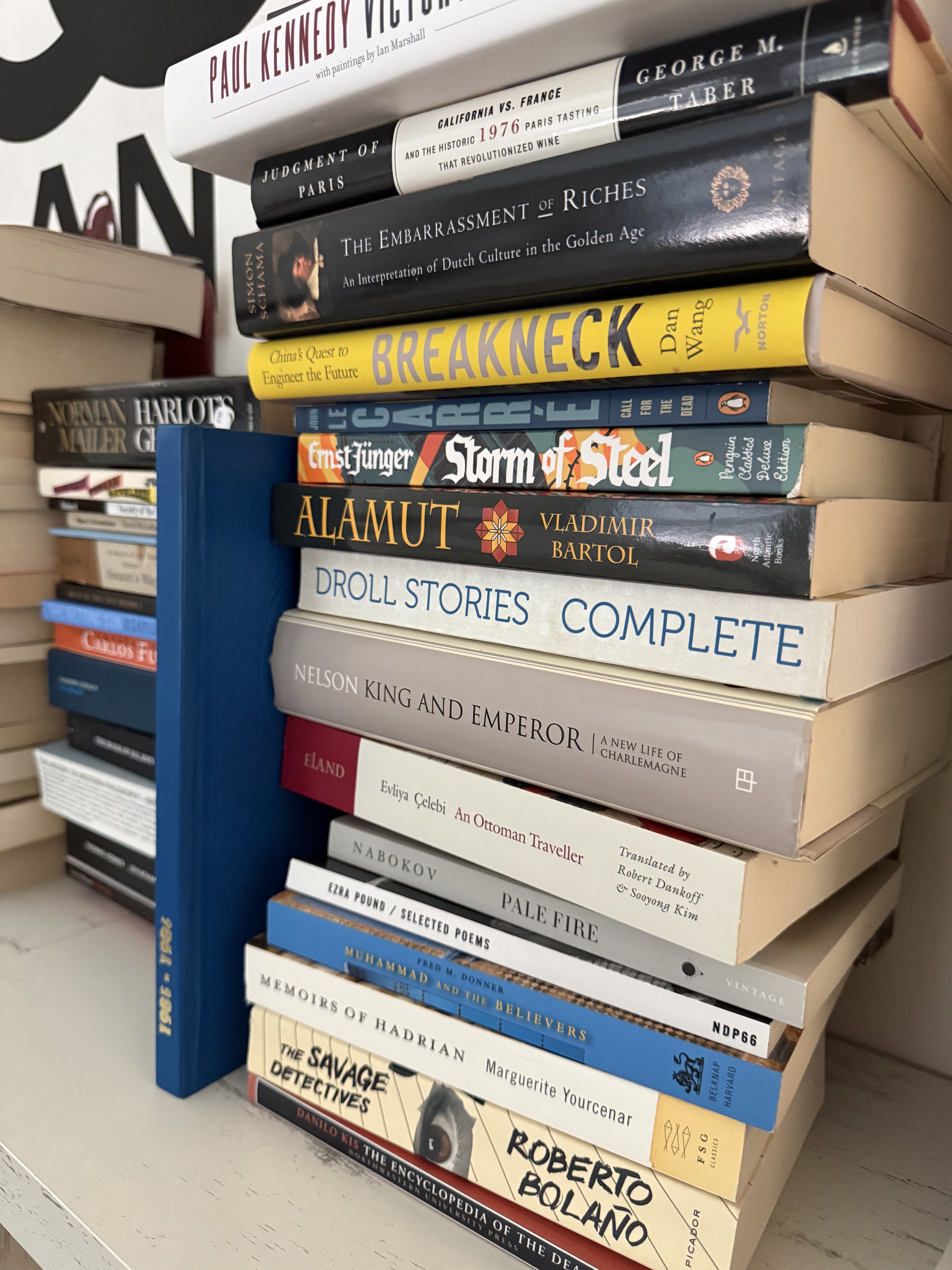
I was looking at the bookshelves in my home recently when I found myself thinking about my perfumes. I have books I’ve read several times, others I haven’t opened in years, and memoirs I return to when I need inspiration, encouragement, or simply the company of someone whose life has something to teach me. Sometimes I revisit a passage I remember loving, only to discover that it speaks to me differently now. I’ve never felt guilty about keeping a book I haven’t read in a decade. I’ve certainly never stood in front of my shelves and declared that I already own enough memoirs, so there is no reason to acquire another. Yet I’ve caught myself applying precisely that kind of reasoning to perfume.
I have always called my books a library and my perfumes a collection. My family has collected stamps and coins, and I grew up understanding collections as things to be preserved, examined, arranged, and admired. Books have a different presence in my life. They aren’t waiting for me to complete a set or fill a gap. They are there when I need them, and sometimes when I don’t yet know I need them. I began to wonder whether the way we speak about perfume has quietly shaped the way we experience it. We count bottles, compare wardrobes, celebrate acquisitions, and debate whether someone owns too much. Even our guilt seems to be measured in numbers. How many bottles have I purchased? How many haven’t I worn? How many more could I possibly need?

Human beings have always surrounded themselves with objects that carry meaning beyond their immediate usefulness. A letter kept in a drawer, a piece of jewelry inherited from a grandmother, a photograph that has traveled through several homes. Their value is rarely determined by how often we take them out or look at them. We keep them because they connect us to something we don’t wish to lose. Books have occupied a particularly important place in this tradition, preserving not only the ideas of their authors but also something of the lives of the people who read and keep them. I can look at my own shelves and recognize interests that occupied me years ago, questions I was trying to answer, and people whose writing influenced the way I saw the world.
Thomas Jefferson had one of the most remarkable private libraries in early America. When British troops burned the Capitol in 1814, destroying the congressional library, he offered his own books to replace those that had been lost. Congress purchased 6,487 volumes from him in 1815 for $23,950, a considerable sum that provoked objections from members who questioned the relevance of such an extensive assortment of books to the business of government. Jefferson had collected works on subjects ranging from political philosophy to architecture, agriculture, literature, and science. He argued that there was no subject a member of Congress might not someday need to consult. He had even organized his library according to a system adapted from Francis Bacon, dividing human knowledge into Memory, Reason, and Imagination. I find myself drawn to those categories, perhaps because they describe so much of what makes a personal library meaningful. The things we choose to keep reveal something about the questions we’ve asked and the interests we’ve pursued, even when their purpose isn’t immediately apparent.
Jefferson was concerned with the preservation and accessibility of knowledge, a rather different enterprise from my shelves of perfume. But I recognize something in his refusal to judge the worth of a book solely by its immediate usefulness. I’ve returned to books years after reading them and found answers to questions I didn’t have when I first bought them. I’ve also discovered that the pleasure of reading something familiar can be greater than the excitement of opening something new. The book hasn’t changed, at least not the words printed on its pages. I have. My experiences have altered the way I understand what I’m reading, sometimes so completely that I wonder how I could have missed what now seems obvious.

I’ve experienced something remarkably similar with perfume. For years, Chanel Coromandel was a fragrance I couldn’t quite embrace. I appreciated that it was an accomplished composition, but I had little desire to wear it. Now I love it. There was no grand revelation, no particular afternoon when everything suddenly made sense. My appreciation changed as I continued exploring perfumery and discovering what appealed to me. I returned to something I’d once dismissed and found pleasure where I hadn’t before. I imagine many people have experienced this with music or literature, returning to an artist they couldn’t appreciate when they were younger and discovering that time has somehow made the work accessible to them.
Perfume has an additional complication because the object itself isn’t entirely stable. Fragrance materials can change over time, particularly when exposed to heat, light, or oxygen. A book may survive centuries, but a perfume cannot be expected to remain chemically unchanged forever. Still, the association we form with a fragrance can remain long after the bottle is empty. Smell has a remarkable relationship with autobiographical memory, one that researchers have investigated for decades. In a 2006 study published in Psychonomic Bulletin & Review, psychologists Johan Willander and Maria Larsson found that odors were especially likely to evoke memories from early childhood and could produce a powerful sensation of being transported back in time. Marcel Proust gave us perhaps the most famous literary account of this phenomenon through a small cake dipped in tea. The taste and aroma of his madeleine awakened a world of childhood memories that conscious effort had failed to recover.

I think about the perfumes I’ve worn through different periods of my life and how readily a familiar fragrance can bring back feelings I hadn’t thought about in years. Some bottles remind me of who I was when I bought them. Others have become attached to my life through ordinary repetition. Recently, I’ve been enjoying lavender fragrances before bed, drawn to their meditative quality and the pleasure of a familiar evening ritual. They don’t commemorate a particular event, but I suspect that years from now the smell of lavender will remind me of this period of my life. We tend to associate memory with the exceptional moments, the holidays, the weddings, the places we visited once and never saw again. So much of our emotional life, however, is formed in the ordinary hours. A particular smell can become the background to years of living without our noticing it happen.
Perfume is also a creative work, something I think gets lost in conversations dominated by performance, longevity, compliments, and price. Behind a fragrance is a perfumer making decisions about materials, proportions, contrasts, and effects. Some compositions reflect the aesthetics of a particular decade; others were radical departures from what came before. In Versailles, the Osmothèque has been preserving this history since 1990, maintaining an archive of thousands of fragrances, including many that are no longer commercially available. Its work includes safeguarding formulas and reconstructing historic perfumes when the necessary materials can be obtained. It is a reminder that perfumery has a history worthy of preservation, even if most of us encounter that history through bottles purchased for our own enjoyment. My shelves are hardly an institutional archive, but they contain works I admire for reasons that have little to do with whether I feel like wearing them on a particular Tuesday.
There is, however, an uncomfortable possibility in all this. We are very good at giving emotional and intellectual significance to things we want to buy, especially when we’re already inclined to want them. I have written extensively about the fragrance industry’s relentless pursuit of novelty and the increasingly elaborate narratives used to sell products. Another founder’s childhood memory, another supposedly revolutionary ingredient, another limited edition presented as an opportunity that may never come again. The pleasure of discovery can become entangled with the fear of missing out, and the more we buy, the more accustomed we become to the excitement of buying itself. It is possible to appreciate perfumery deeply and still recognize when our enthusiasm is being exploited.

The French philosopher Denis Diderot described a version of this predicament in his essay Regrets on Parting with My Old Dressing Gown, first circulated in 1769, long before fragrance launches arrived accompanied by elaborate campaigns and armies of content creators. He recounted how receiving a beautiful new dressing gown disturbed the harmony of his familiar surroundings. Suddenly his old furnishings seemed unworthy of the garment. He began replacing things, each new acquisition exposing another perceived deficiency, until the satisfaction of owning something finer had given way to expense and regret. The phenomenon later became known as the Diderot effect. Anyone who has bought a new perfume and almost immediately begun searching for the next one may recognize something of themselves in his predicament. I certainly can.
This is where the idea of a perfume library has to withstand some scrutiny. Calling something a library doesn’t automatically make it thoughtful, any more than buying hundreds of books makes someone well-read. I own more than two hundred bottles of perfume, and I recognize the privilege involved in that. Every bottle represents materials, packaging, manufacturing, transportation, and money that could have been spent elsewhere. Some purchases have been more considered than others, and there are fragrances I’ve bought because I was curious, because someone persuaded me, or because I became caught up in the excitement surrounding a release. I don’t regret every imperfect purchase, since discovering what we dislike can be part of developing taste, but I have no intention of presenting indiscriminate consumption as a noble intellectual pursuit simply because I can find a more attractive word for it.

What troubles me is the assumption that the number of things we own tells the whole story. A person with fifteen fragrances may have chosen each with extraordinary care, while someone with two hundred may have spent decades studying perfumery and gradually developing a wardrobe that reflects a lifetime of changing preferences. Equally, someone can own very little and still buy compulsively, always replacing what they have in pursuit of something newer. I’ve come to believe that the more revealing questions concern how we choose, how well we know what we own, and whether the pleasure comes from experiencing the fragrance or simply acquiring it. There are bottles in my wardrobe that I would never purchase again, just as there are books on my shelves that no longer interest me. That doesn’t make the years I spent with them meaningless, nor does it mean they must remain with me forever.

Perhaps this change in perspective will influence the way I buy perfume, too. I still want to discover new perfumers, explore unfamiliar compositions, and occasionally bring something wonderful home. But I can admire a fragrance without needing to own it. Meanwhile, there are bottles on my shelves I haven’t touched in years, and I’m curious about what I’ll think of them now. Some may have lost their appeal, while others might surprise me, as Coromandel did. I rather like the idea of discovering something new among things I’ve owned for years. There is no shortage of perfume being made, and there never will be. I don’t have to keep pace with it.
The next time I find myself wondering whether I own too much perfume, I hope I’ll remember that afternoon among my books. I never asked how many of them I needed to justify keeping. I simply enjoyed knowing they were there, waiting for the day I might want to open them again. I’d like to offer my perfumes the same consideration. A personal library, written in scent.







Leave a Reply