
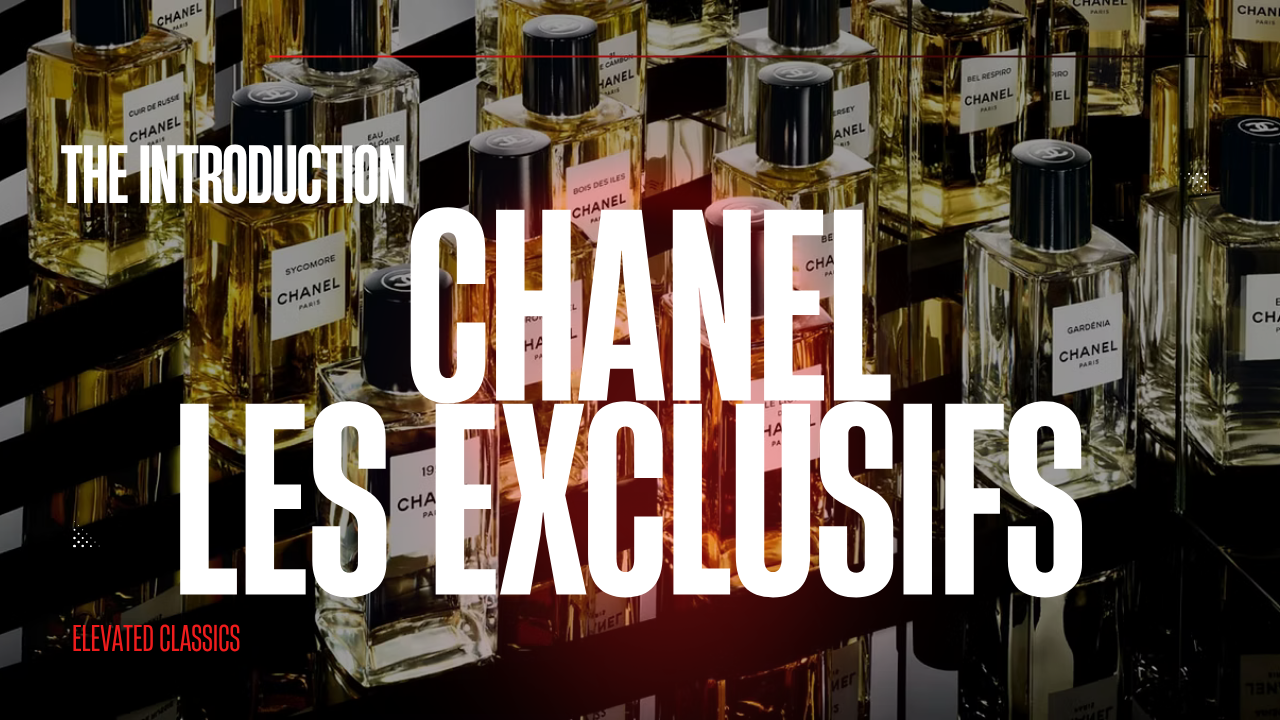
Before reviewing my bottles from Les Exclusifs de Chanel, I wanted to begin with the history behind Chanel fragrance itself. Chanel perfume is one of the great success stories of French luxury, but the story is far more complicated than the polished mythology usually allows.

Most people begin with Chanel N°5, launched in 1921 with perfumer Ernest Beaux. It was abstract, aldehydic, modern, and visually spare. The name was a number. The bottle was restrained. The perfume did not smell like one literal flower. It smelled composed, constructed, and new.
But a beautiful perfume does not become a global object by taste alone.
In 1924, Parfums Chanel was created to produce and distribute Chanel fragrances. Gabrielle Chanel had the name, the image, and the instinct for modernity. The Wertheimer brothers had the money, manufacturing, and distribution power through Bourjois. Théophile Bader of Galeries Lafayette helped bring the parties together. The deal gave the Wertheimers 70 percent of Parfums Chanel, Bader 20 percent, and Gabrielle Chanel 10 percent.
That arrangement shaped everything that followed.
Chanel N°5 carried her name and her image, but the perfume business was largely controlled by her partners. By the 1930s, Chanel wanted more control. During the Second World War, the dispute entered its darkest chapter. The Wertheimers were Jewish and had fled France. Gabrielle Chanel attempted to use Vichy anti-Jewish property laws to take control of Parfums Chanel, but the Wertheimers had already protected the company by transferring control to Félix Amiot, a non-Jewish French industrialist. After the war, the company was returned to them.
The business did not end there. In 1947, Pierre Wertheimer settled with Chanel financially, but she did not regain control of the perfume company. In 1954, when she wanted to return to couture, Wertheimer financed her comeback. Over time, the Wertheimer family consolidated control of the Chanel name and business.

That history matters when we talk about Chanel perfume. The fragrances are beautiful, but they also sit inside a larger story of ownership, distribution, image, contracts, wartime strategy, and the value of a name on a bottle.
This video is the introduction to my Les Exclusifs de Chanel series. Over the next several weeks, I will be discussing the bottles I own one by one, including N°22, Gardénia, Bel Respiro, 31 Rue Cambon, Beige, 1932, Jersey, Misia, Boy, 1957, Coromandel and Comète.
I only own the current eau de parfum versions, so that is what I will be reviewing. Some collectors prefer the earlier eaux de toilette for their transparency, and that conversation belongs to Chanel collecting history. My focus will be on the perfumes I actually wear, how they smell on skin, where they sit inside the Chanel story, and why this collection still holds such power for fragrance lovers.
Chanel perfume is elegant, historical, commercial, controlled, beautiful, and complicated. That is exactly why I wanted to start here.
Watch the introduction below.






Leave a Reply