

For years, perfume bottles carried only one name: the brand. The house took the glory, the marketing shaped the story, and the person who actually built the scent stayed invisible. Consumers were encouraged to believe in myths and legends. Some companies even leaned into that silence, and the result was a culture where perfumers were treated like ghosts behind the curtain.
The shift happened slowly. When Frédéric Malle launched Editions de Parfums, he made something radical feel obvious. He gave perfumers their byline. He treated them the way publishing treats authors. The message was simple. If you create the work, your name belongs on it. This changed the culture of perfumery more than most people realize.
Estimated reading time: 4 minutes

Once you start recognizing perfumers, another truth becomes clear. They are not working in isolation. Unless the perfumer owns the brand, someone else shapes the direction, defines the boundaries, and protects the identity of the final product. That person is the creative director. For a long time, I dismissed their role. I believed the perfumer deserved the spotlight and the creative director was simply giving instructions. Then I remembered my own life.
I spent almost two decades as a creative director and publisher. I worked with designers, writers, illustrators, and photographers who were far more technically skilled than I was. I did not have formal training in graphic design, but I knew what I wanted. The right creative partner understood my vision and helped me translate it into something real. That collaboration was the soul of every magazine I produced. When I stepped into the fragrance world, I saw the same structure. A clear brief, an idea that needs form, and a specialist who can bring that form to life.
The best perfumes happen when both sides meet as equals. The creative director carries the vision, the atmosphere, the boundaries, and the emotional tone. The perfumer brings the technique, the palette, and the ability to translate feeling into materials. The final fragrance sits between their strengths. When the balance works, the result feels intentional and alive. When it collapses, the perfume feels scattered, confused, or simply unfinished.
There is still one person missing in this conversation. The industry has finally (for the most part) learned to credit perfumers. It has started to recognize creative directors. Yet almost no one talks about the labs that bring the formula into the physical world. The lab is where a perfume becomes real. It is where oils meet alcohol, where maceration happens, where quality control succeeds or fails, and where the final liquid gains its texture and longevity.
Consumers rarely think about this stage of the process. A formula can be extraordinary, but the finished perfume will only be as good as the lab that produces it. Was it made in a historic facility in Grasse with generations of craft. Was it compounded in a small Florentine lab where every batch is handled with precision. Or was it produced in a large factory that turns out thousands of brands with the same equipment and timelines. These choices shape texture, longevity, and the way a scent behaves on skin.
The ultimate, of course, is when a brand is vertically integrated and controls the entire process. When the vision, the formula, and the production all sit inside the same ecosystem, you can feel the difference. The perfume carries a sense of intention that comes from total ownership of how it is made.
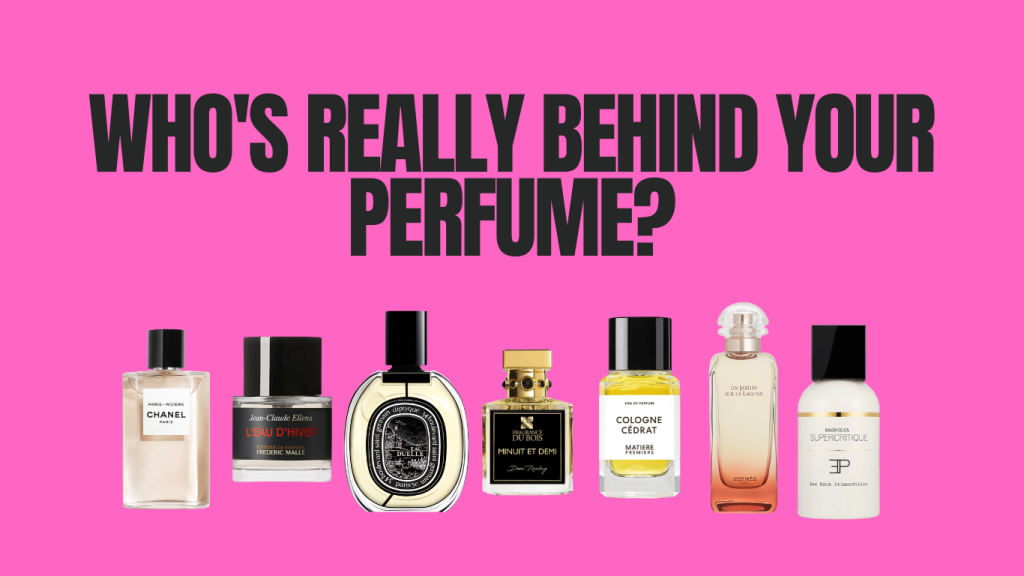
We could follow the chain even further. Farms, suppliers, distillers, and distributors all play a part. But if we are talking about what belongs on a byline, there are three names that matter most. The creative director who shaped the vision. The perfumer who built the formula. The lab that produced the bottle in your hand.
Perfumery is not a solo performance. It is a collaboration. When those three players work in harmony, the result feels whole. When they do not, you can smell the disconnect.
I also know that most consumers are not thinking about any of this. In a capitalistic system, brands will always do the bare minimum the industry allows, and they will keep doing it as long as they can. You get away with what you can until someone asks for better. My hope is that consumers start asking. The more we understand who actually makes our perfumes, the more pressure there is for real transparency.
If we want transparency in this industry, this is the starting point. Three names. One perfume. A story that finally makes sense.


Leave a Reply