
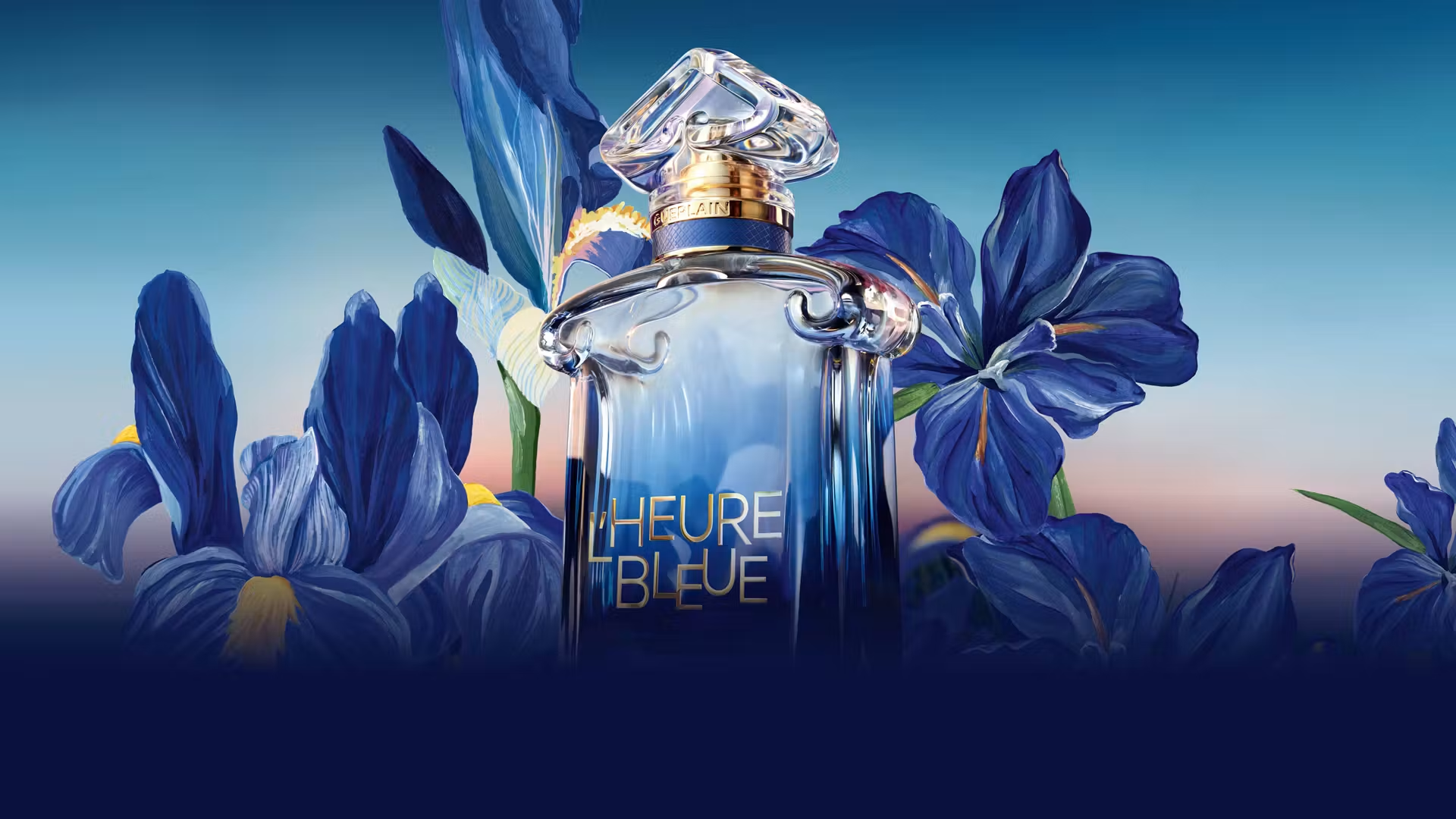
I ordered my bottle of Guerlain’s new L’Heure Bleue directly from the house and had my name engraved on it. Why not? If I am going to buy a new release that I hope might become a classic, I like the idea of making the bottle personal from the beginning. The presentation was lovely, including the box, and opening it felt like a pleasure in its own right. It is something I intend to do again with future purchases.
Then I smelled it, and my response was fairly uncomplicated: this is a beautiful perfume. It is fresh and powdery at the same time, with a musky softness and the orange blossom and jasmine that I pick out on my skin. I also welcome how well it lasts. So many perfumes seem to disappear on me that finding one willing to stay feels like a considerable advantage.

Around this very pleasurable experience, however, is a rather more complicated conversation. Delphine Jelk’s new fragrance has arrived under the name L’Heure Bleue while Jacques Guerlain’s earlier creation is now called L’Heure Bleue 1912. For some admirers of the historic perfume, that decision has been difficult to accept. There are objections to the name, to the composition, and to what the launch supposedly says about Guerlain’s direction. There is also the suggestion that the new perfume is for a younger audience. Having smelled both, and being perfectly willing to own both, I find myself questioning several of those conclusions.
The Name
The naming deserves a fair hearing. A fragrance’s name carries the memory of how it smells, along with all the associations its wearer has accumulated. Someone asking for L’Heure Bleue has, for generations, had a particular perfume in mind. Giving the unqualified name to a different creation changes that understanding. I can see why a devoted wearer would have preferred a distinct name or an additional word attached to the new bottle.
The clearest explanation comes from Guerlain’s CEO, Gabrielle Saint-Genis. In Vogue Business, she describes the ambition to create an accessible global flagship rooted in Guerlain’s heritage, while retaining the earlier fragrance as L’Heure Bleue 1912. She also discusses the appeal of bringing that heritage to younger consumers. This is a house strategy.


Guerlain continues to list L’Heure Bleue 1912 in its Les Légendaires collection. My reading of the arrangement is that the new fragrance takes the leading contemporary role, while the date identifies the historic creation. The commercial reasoning is understandable, although Guerlain has also invited comparison by choosing such a consequential name. That comparison should be thoughtful enough to consider what Jelk actually set out to create.
The Scent
In her ELLE interview, Jelk explains that she kept the elements she loved in the earlier perfume’s drydown: orange blossom, iris and vanilla. In Vogue Arabia, she describes translating the blue hour through the contrast between cool air and warm skin. Cascalone helps express the sky, while the floral and vanilla materials provide softness. She also speaks of reviving iris tincture, part of Guerlain’s historical knowledge, through three years of development. Her interpretation has both a material connection and an emotional connection to its predecessor.

On my skin, the freshness and the powder are what make the new perfume so appealing. They exist together beautifully. I smell the flowers within that softness, particularly orange blossom and jasmine, although I would hesitate to assign every impression to a particular ingredient. There is something musky about it that I enjoy. I find the whole composition more immediately compelling than the exercise of taking it apart. It makes me want to keep smelling my skin.
Longevity
The strength of the fragrance is also worth discussing as a matter of experience. A long-lasting perfume is a welcome discovery when your usual complaint is that fragrance vanishes too quickly. I am pleased that this one stays with me. Someone who finds its presence excessive is describing a different response, and that response deserves the same consideration as mine. Performance only becomes meaningful in relation to the person wearing the perfume.

In her Fragrantica review, Elena Prokofeva finds the Ambroxan and diffusion too forceful for her taste and associates the fragrance with youthful energy. She praises aspects of the vanilla, but describes the whole as “the scent of youth.” Elsewhere on the same publication, Elena Knezevic responds enthusiastically to its rich, powdery development and evening character. Those differing readings are part of what makes perfume criticism interesting. A fragrance can suggest very different people, places and occasions to equally attentive noses.
Less of a “Grandma”
Where I become less persuaded is when a contemporary style is treated as a reliable indication of the wearer’s age. I am a woman in my fifties, and I enjoy freshness, powder, white flowers and a perfume that lasts. None of those pleasures feels like an attempt to borrow someone else’s youth. My taste has developed through years of smelling and wearing fragrance, and it remains receptive to something new. I would like the phrase ‘women today’ to include us without qualification.

Jelk’s own language is worth examining here, too. In ELLE, she describes the new material as “less of a ‘grandma’ iris.” I find that shorthand unhelpful. In Vogue Arabia, she also speaks affectionately of iris recalling mothers and grandmothers. That warmer account is far more interesting to me. Powder can carry memory, intimacy and beauty. We have more precise ways to discuss its texture than attaching an age to it.
A company can hope to attract younger customers, and a critic can imagine a young person wearing its perfume. Neither observation determines the limits of its appeal. I would rather read about how the flowers, freshness and powder interact, how the perfume develops, and whether its presence becomes pleasurable or tiring. Those descriptions help me decide whether I want to wear something. An imagined birth date for its ideal customer tells me considerably less.
I have smelled the earlier L’Heure Bleue and would be very happy to have it in my collection. My appreciation of Jelk’s creation leaves that desire intact. I can understand the attachment to the historic name while enjoying the freshness, flowers and powder of the new perfume. There is room for both responses, just as there would be room for both bottles.
Whether this L’Heure Bleue becomes a classic will take years to discover. For now, I have a beautiful perfume that feels entirely at home on my skin, lasts well, and arrived with the care I hoped for when I ordered it. Having my name engraved on the bottle was a small indulgence, and I am glad I chose it. I expect to get a great deal of pleasure from wearing what is inside.




Leave a Reply